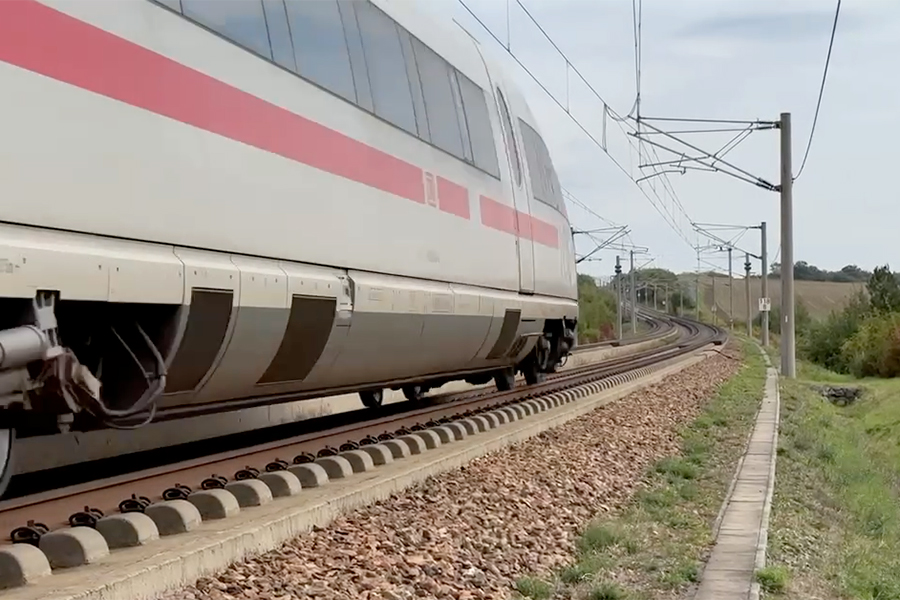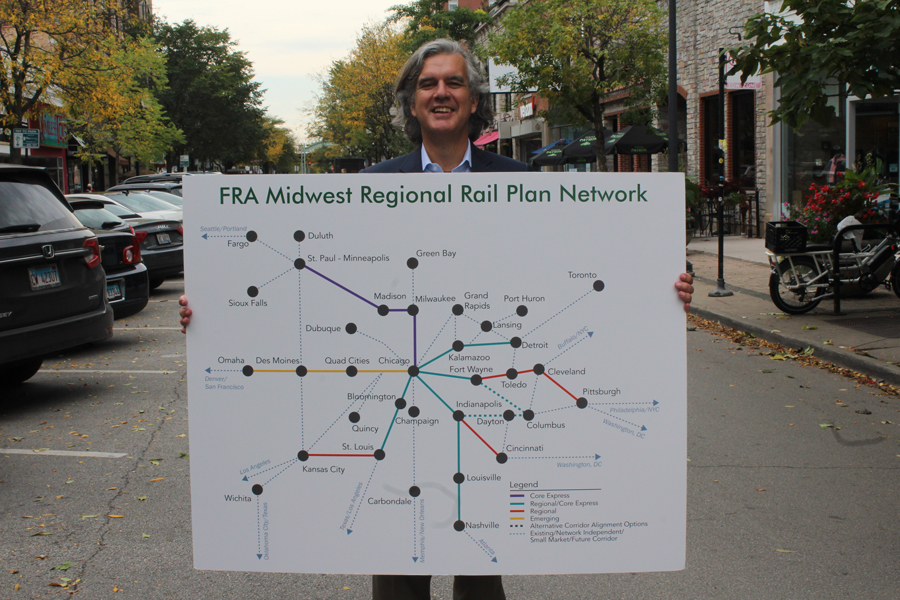

The City of Madison tackles the station location challenge The City of Madison Department of Transportation recently released a study of potential train station sites. It identified a first choice and a “Plan B” alternative from a list of nine contenders. Two other...
Why intercity buses are key to building a quality rail network
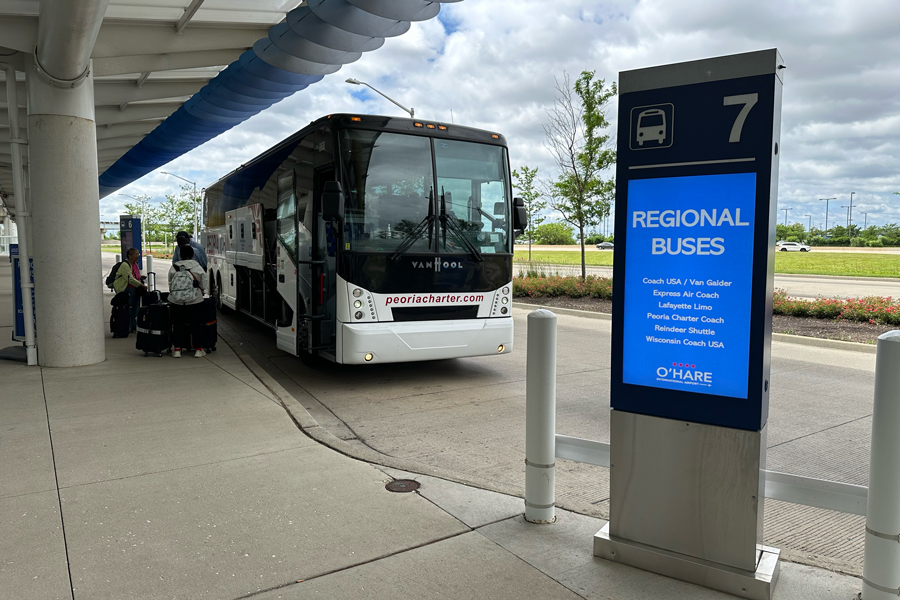
The Alliance has recently advocated for more investment in intercity buses, including a regional bus network in Illinois and a publicly owned intercity bus station in Chicago.
Which raises an important question: What do buses have to do with trains?
Here are three key ways that a network of quality intercity buses can complement and help build rail networks:
- The big-picture goal is to give everyone an easy, affordable way to travel anywhere in a country—without a car. No matter how extensive the rail network is, there will be scores of smaller communities not served by trains. We need intercity buses to supplement existing rail routes, fill in service gaps, and connect smaller towns and cities with each other and with the region’s rail network.
- Trains and buses are phenomenally fuel efficient. They’re easily the most sustainable modes of motorized transportation. Since transportation is the single greatest source of US greenhouse-gas emissions, trains and buses are among our most powerful tools for fighting climate change. Their impact is multiplied when they are well-coordinated in a network that integrates buses and trains and has well-timed connections.
- Buses have the great advantage of flexibility. New routes and added service can launch quickly—and at low cost—when demand dictates. In Illinois specifically, for example, a quality network of intercity buses could supplement rail service and make key tourist attractions (like Galena and Starved Rock State Park) and key institutions and amenities (like the University of Illinois and O’Hare) more accessible to the whole region.
Fortunately, states across the US are recognizing the value of intercity buses and investing in them. Maine, for example, recently launched a pilot intercity bus service between Portland, Lewiston, and Auburn. Meanwhile, state-supported systems in Colorado, North Carolina, Ohio, Oregon, Vermont, Virginia, and Washington are thriving and “creating spill-over benefits for the entire national bus system,” as DePaul University analyst Joseph Schwieterman noted in a recent essay. (His Alliance blog post about saving Chicago’s intercity bus station can be found here.)
An estimated 50 million people used intercity buses in 2023. Amtrak’s total ridership was less than 30 million. Schwieterman co-authored a report, “Back on the Bus,” that predicts the growing bus/train synergies will benefit both modes of travel—and will increase in the coming years, based on successes in several states.
For example, Amtrak’s Cascade Thruway buses make mid-day runs to supplement two daily Amtrak trains between Seattle and Bellingham. Last year, Amtrak replaced diesel buses on the route with electric vehicles—the first in its fleet. The buses travel nearly 200 miles on one charge, and they connect with trains running to and from stations south of Seattle.
Likewise, Vermont’s bus network, Trainslines, has an Albany-Rutland-Burlington line that connects with Amtrak trains at Albany. The line fills gaps in Amtrak’s schedule and “allows travelers to reach Burlington and New York several hours earlier than train-only options,” according to “Back on the Bus.” The upshot? Ridership on Trainslines increased by 25% from 2022 to 2023. About one-third of its customers make a train connection.
There’s good progress in the realm of ticketing as well. For example, it’s now possible to buy bus-only tickets at amtrak.com for several routes on California’s Amtrak Thruway bus system. In 2019, California repealed a law that prohibited Amtrak from selling bus tickets without a rail component. The bill had passed in 1999 on the theory that allowing Amtrak to sell Thruway-only bus tickets created unfair competition for other intercity bus carriers. Greyhound subsequently reduced its service in the state. California has the most extensive Amtrak Thruway bus system in the US, with 16 routes that serve all parts of the state. For popular rail routes like the Pacific Surfliner, Amtrak touts“reliable and convenient” bus/train transfers.
Bus carriers in at least four other states—Oregon, Pennsylvania, Washington, and Wisconsin—also offer bus-only tickets on Amtrak’s website. Assessing this progress, Schwieterman writes that “the days when intercity bus providers and Amtrak are . . . locked in a zero-sum battle for customers” are over.
Here’s hoping.
Please go here to sign our petition to leaders in Illinois to save Chicago’s intercity bus station. And go here to sign our petition for a statewide rail program in IL.
The Latest from HSRA
Our Latest Blog Posts
Check out the latest news, updates, and high speed rail insights from our blog!