The spiritual home of the American railroad signed the Paris Agreement. Its latest climate plan mentions the word "train" exactly zero times. Guest post by Board Treasurer Matthew Roling The Illinois Environmental Protection Agency published its updated Comprehensive...
Chicago Bears Stadium Proposal Should Include Regional Rail
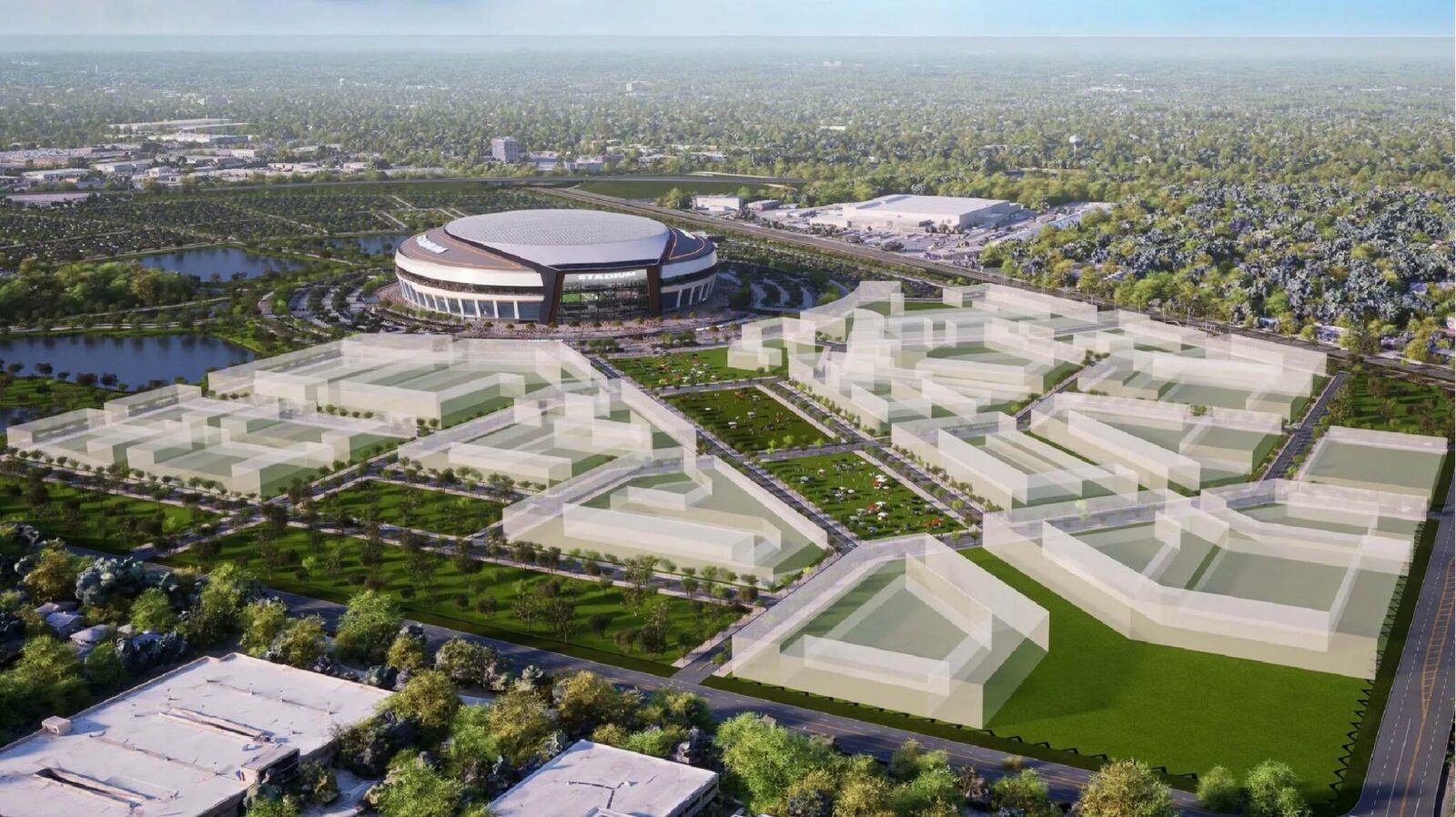
The Chicago Bears are considering two non-Chicago sites for a new stadium: Arlington Heights, IL and Hammond, IN. Regional rail should be a deciding factor: Arlington Heights has a train station with service that can be improved, while the Hammond site doesn’t have passenger rail access and never will have it.
The Bears stadium would be built alongside a mixed-use district, “a year-round hub for dining, shopping, and live events,” the club says. The stadium and district would be a private investment, but the club is seeking $855 million in public funding in the form of tax breaks and improved roads, sewers, and transit.
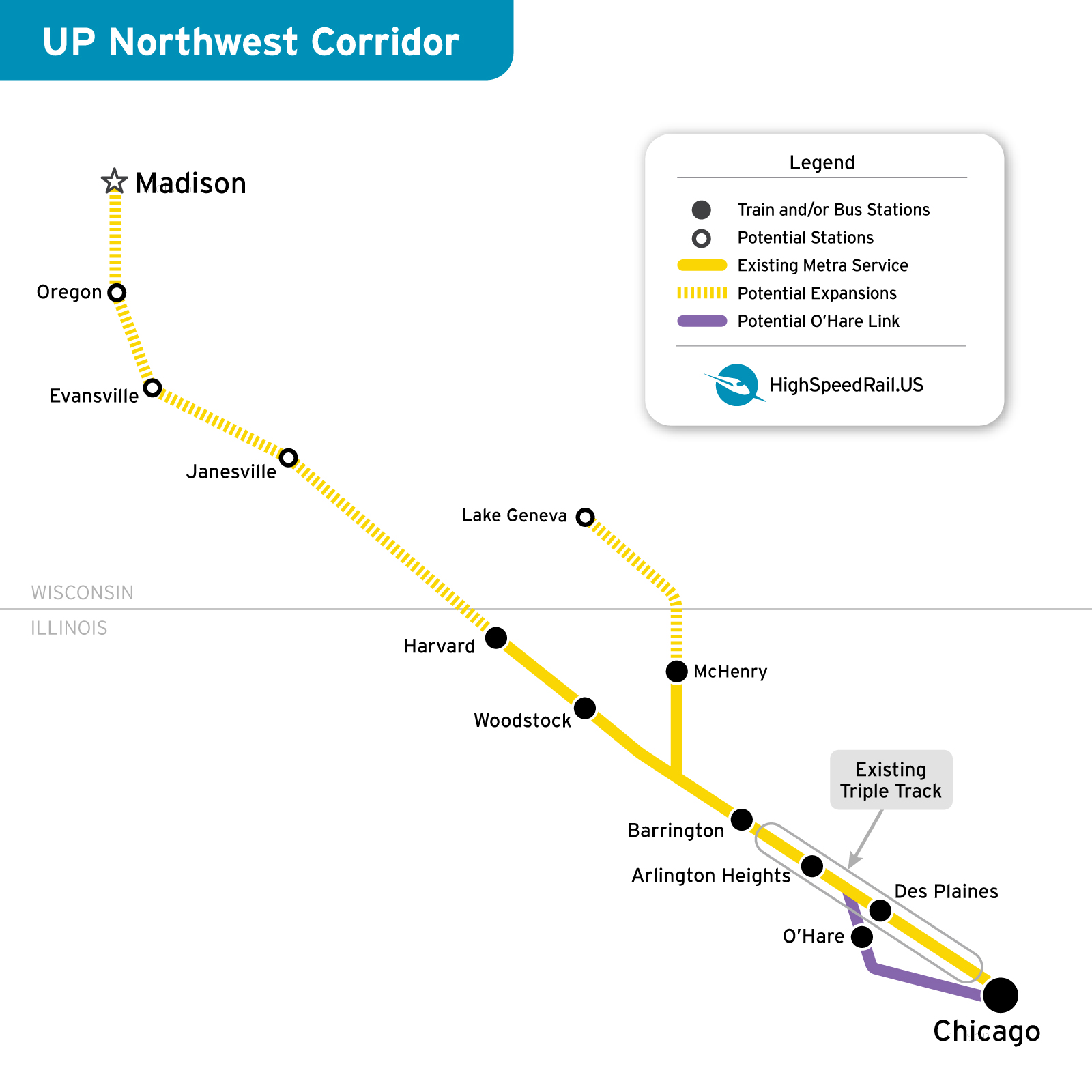
The Arlington Heights site is served by the Metra Union Pacific Northwest Line, which could become regional rail simply by running a train every 15 to 30 minutes. The Arlington Heights location also could be the catalyst for extending Metra to Janesville and Madison, WI, and Metra’s proposed downtown Chicago-to-O’Hare Airport train could be extended to Arlington Heights and Barrington.
Think of the convenience this would provide for Bears fans, hotel guests, and patrons of the other businesses on the property, as well as residents and employees.
At the Hammond location, the closest train station is three miles away. The site is surrounded by protected wetlands and squeezed between two lakes. A train is never coming to this spot.
The background is that the Bears are earnestly pursuing a new stadium, having played in Soldier Field, now 102 years old, since 1971. The club purchased the 326-acre site of the former Arlington International Racecourse in Arlington Heights in 2023, and in 2025 confirmed that that’s the direction they’re looking for a new stadium. The team is also eyeballing the Hammond site. Indiana has established a stadium finance authority; lawmakers in Illinois are considering legislation to entice the club to choose Arlington Heights.
Get Involved
Tell Congress: It’s time to reconnect the country with high-speed and regional rail!
On game day, don’t bury Arlington Heights in parking
This whole concept of a stadium as a fulcrum for further development would be ruined if developers of the stadium and adjacent commercial area decide that driving and parking will be the best way to reach the location.
“Professional sports teams really do care about the fan experience. Sitting in a traffic jam for an hour is not a good experience,” says Lauren Mattern, founder of the Chicago-based firm Journey Mobility, a transportation planning consultancy. Mattern helped plan access for Q2 stadium in Austin Texas, the home of MLS side Austin FC, which opened in 2021.
Mattern notes that teams know the ZIP codes of their season ticket holders, and while that could change significantly if the team builds a new stadium 25 miles away from where they played for the previous 60 years – “It’s a schlep,” NFL television announcer Al Michaels said of Arlington Heights – it is nevertheless useful data for planning.
Use existing parking
Fans without access to the Union Pacific Northwest Line may believe they have no choice but to drive to the game. Perhaps they will drive, but this project should make the best use of existing parking.
Some of the train stations northwest of Arlington Park have significant parking capacity: Palatine 1,368 spaces, Barrington 914 spaces, Pingree Road 709 spaces, and Crystal Lake 1,096 spaces. Parking at these stations is typically free on weekends. Some of these towns might even encourage tailgating in their train station parking lots before Bears games, promoting business at their local bars and restaurants. Then when the train comes, everyone gets on with their fellow Bears (or opponents’) fans for the ride to Arlington Park, which is four minutes from Palatine, 11 minutes from Barrington, and 29 minutes from Crystal Lake.
After the game, returning fans would get back on the train, confident that one is coming in 15 minutes even on Sundays, and upon arrival in the parking lot would face a much smaller, negligible even, traffic jam than they would have faced if parking immediately surrounded the stadium.
Meanwhile, at the Hammond location, you can’t build a train station because the tracks don’t go there, and building new tracks across the water to this location would cost billions, with minimal return on investment. If that kind of money was available, it would be wiser to upgrade the speed and frequency of trains that everyone could use, not just football fans on a handful of Sundays. For the same money, the South Shore Line could extend the Monon Corridor from Dyer to Lafayette and run hourly service every day of the year, for example.
We see Arlington Heights as the only long-term choice, notwithstanding a potential option in Chicago. If Arlington Heights is where the Bears opt to build, we urge civic leaders to promote Metra access from the parking available at train stations northwest of the stadium site, and to see the potential for the region of hourly trains to Madison, and trains to O’Hare Airport and downtown Chicago every 12-15 minutes. This would be huge for the Northwest Suburbs, Chicago and the state of Illinois.
The Latest from HSRA
Our Latest Blog Posts
Check out the latest news, updates, and high speed rail insights from our blog!