Take the SurveyWashington is designing a transformative high-speed line The Washington State Department of Transportation (WSDOT) is taking public comment on its study for a high-speed line between Portland, Seattle, and Vancouver, B.C. The study will be released in...
Last Train to Paris
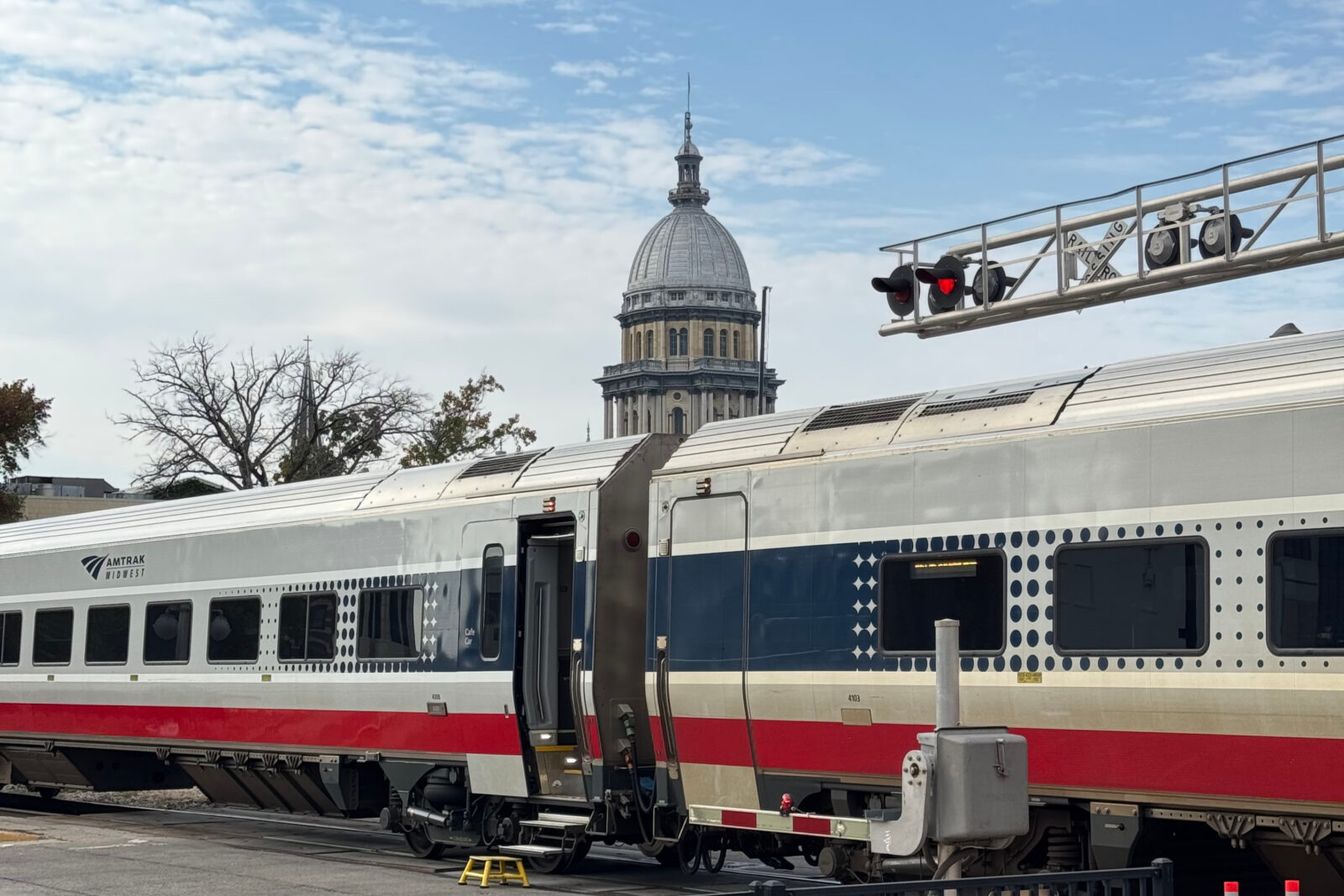
The spiritual home of the American railroad signed the Paris Agreement. Its latest climate plan mentions the word “train” exactly zero times.
Guest post by Board Treasurer Matthew Roling
The Illinois Environmental Protection Agency published its updated Comprehensive Climate Action Plan on June 1, 2026, and the leaders in Springfield must think the average Illinoisan is a 55-year-old suburban dad making over $150,000 a year. Because they rolled out the red carpet for electric vehicle incentives and offered essentially nothing for mode shift, transit, or, most glaringly, passenger rail.
Before going further, let us acknowledge what Illinois has accomplished. The state has done serious work decarbonizing its electricity grid. In 2005, power generation accounted for 95.6 million metric tons of greenhouse gas pollution, about 32% of total state emissions. By 2023 that number had dropped to 38.3 million metric tons, a nearly 60% reduction. That is a genuine achievement and it deserves recognition.
But transportation is a different story. In 2005, transportation emissions were 75.2 million metric tons, about 25% of the state’s total. By 2023 they had dropped to 57.2 million metric tons, a reduction of less than 24% over 18 years, and transportation’s share of total emissions grew to 28% as the grid got cleaner. Illinois has been making real progress where progress is easy. It has barely moved on the hard part.
The Land of Lincoln, Railroads, and Irony
This state invented the American railroad. Chicago became the greatest city in the Midwest because every rail line in the country ran through it. Illinois has more miles of railroad track than almost any state in the nation. The Santa Fe, the Burlington Route, the Illinois Central, the Chicago & North Western, these lines were built here, by us, connecting a continent. Abraham Lincoln was a railroad lawyer before he was a president.
And yet the state’s 83-page climate plan mentions the word “train” exactly zero times.
The plan does gesture toward reducing vehicle miles traveled (VMT), projecting a 9% VMT reduction with no explanation of how we are going to achieve it. It nods to land use density with vague language about concentrating new construction in high-density regions. It mandates that municipalities and government agencies purchase electric buses, a requirement so toothless that it includes no funding mechanism and no enforcement timeline.
The implicit theory of the plan is that Illinois will solve its transportation emissions problem by convincing 575,000 new car buyers per year to buy electric vehicles instead of gas-powered ones. At up to $4,000 rebate per vehicle, replacing every new car sold in Illinois with an EV could cost as much as $2.3 billion annually. That is more than the entire operating budget of the Chicago Transit Authority, one of the largest public transit systems in America.
There is a cheaper, faster, and more equitable answer hiding in plain sight.
The Average Illinoisan Does Not Make $150,000
The EV strategy has a fundamental problem. The average new car in America now costs $50,326. The median Illinois household income is approximately $80,000. New car buyers with household incomes above $150,000 now represent 43% of all new vehicle sales nationally, up from 33% just six years ago. EV rebates are, in practice, subsidies for people who were already going to buy an expensive car.
Mode shift is different. A train ticket from Springfield to Chicago does not require a household income of $150,000. It does not require a $722 monthly payment. It does not require seven years of debt. It just requires a train.
The Commission That Needs a Signature
Illinois has already built the institutional infrastructure to do this right. And the High Speed Rail Alliance (HSRA) has been doing the quiet, unglamorous work of making sure it survives.
The Illinois High-Speed Railway Commission has spent years researching potential routings between Chicago and St. Louis, conducting initial ridership projections, and holding monthly public meetings where ordinary Illinoisans can weigh in on how their statewide rail system should be shaped. Metra, whose CEO chairs the Commission, is one of the best publicly-owned commuter railroads in the country. The Commission is staffed by people who know railroads, and its public meeting structure means citizens have more say in how their statewide rail system is shaped than in almost any comparable planning body in the country.
This spring, thanks in no small part to advocacy by the HSRA, the Illinois legislature voted to extend the Commission’s sunset from January 1, 2027 to January 1, 2030. This extension matters because serious rail planning takes time, and killing the Commission in 2027 would have meant discarding years of routing research and ridership analysis before it could be acted on. HSRA successfully fought to prevent that from happening. The extension bill is now on Governor Pritzker’s desk waiting for his signature.
The legislature also voted, again with HSRA’s advocacy behind it, to endorse the American High Speed Rail Act, introduced by Representative Seth Moulton and co-sponsored by 47 representatives, which would authorize $41 billion for high-speed and higher-speed rail nationally. Illinois going on record in support of that bill sends a signal to Washington that the Midwest is ready to be part of a national passenger rail network, not just a flyover corridor between coasts.
HSRA won those two legislative victories in a session that had no shortage of competing priorities. That is exactly the kind of patient, persistent advocacy that moves infrastructure policy in a state where the highway lobby has had decades of runway.
What You Can Do
Giving HSRA $10 a month is an investment in the only organization in Illinois that showed up to fight for trains when the climate plan forgot they existed. Become a sustaining member. Then send this piece to one person who cares about getting this right.
The spiritual home of the American railroad has everything it needs to lead on this. Governor Pritzker has the pen. It is time to use it.
Matthew Roling is a Clinical Assistant Professor and Founding Executive Director of the Abrams Climate Academy at the Kellogg School of Management, Northwestern University. He serves as Treasurer of the High Speed Rail Alliance and writes The Write-Down, a Substack on climate finance. The views expressed are his own and do not represent Northwestern University or the Kellogg School of Management.
The Latest from HSRA
Our Latest Blog Posts
Check out the latest news, updates, and high speed rail insights from our blog!