Take the SurveyWashington is designing a transformative high-speed line The Washington State Department of Transportation (WSDOT) is taking public comment on its study for a high-speed line between Portland, Seattle, and Vancouver, B.C. The study will be released in...
The Brightline Paradox Answers the Question Everyone Asks About Trains in the U.S.
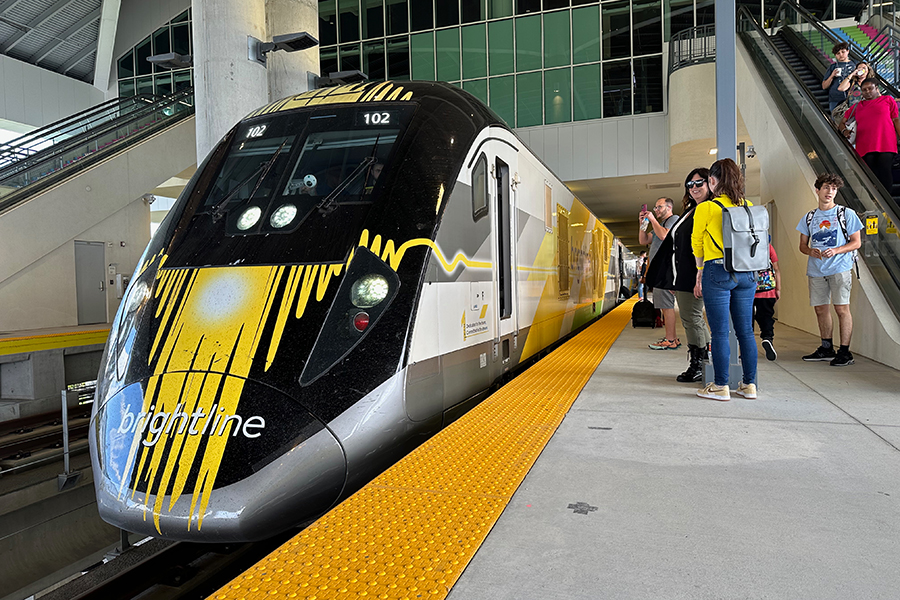
Brightline Florida is two very different stories in one.
The first is a happy one. Brightline’s revenues rose from $188 million to $214 million from 2024 to 2025, and it served more than 900,000 passengers in just the first quarter of 2026—a 13% year-on-year increase. For comparison, the Lincoln Service from Chicago to St. Louis had about 600,000 riders in all of 2025. The Capitol Corridor line, from Sacramento to the Bay Area, had about 1.1 million.
So Brightline is building a large and loyal ridership—and showing that Americans will ride trains when the service is fast and frequent enough to compete with driving.
But the second story is grim. Brightline’s auditor attached a “going concern” warning to the company’s financial statements this week. It doesn’t have enough liquid cash to service its debt and meet its upcoming obligations. And Brightline has deferred $117 million in interest payments on its $2 billion in long-term debt. So Chapter 11 bankruptcy is a real possibility
In short, Brightline faces a brutal paradox: Its product is popular and its revenues are strong and growing. But it’s being crushed by debt.
This isn’t a failure of demand or delivery. It’s a failure of the financial model. The Brightline paradox shines a harsh light on the deep inequalities and dysfunction of U.S. transportation.
And it helps answer the question everyone asks about U.S. trains: If they can do it in [some random country I once visited, where they had great trains], why can’t we do it here?
Infrastructure inequalities
Start with the fact that Brightline took on far more than just labor and rolling-stock costs.
It bought right of way in one of America’s most expensive real estate markets; built nearly 170 miles of new track alongside an active railway corridor; constructed stations in downtown Miami, Fort Lauderdale, West Palm Beach, and Orlando; installed modern signaling and grade crossing safety systems; and navigated several years of environmental review, litigation, and regulatory approvals.
The upfront capital costs, running into the billions, were financed through private loans at commercial interest rates. That debt, which is now strangling the company, results from a system rigged against trains.
When you fly, you use infrastructure built and maintained by the government (at various levels), including airport terminals, runways, and air-traffic control systems. When you drive, you’re using a highway system that cost more than half a trillion public dollars to build—plus tens of billions, annually, to maintain. And to be clear: The federal government covers roughly half of those costs from general tax revenues—not gas taxes.
With Brightline, there is no equivalent public backstop. The company built the tracks, paid for the land, financed the stations, and carries the full capital cost of its infrastructure—borrowed at market rates—on its balance sheet.
The “free market” for trains, socialism for cars and planes
This inequality has been reinforced and expanded at every turn by a century of public policy.
The Interstate Highway System—authorized in 1956 by the Federal-Aid Highway Act—was the largest public works project in American history. Its original price tag was roughly $500 billion in today’s dollars, and the federal government covered 90% of the cost. The project soon reshaped the country around the automobile, and passenger rail began its long decline as suburbs sprawled and downtowns hollowed out.
Gas taxes, which were supposed to make the system self-financing, never fully covered the cost. Last year, in fact, the Congressional Budget Office projected a roughly $111 billion gap between Highway Trust Fund revenues and highway spending from 2025 to 2029. General tax revenue, property taxes, and deficit spending fill the gap.
Airlines benefit from this infrastructure socialism as well. The Federal Airport Act of 1946 established the norm of using public funds to build and maintain airports. Ditto for air-traffic control with the creation of the Federal Aviation Administration in 1958. In 1970, the Airport and Airway Development Act formalized federal grants for airport construction and expansion. By 2022, the airline industry received about $20 billion in annual subsidies.
Meanwhile, public policy steadily undermined passenger rail. Through the mid-century decades, the Interstate Commerce Commission regulated passenger fares and service requirements while freight railroads, which owned most of the track, abandoned passenger service. In 1971, Congress established Amtrak as a public corporation to rescue the remnants of intercity passenger rail. But it had a mandate to be “self-sufficient. That’s a standard that isn’t (and couldn’t be) demanded of any other transportation mode. It’s considered absurd in other parts of the world. Countries that have great trains treat them as essential public goods, worth robust public investments.
So cars and planes have been propped up by a century of massive public investment in roads, airports, and traffic control. They were built and are maintained at taxpayer expense. Meanwhile, the financial model for trains asks passenger railroads to do something no other mode of transportation is required to do: build its own highway, borrow billions at market rates to pay for it, and compete against industries whose infrastructure costs have been socialized for generations.
Brightline is the latest victim of this rigged game.
So there’s your answer to why [some random country] has great trains and the U.S. doesn’t. Americans will flock to fast, frequent train service when it’s actually an option. But when the costs of driving and flying are heavily subsidized—while rail lines are held to “free-market” standards—offering a great product to meet strong market demand may not be enough.
It all comes down to where and how we invest public funds.
We’ve chosen one path for more than a century. We’ve seen where it leads. We can choose differently.
Get Involved
Tell Congress: It’s time to reconnect the country with high-speed and regional rail!
The Latest from HSRA
Our Latest Blog Posts
Check out the latest news, updates, and high speed rail insights from our blog!