Railways ‘50 times safer than cars’ More than 40 people were killed and 152 injured in a crash of two high-speed trains near Córdoba, Spain on Jan. 18. Preliminarily, the crash is blamed on a derailment due to a broken joint on the tracks. On Jan. 14, a construction...
Metra’s South Chicago Branch and the Illinois Quantum Campus

Modernizing Metra’s South Chicago Branch is essential to Quantum’s success
The future is fast approaching the South Chicago neighborhood, located on the south lakefront – but in some respects, not fast enough.
Plans were announced in 2024 for the creation of the Illinois Quantum and Microelectronics Park at 87th Street and the Lakefront, with an investment of $500 million from the State of Illinois. It is meant to be operational in 2027.
The Quantum Campus brings attention to a unique Metra line: the Metra Electric District South Chicago Branch, a 4.7-mile spur from the Metra Electric Main Line, built in 1883 by the Illinois Central Railroad, and electrified with overhead wires in 1926.
The South Chicago Branch is a unique yet scarcely used asset, a frog waiting to be kissed by a princess so it can reach its potential.
It is more like the CTA Brown Line then Metra’s commuter rail routes.
Get Involved
Subscribe to our weekly newsletter to stay up-to-date on high-speed and regional rail issues.
A rapid transit line hiding in plain sight
Like the Brown Line, it has no interaction with freight trains, has level boarding, and serves a variety of dense, vibrant communities, of which Hyde Park is the most recognized. The area along 71st Street is similar to the Albany Park neighborhood at the end of the Brown line. The South Shore and South Chicago neighborhoods are densely populated, though population has been declining recently.
The South Chicago Branch is faster than the Brown Line, with a trip from 87th street to Hyde Park taking just 17 minutes and a trip to Van Buren taking 33 minutes.
The Brown Line has stimulated growth in the surrounding neighborhoods since it was reconstructed in the early 2000s. The combination of the Quantum Campus and a modernized South Chicago Branch can do the same for South Chicago and South Shore.
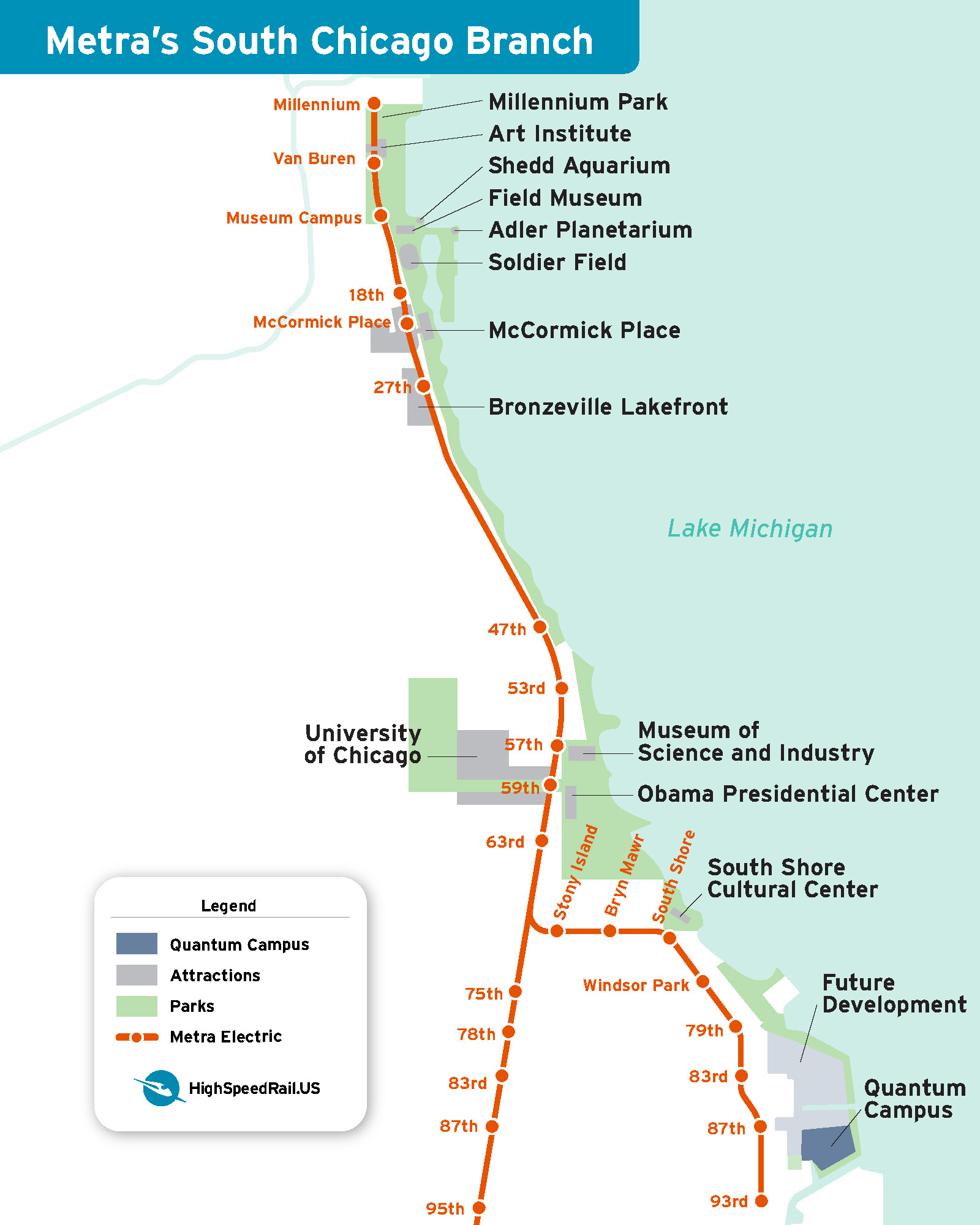
Metra’s South Chicago Branch connects Quantum and many other high-traffic destinations together.
What’s the problem?
Metra downgraded service in the 1980s to make it fit their commuter rail model and has ignored its potential. Metra, until recently, perceived its mission to be moving suburbanites to their downtown jobs.
The result has been a service offering that doesn’t fit the needs of the market:
> Few trains: The Brown line operates as often as every three minutes peak and every 15 minutes off-peak. The South Chicago Branch runs a paltry train every 30 minutes peak and only every one or two hours off-peak.
> High fares: Metra charges $3.75 per ride compared to the Brown Line at $2.50.
> No transfers: The South Chicago Branch has no coordination with the CTA. Not only must connecting passengers pay separate fares, but Metra and CTA have different methods of payment.
Making the South Chicago Branch great
Metra has expressed a desire to convert to “regional rail,” which uses high-frequency service on pulse schedules to make travel convenient for all kinds of trips, throughout the day.
The South Chicago Branch is one of the best places to start.
Given the high level of state support for Quantum, working with Metra and the CTA to upgrade the branch should be in Quatum’s developing plans and budget.
The needed fixes
> Run more trains
Trains should operate every 10 – 15 minutes during regular hours (6 a.m.-9 p.m. weekdays, 9 a.m.-9 p.m. weekends) and every 15-30 minutes during off hours.
> Compel Metra and CTA coordination
This is the best test case for developing the fare and schedule cooridation needed throughout the 6-county region. That means getting Metra to allow passengers to pay by tapping a Ventra card or credit card and establishing fare transfers between the Metra and CTA.
> Work with the community to speed up the trains
The street-running portions could be made faster through modest track upgrades and operational improvements. Faster trains will also require working with the community to improve grade-crossing safety.
> Improve access to downtown stations
Walking access to Millenium and Van Buren stations is very conveient – if you know where the station entrances are. The City should work to improve visibilty of the stations. More importantly, connections to downtown bus routes is inconvenient. The City should work to make these easy.
> Improve access to Quantum
The Quantum campus should be designed to provide easy walking connections within the campus and to the intersection of 87th and Lake Shore Drive. Quantum should provide a shuttle, perhaps autonomous, between the 87th street station and the various buildings within the campus.

The Quantum campus should be designed to make walking to the South Chicago Branch convenient. Extending CTA bus routes and running a dedicated shuttle should also be in the mix.
What you can do
If you live or work in South Chicago or South Shore, or if your business involves quantum computing and microelectronics, or if you like solid urban commercial and residential development, let your leaders know – political leaders, business leaders and academic leaders – that upgrading this train line is a must.
The Latest from HSRA
Our Latest Blog Posts
Check out the latest news, updates, and high speed rail insights from our blog!