Compartmentalized Responsibility Amtrak, at the prompting of the Federal Railroad Administration, is proposing a major restructuring. According to Amtrak’s website: “The preliminary framework would transform key parts of the organization into smaller, more focused...
Shouldn’t You Be Able to Get to Montreal by Train?
Montreal is a vibrant, exciting city. Unfortunately, Amtrak’s Adirondack will not travel north of Saratoga Springs, New York, from May 20 to June 29. This is the second year in a row that train service to Montreal has stopped during the summer travel season.
Last year, heat-related speed restrictions halted Amtrak service for Montreal. This year’s cause is track work on the line owned by Canadian National.
Rail lines all over North America need fixing or improvement, and we shouldn’t begrudge getting the work done. But it’s unacceptable to completely stop running trains, especially for so long. That scrambles the plans of current ticket-holders, and it discourages potential future riders too, when they try to buy a ticket but can’t, or simply hear bad news repeatedly.
This highlights the core problem for American passenger trains. The freight railroads who own most of the track have reduced their infrastructure to the point of meeting current demand, but no more. This, combined with periodic bursts of repair work, might make good business sense for the railroads, but it provides for no redundancy or expansion of service. Passengers suffer.
This shows the need for a national railway program that takes a Big Picture view—and supports it, with planning and investment. A federal railway program would invest in more double-tracking, to make complete stoppages unnecessary. It could also provide dependable, consistent support for regular maintenance, instead of putting it off and allowing problems to reach the point of requiring a prolonged shutdown.
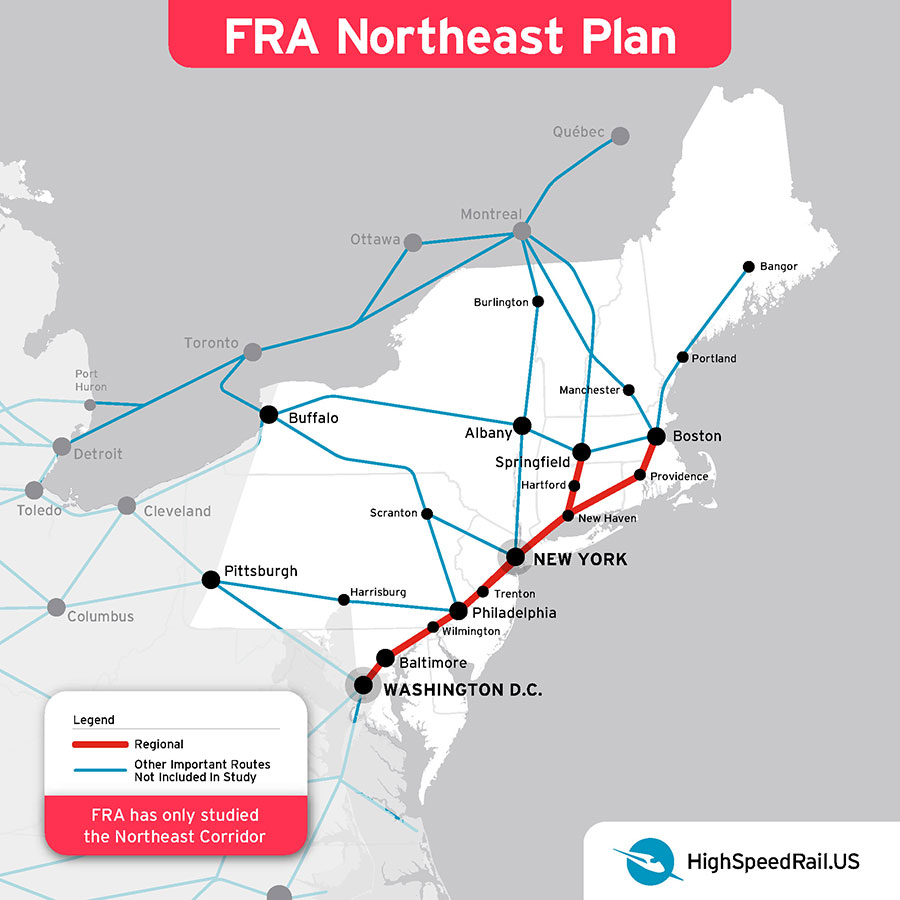
A national railway program would also provide more options. From the U.S. side of the border, it’s clear that we need more than one train a day for a major city like Montreal. As the map above shows, at least three routes to and from northeastern U.S. cities like Boston, Springfield, Mass., and New York could serve Montreal. If one line needs to shut down for maintenance, travelers could be rerouted to other lines still in operation.
In general, the Alliance advocates for intercity trains at least every two hours. And in a region this densely populated, it’s easy to make a case for even more frequent service, high-speed trains, and overnight sleeper trains too.
Last year, Corridor ID grants went to fund initial planning work for two of these three: to improve Amtrak’s Adirondack service from New York, as well as to extend the Amtrak Vermonter (the route via Springfield) into Canada.
That’s at least a step in the right direction. We need fast, frequent service between cities in this region, and throughout North America.
Read More
Amtrak Adirondack to Be Cancelled in Northern New York State and Canada for More Than a Month
The Latest from HSRA
Our Latest Blog Posts
Check out the latest news, updates, and high speed rail insights from our blog!