
Competing visions for transportation reauthorization Penn Station handles about 600,000 passengers on a typical weekday—more than LaGuardia, JFK, and Newark airports combined. It powers New York City’s economy, and it’s the beating heart of the most developed and...
Illinois Passenger Rail Commission Could Take on State Planning
Evaluation of improvements in Illinois, Midwest may move to High Speed Rail Commission
A compromise among interested parties in the Illinois State Capitol would, if adopted, place evaluation of new or improved passenger rail lines in the state, and potentially around the Midwest, in the hands of railroad people, and into public view.
The High Speed Rail Alliance, our members, and our allies have been promoting the Passenger Rail Planning Act, legislation in Illinois that would direct the Illinois Department of Transportation to plan for high levels of frequency for passenger train lines mostly radiating from Chicago to points around Illinois, the Midwest, and into the Northeast and South.
Now, the legislation may be amended to shift the initial planning responsibility to the existing Illinois High Speed Rail Commission – meaning that deliberations and recommendations will come from people whose priority is trains, not highways.
The primary reason for the proposed amendment was resistance from the private railroads, which own much of the property on which trains run or would run. They believe a statute dictating passenger rail frequency would be inflexible, and would interfere with their freight business.
The Passenger Rail Planning Act was proposed to address the fact that passenger routes that run two round trips per day will never generate the ridership necessary to overcome the expense of establishing the service. Such a model always will be a money loser that serves a fraction of the ridership it could serve if trains ran every hour or every two hours. For passengers, time spent waiting is part of their travel time calculation. The intent of the bill is to get high frequency service into the planning process from the start.
Under the amendment, a modified and extended High Speed Rail Commission (whose name would be changed) would take on the responsibility of developing a plan for regional rail, which it would recommend to the Illinois Department of Transportation. The Commission up to this point has been limited in scope to planning for a single high-speed rail line between East St. Louis and Chicago.
This shift is excellent for several reasons:
- The Commission holds public meetings every month. The public can attend meetings (or view them on Zoom), and submit comments, either orally or in writing. Any official documents that Commission members read as “homework” are available for the public to read. At the Illinois Department of Transportation, there is no monthly meeting.
- The public participation component is tremendously beneficial. These meetings are an opportunity for people with otherwise no outlet to show up and say yes, we do want hourly service to Champaign, or East St. Louis, or Rockford, and every two hours to Moline and Peoria. Members of the General Assembly will see this public support in a way they would not have seen it if all discussion was staffer-to-staffer at IDOT headquarters, out of public view. Those members of the General Assembly then will realize passenger rail is a vote winner.
- The Illinois Department of Transportation is primarily a highway agency. It’s the agency that operates and maintains 15,895 miles of highways and 7,847 bridges throughout the state. Since passenger rail occurs mostly on private property, it is an afterthought. IDOT will benefit from the Commission’s recommendations.
- The High Speed Rail Commission, which is already involved in passenger rail planning, is chaired by James M. Derwinski, the head of Metra, the Chicago-area commuter/regional rail agency – one of the best public railroads in the country. Having the chief executive of Metra as the chairman of a commission doing planning and oversight of the state passenger rail program makes sense. The vice chairman is Tim Butler, president of the Illinois Railroad Association, the trade association for the railroad industry. Members include delegates from relevant labor unions, metropolitan planning organizations, and High Speed Rail Alliance Executive Director Rick Harnish – so it’s a representative group, experienced and capable.
The frequency of service for each route would be discussed and debated by the Commission in public. Each route has unique needs. Maybe increased passenger service would fit on a freight corridor in some places, or require new tracks on existing right of way. Some routes may benefit from an entirely new passenger-dedicated right of way.
The High Speed Rail Commission is an advisory body, with IDOT having approval authority, though the ultimate decision on where to spend billions on engineering and construction is always made by elected officials.
The routes the Commission would evaluate, and make recommendations on for the implementation of service, frequency, or both, would be:
- Chicago to Milwaukee and Green Bay
- Chicago to Janesville, Madison and St. Paul
- Chicago to Rockford and East Dubuque
- Chicago to Normal and Springfield
- Chicago to Detroit and Toronto
- Chicago to Cleveland, Buffalo and Boston
- Chicago to Fort Wayne, Columbus, Pittsburgh and Philadelphia
- Chicago to Indianapolis to Cincinnati
- Chicago to Indianapolis, Louisville, Nashville and Atlanta
- Chicago to Champaign, Carbondale and Memphis
- Champaign to Decatur and Springfield
- Springfield to East St. Louis, St. Louis and Kansas City
- Chicago to Moline, Des Moines, Omaha and Denver
- Chicago to Peoria
- Chicago to Galesburg, Quincy and Hannibal
- Carbondale to East St. Louis.
Since these routes extend into states beyond Illinois, the Commission is equipped to meet with and hear from representatives of multiple states in a way that the state Department of Transportation is not.
The original bill was recommended for passage by the Senate Transportation Committee on Tuesday. If stakeholders, including IDOT, Metra and the host railroads, can reach agreement on language, the amendment will be presented to the Committee in the next few weeks.
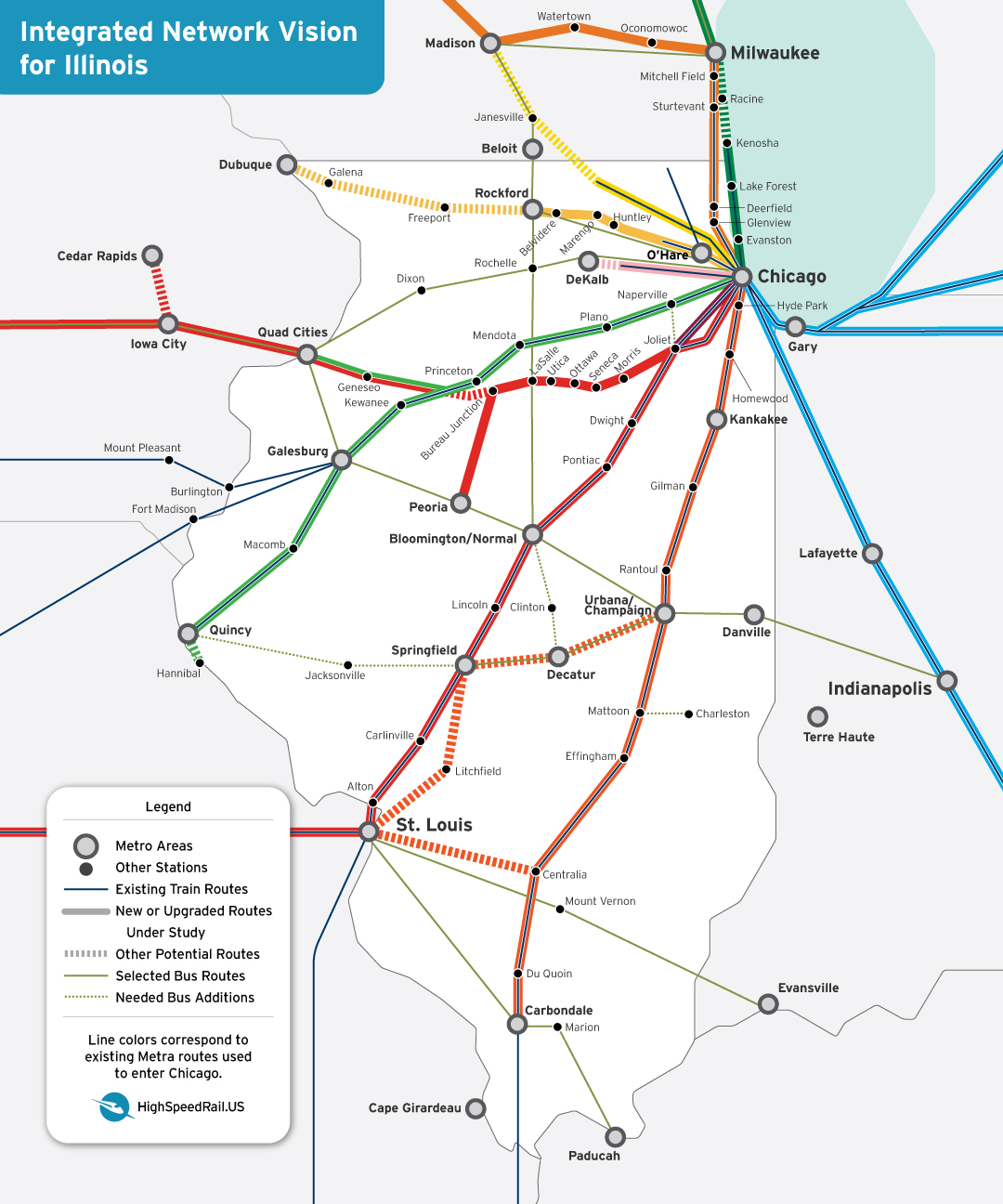
A map of existing and potential passenger rail routes in Illinois.
The Latest from HSRA
Our Latest Blog Posts
Check out the latest news, updates, and high speed rail insights from our blog!