The High Speed Rail Alliance Podcast We are excited to announce the launch of our podcast High Speed Rail Talk. This new format builds upon our celebrated webinar series to bring you news and discussion about fast, frequent trains and the future of transportation in...
The O’Hare Flyer: Chicago May Finally Get Its Airport Express Train
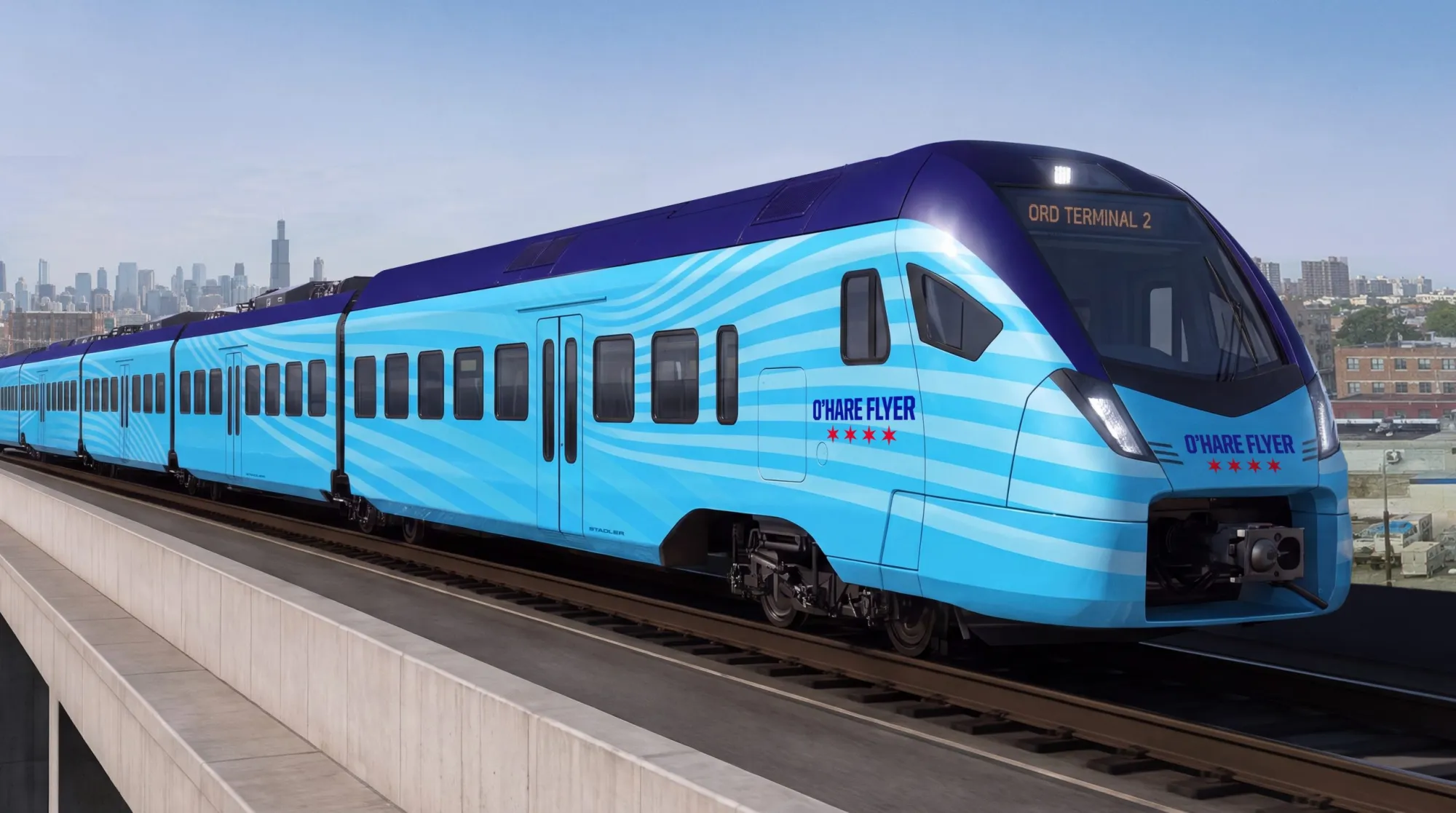
America Has Never Built an Airport Express Railway. Chicago Is About to Try.
Nearly everyone agrees that there should be fast trains between downtown Chicago and O’Hare International Airport. The sticking point has always been how to make it happen: where the line should run, how fast the trains should go, and who should pay for it.
A private group thinks it has answers. It’s proposing the O’Hare Flyer, a battery-electric express train from downtown to O’Hare’s Terminal 2. The trip would take 15 minutes, and the trains would depart from the Old Post Office every 15 minutes, from 4 a.m. to 10 p.m., averaging 80 mph on a mostly single-track line. By car or public transit the trip can easily take an hour, depending on traffic. (Watch the company’s promotional video here.)
The group hopes to begin construction in 2027. The projected completion date is 2032. The Flyer’s $2.25 billion price tag would be covered by private investors rather than local transit agencies. So far, the plan has the support of the city’s leadership, including Mayor Brandon Johnson. And there’s strong public interest: The Alliance’s recent webinar devoted to the subject was the most-attended event in the series’ history.
If it works, the plan could be a model for transforming underused freight corridors into urban passenger-rail lines across the US, via private investment and/or public-private partnerships.
But that’s a big if. The O’Hare Flyer would be America’s first airport express train, although the idea has been floated many times—in Chicago and elsewhere. In 1995, New York planned to build a 22-mile railway between Manhattan and its airports. The project was derailed by spiraling costs, financing struggles, and pushback over the routing. Then, in 2018, Chicago Mayor Rahm Emanuel announced a collaboration with Elon Musk to build an O’Hare express line. That project soon fizzled as well.
Fifth time’s the charm?
The Flyer team—led by Kristi Lafleur, Dave Lundy, and Mark Walbrun—believes that three underused freight rights-of-way in Chicago are the key to its success. Walbrun led the 1990s redesign of Chicago Union Station. Lundy is a strategic consultant, and Lafleur is former director of the Illinois Tollway and former CEO of the Chicago Skyway. They reportedly have a tentative agreement with CSX and “a pathway to yes” with the other two relevant railroads, Canadian National and Union Pacific.
The group only recently made its plans for the Flyer public after years of laying the groundwork: It weighed potential routes, did preliminary engineering work, negotiated with the railroads, courted potential investors, and studied global examples.
“Chicago has tried, unsuccessfully, to do this four different times,” Lundy said in the recent Alliance webinar devoted to the project. “The difference between those plans and our plan is that this can actually happen, because we’re repurposing existing and largely unused freight rail lines.”
Walbrun noted that the Flyer will be the only operator using the line, and that dedicated tracks are a common denominator in successful express lines.
“The ones that have the highest reliability have a dedicated line,” he said. “They don’t have any other operator. There’s no freight, there’s no crossing points with other railroads. By having a dedicated line, you can ensure that the trains are operated very efficiently all throughout the day.”
Not in my backyard?
One of the project’s biggest challenges, in addition to financing and routing, may still lie ahead. The day after the plan was announced, the village president of River Forest—an affluent Chicago suburb located at about the midpoint of the proposed line—expressed her “vehement opposition.” The Flyer, she noted, “would be on a train line that runs entirely through our Village.” She scheduled a town meeting about the project for early October.
The Flyer team has said that the portion of the line through River Forest would be elevated, to eliminate grade crossings. It would be fenced, as well, and the elevated portion would have sound insulation. “One thing we are trying to make clear to the community is that it’s a discussion,” Lundy said. “There are different things that you want to do, we are happy to talk about those. The only thing that is not changing is the route. The route is the route.”
So there’s a case that Flyer will be different than the many stalled express projects that have come before. The private investment sidesteps the fight over public dollars, and the freight rights-of-way sidestep conflicts over new construction. Whether those strengths can overcome the political pushback—the oldest and greatest obstacle in American infrastructure—remains to be seen.
“There are two dozen of these around the world,” Lundy said. “We believe we can take the best practices from every one of these trains around the world and create the best airport express train on planet Earth. That is our ambition, and we believe it is a very achievable goal.”
Get Involved
Tell Congress: It’s time to reconnect the country with high-speed and regional rail!
The Latest from HSRA
Our Latest Blog Posts
Check out the latest news, updates, and high speed rail insights from our blog!