A Car and Driver-style comparo for people who think "zero to 200" should only apply to supercars and motorcycles Guest post by HSRA Board Treasurer Matthew Roling When I was ten years old, I had a poster up on my wall of a cherry red Porsche 911 “whale tail”—it was...
Early work is underway on the two-mile Frederick Douglass Tunnel in Baltimore. It’s the largest Amtrak-led infrastructure investment in the railroad’s history, and it’s the most consequential piece of the Northeast Corridor’s future outside of New York.
Amtrak’s Northeast Corridor trains served about 15 million passengers in FY 2025. For comparison, Amtrak’s four western routes—running through California, Oregon, and Washington—served about 5 million people.
Below is a summary of what’s happening and why it matters.
A key takeaway—beyond the significant impact of this one project—is that the money appropriated for train infrastructure Investment and Jobs Act of 2021 is having a real, positive impact across America.
Now, we need the new surface transportation bill—currently working its way through Congress, with passage expected sometime in 2027—to fund many more such projects. And we need the funding for Amtrak and state-led passenger-train projects to have the same advanced appropriation status as highway projects. (Learn more here and sign our petition here.)
Nuts and bolts
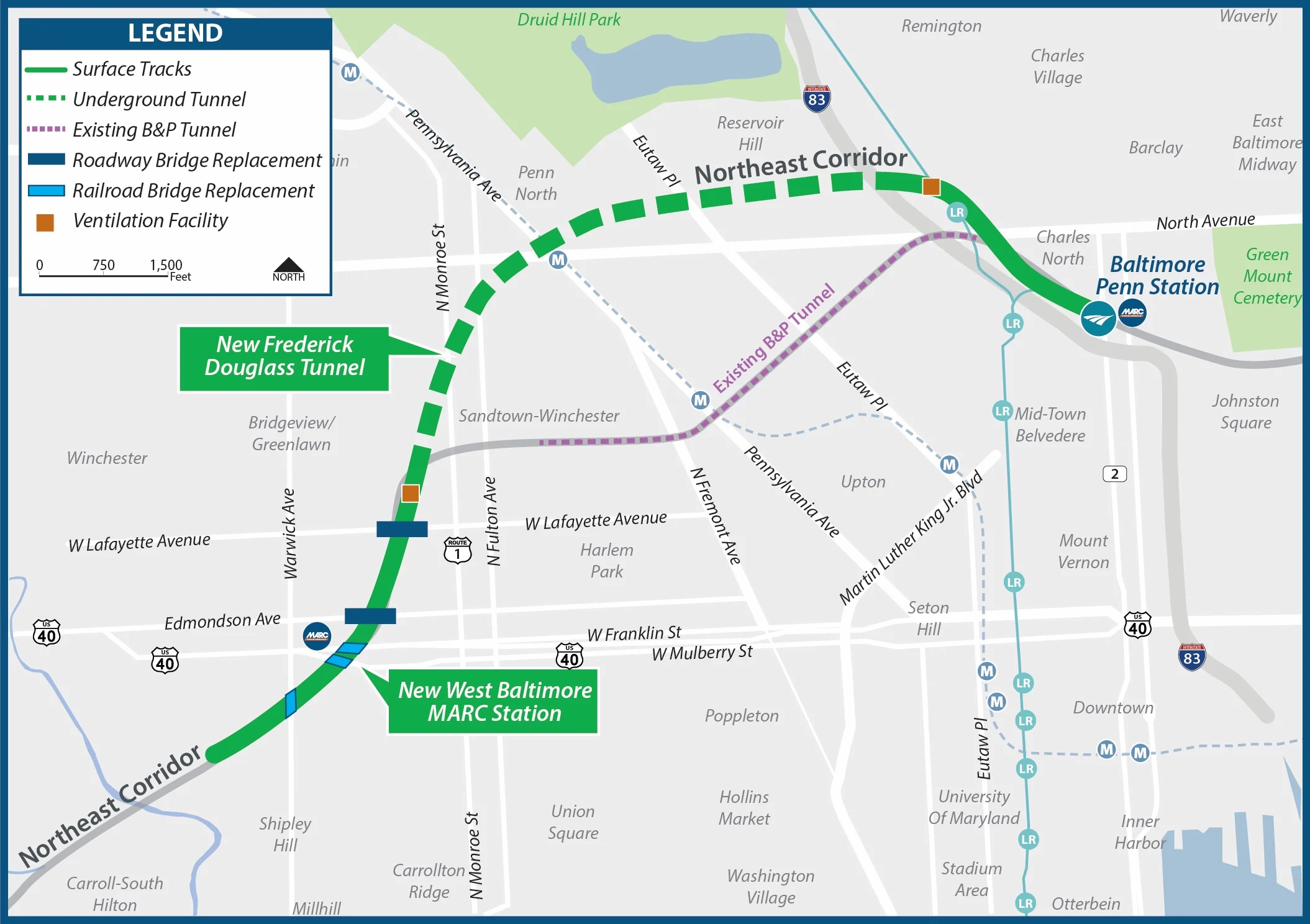
The Frederick Douglass Tunnel is a new, underground, twin-tube tunnel. Each tube is roughly two miles long and designed for electrified Amtrak and MARC passenger trains. It will replace the Baltimore & Potomac (B&P) Tunnel—a 1.4-mile, two-track tunnel that opened in 1873, making it the oldest in Amtrak’s network.
But the full project—called the B&P Tunnel Replacement Program—is bigger than just the Frederick Douglass Tunnel. It includes:
- A new ADA-accessible West Baltimore MARC Station. (MARC is the Maryland Area Regional Commuter system.)
- Five bridge replacements and roughly 10 miles of rail-infrastructure upgrades.
- Reconfigured city streets and major utility relocations, including a 345-foot utility siphon tunnel.
- A $50 million Community Investment Program to compensate residents along the alignment.
The project’s most recent cost estimate is roughly $6 billion, funded through a $4.7 billion federal grant as well as $727 million from Amtrak and $450 million from the state of Maryland.
Two tunnel-boring machines, now being built in Germany, will begin digging in 2028. The project’s estimated completion date is 2036.
Why it matters
Roughly 130 trains—Amtrak/Acela, MARC, and Norfolk Southern freight trains—pass through the B&P Tunnel each day, carrying about 12 million passengers annually.
It’s the worst bottleneck in the Northeast Corridor between D.C. and New Jersey. Trains slow to about 30 mph to navigate the tight curves, creating delays for more than 10 percent of weekday trains. The tunnel has no modern fire and life-safety systems and cannot be retrofitted with them.
Amtrak calls it a “single point of failure” for the Northeast Corridor—meaning that, if it fails, there is no adequate detour. Passenger service through Baltimore would be severely curtailed or suspended.
And the tunnel is gradually failing. It suffers from water infiltration, a deteriorating structure, and a sinking floor.
The Frederick Douglass Tunnel will change all of that:
- Speed: 30 mph today vs. 100 mph design speed in the new tunnel.
- Capacity: Amtrak says the two new tubes will triple passenger throughput on the segment.
- Reliability: Modern safety systems, modern track.
- Regional benefit: Faster, more reliable Amtrak and MARC service.
The project’s environmental review projects a maximum time savings of about 2.5 minutes per trip through the tunnel segment. The real gains will come primarily from added capacity and reliability rather than speed.
Kathy Hollinger, CEO of a local business advocacy group, described the project as a “once-in-a-generation opportunity to expand access throughout our region, making us the best region to live, work, and build a business.” (Watch Amtrak’s video about it here.)
How we got here
The B&P Tunnel in use today was built in the early 1870s and was considered obsolete more than a century ago. In 1915, the Pennsylvania Railroad studied either replacing it or rerouting traffic to an elevated line. The city of Baltimore nixed the idea of an elevated line, and the Great Depression of the 1930s killed the idea of building a new tunnel.
Emergency upgrades to the track in the early 1980s allowed it to remain in use but did little to resolve its many shortcomings. In 2005, the FRA reported to Congress that the tunnel needed to be rebuilt or replaced within 10 to 20 years. An environmental review followed, resulting in a Record of Decision in 2017.
But funding didn’t arrive until 2023, via a federal grant under the Infrastructure Investment and Jobs Act.
The challenges
The case for building the tunnel is clear, but the challenges have been significant.
Notably, the project got smaller and the price increased. The 2017 plan approved four tubes, including capacity for double-stacked freight. In 2021, Amtrak split the program into phases: Phase 1 (two passenger tubes, under construction) and Phase 2 (two freight tubes, with no timeline). Amtrak says it is not certain when or if Phase 2 will happen.
But revised design does have at least one positive effect: The two tubes being built will accommodate only electric trains. As a result, MARC’s Penn Line will convert to all-electric trains, which are dramatically less polluting than the diesel-powered locomotives used by some MARC trains.
The 2017 Record of Decision estimated the full project at $4.5 billion. Today, Phase 1 alone is projected to cost about $6 billion—a 34% increase on half the original scope.
Meanwhile, the affected neighborhoods are pushing back.
The tunnel alignment runs underneath predominantly Black neighborhoods in West Baltimore with a history of being cut apart by infrastructure projects. They include Bolton Hill, Madison Park, Reservoir Hill, Sandtown-Winchester, and Upton. Amtrak announced that it would acquire more than 600 properties. In addition to hundreds of residents and dozens of businesses, several churches and a medical center will be displaced.
Residents have organized in protest. The Community Law Center represents 10 neighborhood groups. A Title VI complaint was filed with USDOT in April 2024. There are specific concerns about vibration damage to 19th-century unframed brick rowhouses.
Amtrak announced a $50 million Community Investment Program in 2024, devoted to “mitigating construction impacts in the community.” It began accepting applications for the first round of awards in March, and the first awardees are expected to be announced this month.
Looking ahead
The B&P Tunnel Replacement Program is funded and moving forward. It will triple capacity and speeds in a key Northeast Corridor tunnel while rebuilding a West Baltimore station and surrounding infrastructure.
It shows a strong commitment to the cornerstone of America’s passenger-rail network. This is solid momentum we can build on as the U.S. continues to rebuild its railway infrastructure and expand its network of passenger trains.
Again, we need to push Congress to fund many more such projects in the surface transportation bill that it’s currently working on. And, crucially, we need Congress to give passenger-train and transit projects the same advanced appropriation status as highway projects. (Learn more here and sign our petition here.)
The Latest from HSRA
Our Latest Blog Posts
Check out the latest news, updates, and high speed rail insights from our blog!