
Washington is designing a transformative high-speed line The Washington State Department of Transportation (WSDOT) is taking public comment on its study for a high-speed line between Portland, Seattle, and Vancouver, B.C. The study will be released in 2028. Go here to...
Brightline Positioned for a Breakthrough in 2026
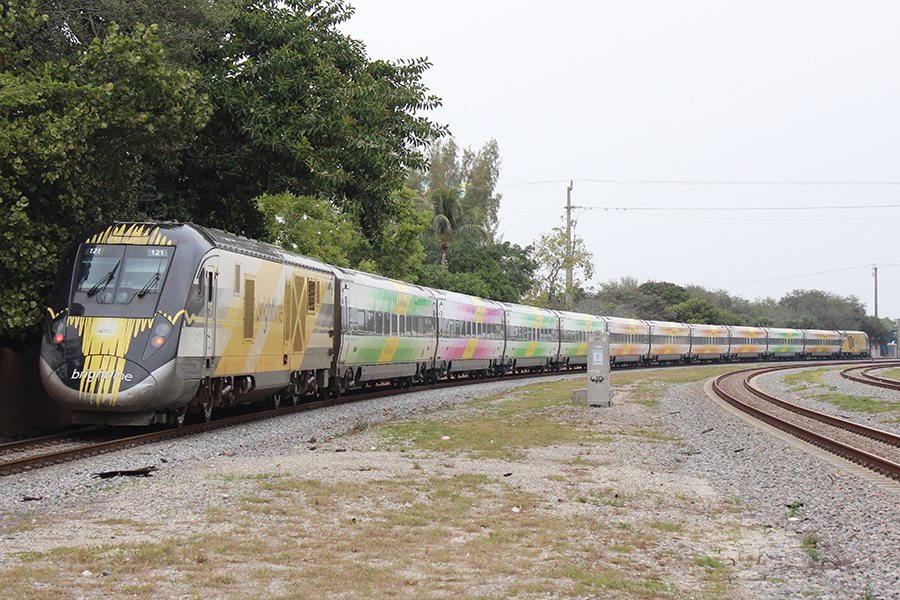
Photo: A 10-car, 601-seat Brightline train departing Fort Lauderdale station. Bob Johnston.
Brightline Florida’s growth paints optimistic picture for the country
Over the past two years, Brightline Florida set the stage for a breakout 2026 by changing its strategy and steadily expanding its trains. As of December, Brightline is running 610-seat trains, more than three times the size of Southwest’s largest, 175-seat jet.
Already, January – May 2026 ridership is up 27% over the same period in 2024.
If Brightline can break into a car-dominated market like Orlando, with relatively slow trains and a poorly located station, then we should be optimistic about high-speed rail across the country. One important factor to their success is launching with hourly departures in each direction.
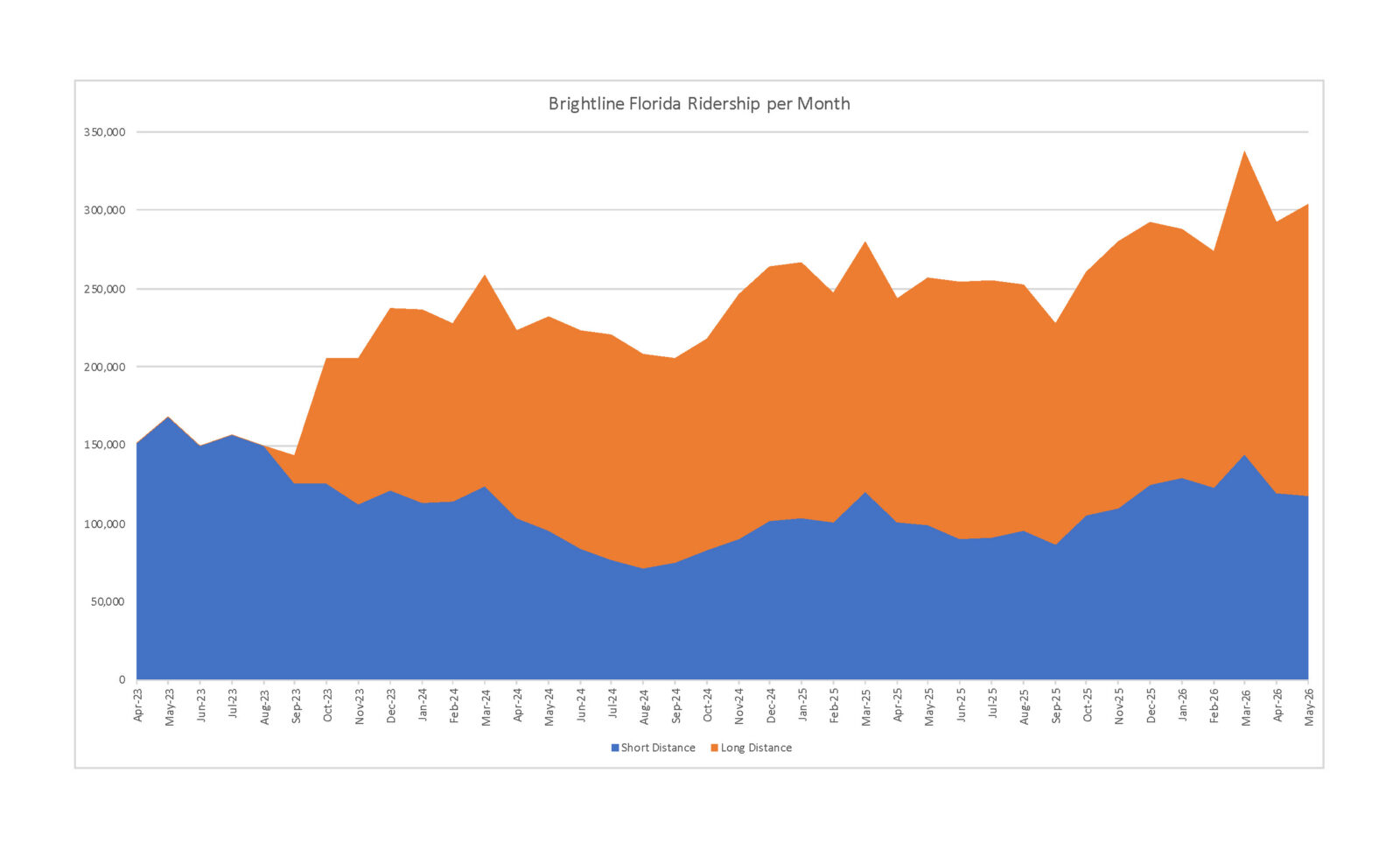
In addition to rapid overall growth, this graph shows that Brightline intentionally reduced the number of short-distance tickets to focus on growing the long-distance market.
- “Short Distance” refers to any city pair between Miami and West Palm Beach.
- “Long Distance” refers to a trip between any city and Orlando.
Sold-out trains from day one
Miami – Orlando service launched in September 2023 with 16 daily round trips using 240-seat (four-car) trains. Brightline had intended to launch with 450-seat (seven-car) trains, but the Siemens factory was too backlogged to meet their launch. (The largest Southwest jet has 175 seats.)
All of Brightline’s 2024 ridership reports stated that demand exceeded supply, and roughly 30% of trains were sold out in many months. Loyal short-distance riders were intentionally turned away in order to build the more profitable long-distance market.
Trains were expanded to 306 seats (five cars) in October 2024, then 372 seats (six cars) in April 2025.
Two improvements have set the stage for dramatic growth in 2026.
- October 2025: Service was restructured, sacrificing a few long-distance round trips in order to add short-distance frequencies during the peaks. Now, there are at least 10 long-distance round trips per day, plus an additional eight short-distance round trips. (Service levels vary by the day of week.)
- December 2025: Long-distance trains were expanded to 601 seats (10 cars), up from 240 seats (four cars) at the beginning of 2024. As a result, January through May ridership this year increased more than 27%, from 1,177,708 in 2024 to 1,497,337 in 2026.
In short, the demand for good train service in south Florida has been strong all along. Brightline’s surging ridership over the past two years is driven by supply catching up with demand.
In addition to the capacity constraints, other comparisons with Brightline support a more optimistic outcome elsewhere. The Chicago – St. Louis Corridor is just one example.
Comparing Brightline to Chicago – St. Louis high-speed rail
Chicago – St. Louis will be much faster.
Brightline takes three hours and 34 minutes to cover the 235 miles between Miami and Orlando, for an average speed of just 66 mph.
Today’s typical Chicago – St. Louis train takes five hours to cover the ~280-mile route, at an average speed of about 56 mph. High-speed rail will double the top speed and cut the trip time to just two hours and 20 minutes.
Data from the new high-speed lines in Europe and Japan suggests that 2.5 hours is the ridership tipping point for train travel, i.e., the point at which a productive day trip becomes practical. You can be in the destination city by mid-morning, have several hours for work or leisure, and be home by the evening. And the quick train trip makes up for the travel time to a downtown train station from suburban locations.
But this 2.5-hour tipping point isn’t just about shifting people from flying or driving to taking the train. It’s also about creating demand. Many executives, families, and tourists will make a fast, low-stress train trip—but would stay home if they had to deal with the costs and hassles of driving or flying.
Multiple studies have shown that a trip of two hours and 20 minutes (an average speed of ~125 mph) is viable for the Chicago – St. Louis line, crossing that critical tipping point.
Orlando’s train station is poorly located.
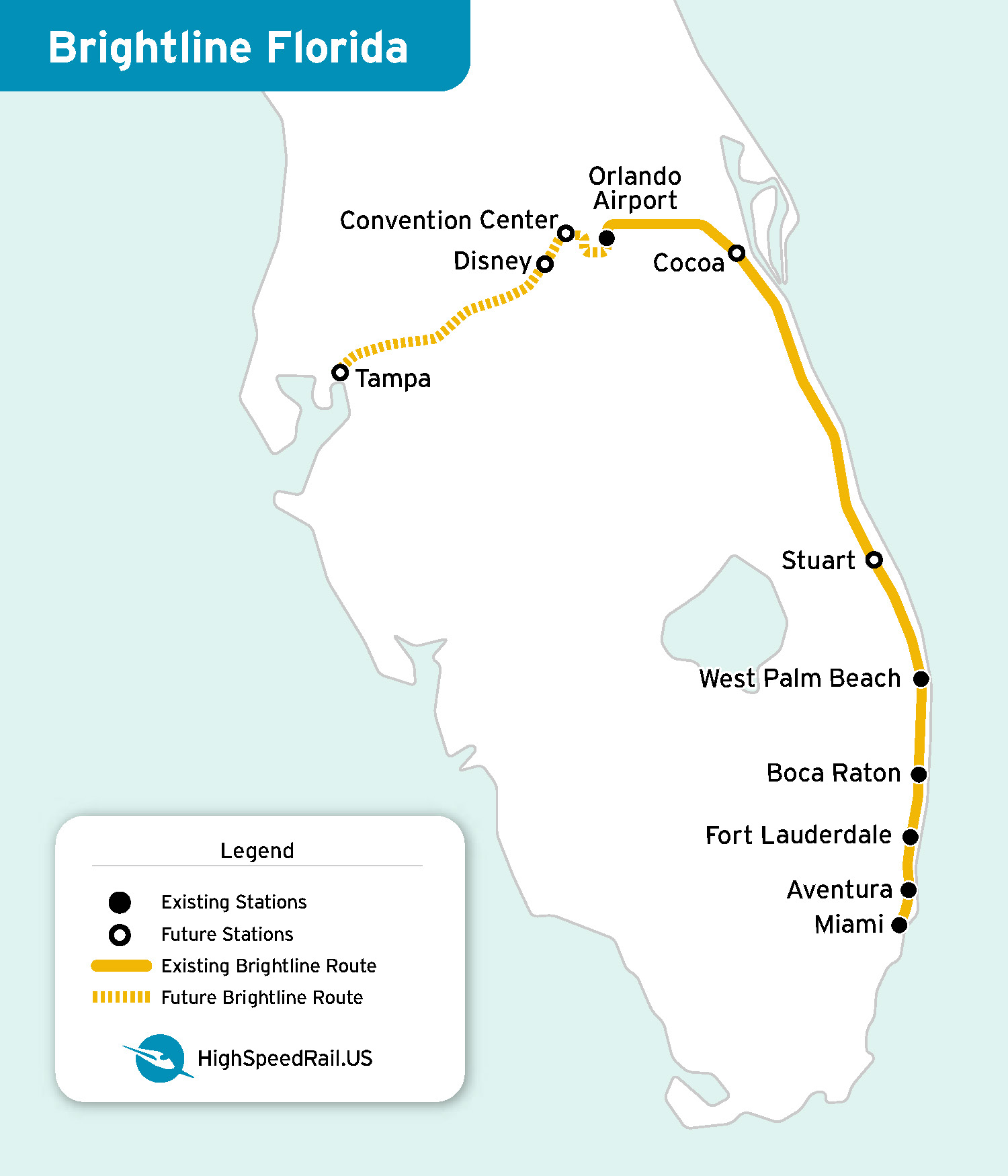
Brightline is located in Orlando International Airport’s Terminal C, so there is no potential real estate development around the station. Even worse, it’s isolated from the local bus transit routes in Terminal A.
This means that NO local customers have easy access to the train. Brightline also lacks adequate parking space at the Orlando airport, so access is limited for both drivers and transit riders.
Fortunately, a planned extension to the Convention Center and the Disney campus—and a connecting train to downtown Orlando—will improve Brightline’s potential moving forward.
For the Chicago – St. Louis line, an interim station at East St. Louis would have a convenient connection to downtown and the St. Louis suburbs via the Metrolink light rail line and highways. It could also become a hub for local and intercity bus lines, and there is excellent potential for economic development around the station.
Miami isn’t Chicago.
Chicago has a dense core and an excellent train and transit network, with CTA, Metra, Amtrak, and South Shore Line connections. The Chicago market is more vibrant—and more accustomed to using trains and transit—than the Miami market.
It’s also much bigger. About 9.5 million people live in the Chicago metropolitan statistical area (MSA), versus 6.5 million in the Miami MSA. Meanwhile, the St. Louis and Orlando MSAs are nearly identical in population. Both are home to about 3 million people.
Final thoughts
Brightline Florida’s surging ridership underscores two important points.
First, the demand for train service in the U.S. is exceptionally strong. When Americans have a choice, they choose trains—even relatively slow trains. World-class, high-speed trains will take demand to a new level.
Second, there’s no equivalent to trains’ capacity to respond to surging demand—quickly, economically, and sustainably. Consider that the 10-car trains Brightline currently uses for its long-distance routes have a capacity of 600 people. That’s more than three times the capacity of the most commonly used passenger jets.
Brightline shows that conventional trains can leverage this advantage to some extent. But creating a dramatic mode shift—from flying and driving to taking the train—will mean getting the trip time to under 2.5 hours. And that will mean building a high-speed line.
The success in Florida helps paint an optimistic picture of high-speed rail as a great tool for Illinois and America.
Get Involved
Tell Congress: It’s time to reconnect the country with high-speed and regional rail!
The Latest from HSRA
Our Latest Blog Posts
Check out the latest news, updates, and high speed rail insights from our blog!