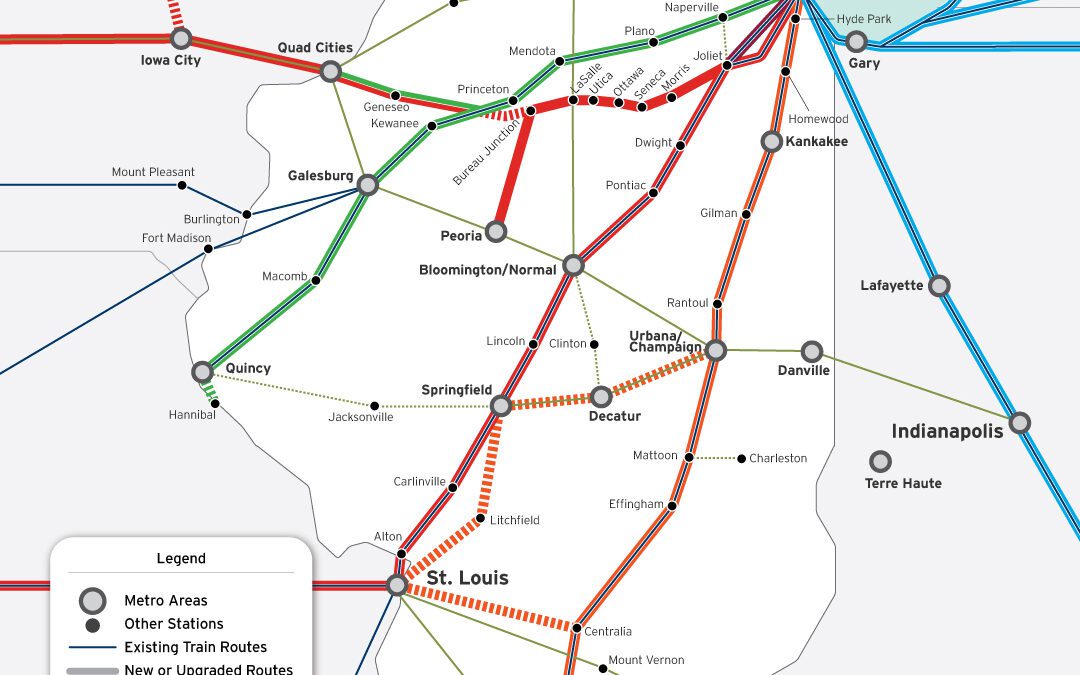
You can provide feedback to IDOT through October 2026. The Illinois Department of Transportation (IDOT) is working to update the 2023 State Rail Plan, with a final draft expected July 2027. State rail plans set future goals for freight and passenger rail. They can be...
A big step in the right direction
Amtrak and Penn Transformation Partners have outlined a path toward overhauling New York Penn Station based on a study released by the Federal Railroad Administration in July.
The study signals a new, improved, and long-overdue approach to modernizing Penn. It is Phase 1 of the study with Phase 2 scheduled for release in 2028.
People have been working to fix the station for decades. And there’s been significant progress in the last five years, including a new Long Island Rail Road concourse and Moynihan Train Hall.
But until now, no one was willing to grapple with Penn’s core problems:
- It takes too long to get people on and off the trains (i.e., “dwell time”)
- The track layout is inefficient
- The operating culture makes these problem worse—and prevents solutions
The FRA’s new study is the first to propose a fundamental, ground-up rethinking of how Penn Station could substantially expand capacity within its current footprint.
It turns out that a new, unified, single-level concourse is the key to unlocking solutions.
Note: Check out these excellent concourse maps to understanding their issues.
Why updating Penn is urgent
The original Penn Station was demolished in 1963 to make way for Madison Square Garden and an office building. Everyone laments the loss of the old, beautiful Penn building. But that station wouldn’t function today even if it were still standing.
The original track layout, platforms, and stairs were left intact. And the 1968 building largely replicated the old concourse layout. So, until 2002, Penn Station functioned as it was originally designed, even if it’s now uglier and feels cramped.
Penn Station simply wasn’t designed for great volume of large trains, and the number of people per train, that it now serves.
Building a separate concourse for NJ Transit (2002), the West End Concourse (2017), the Moynihan Train Hall for Amtrak (2021), and rehabbing the Long Island Rail Road concourse (2023) helped. But they failed to address the core problems. In fact, Moynihan Train Hall contributes to Amtrak’s unacceptable dwell times and the disjointed approach makes navigating the station difficult.
It’s already beyond its limit. And a lot more train traffic is coming.
A new Hudson River tunnel will double capacity on the station’s west side—to 48 trains hourly in the peak direction—in 2038. Meanwhile, Metro-North Railroad plans to offer direct service to Penn from the Bronx (for the first time) by 2030.
Slashing dwell times
The easiest way to get more people and trains through the station is to get people on and off the train faster. But the narrow platforms, restricted stairways, and concentrated boarding areas get in the way.
Ideally, the track layout would be rebuilt to allow wider platforms. But the current level of traffic—and the columns supporting the buildings above—make a full reconstruction very difficult.
The report outlines several alternative steps:
- Get everything off the platforms that doesn’t have to be there (poorly situated trash bins, for example)
- Install new stairways, escalators, and elevators (“vertical circulation elements”)
- Make it easy to use multiple stairs to board (“distributed boarding”)
Accomplishing Steps 2 and 3 requires a new approach to the concourse.
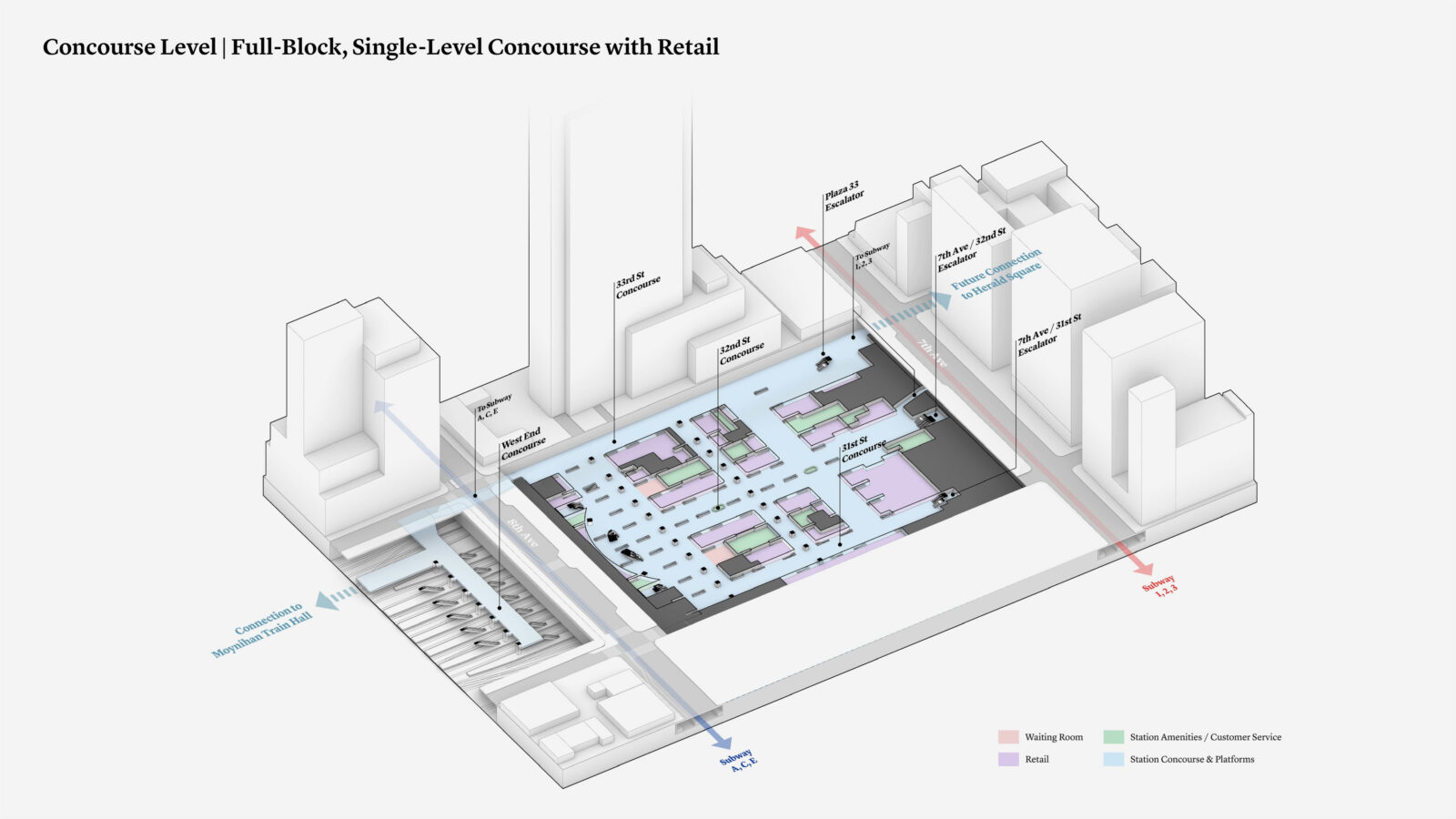
Infosys Theater and the single-level concourse solution
Removing Infosys Theater, which is sandwiched between the concourse below and Madison Square Garden above, is the key. (See where the theater is located in the sixth image.)
Buying and removing the theater would allow 100 supporting columns to be removed—a big step toward decluttering the platforms. It would also create space for a unified, single-level Penn Station concourse with 55-foot-high ceilings, substantial retail and restaurant space, and plenty of natural light (in sharp contrast to the current basement facility).
But the new concourse is about much more than amenities and aesthetics. It would allow for a 33% increase in stairs, elevators, and escalators, which are needed to clear the platforms more quickly.
Creating a unified concourse would also make it possible to distribute boarding passengers along the entire length of the platform—and closer to their assigned car (on trains with assigned seating). This combination of better spacing and more stairs, elevators, and escalators would mean much less congestion and much faster, more fluid movement on the platforms.
As things stand, Amtrak boarding is a particularly acute problem. Boarding through Moynihan Train Hall causes substantial delays, as everyone waits to ride a single escalator to reach the platform. And that escalator deposits everyone at one end of the train, regardless of which car they need to board.
Experienced passengers know that they can wait for their train to be called in the old concourse—and save time by skipping the line. But the logistics of communicating which stair is best would be daunting in the current layout.
With a unified concourse and assigned seating, passengers could be directed to the stair/escalator closest to the car they need. The result: Trains would load much faster.
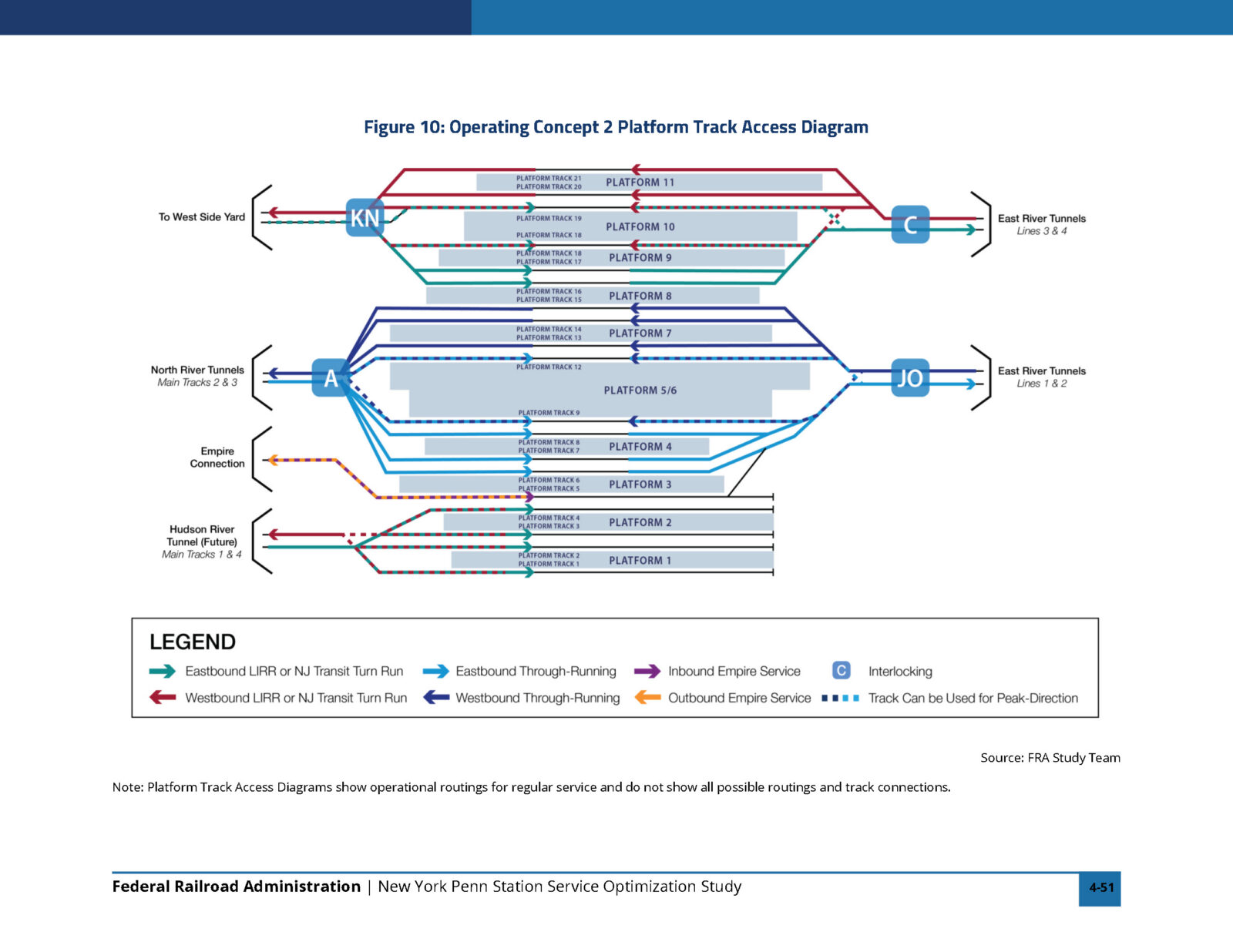
The report described one potential hybrid operating scenario that combines through-running in the middle and terminating trains on either side.
Through-running and other operating issues
In addition to addressing long dwell times, the report notes and outlines potential solutions for operational and cultural issues that slow trains down at Penn.
For example, it suggests lengthening the platforms for Tracks 1-4 to allow full-length NJ Transit trains to berth there, and it broaches the idea of one double-wide platform for through-running regional rail trains.
Importantly, this is the first time the network modeling software Rail Traffic Controller has been used, at least in part, to test through-running operating scenarios within the footprint of today’s Penn Station.
Enhancing through-running capacity is crucial. Through-running trains have low dwell times and make a line more useful to more potential riders.
The failure of past planners to seriously consider through-running solutions at Penn has been a major point of contention, especially in the controversy over the now-canceled Penn Station South idea. That project would have cost roughly $16 billion and it would have demolished an entire city block.
The great news
This Phase 1 study does not go far enough in addressing foundational problems—notably, the fact that three railroads (soon to be four) have used Penn for decades but have so far failed to cooperate on creating a unified operating plan to maximize its potential. And, Amtrak hasn’t yet figured out how to handle 48 trains per hour through the west end.
But the study does create a framework for getting construction underway. In fact, the project’s lead, Andy Byford, has said that Amtrak aims to begin construction in late 2027, even before the study’s second phase is completed in 2028.
Obviously, many details still need to be worked out and clarified—especially with regard to the track layout and through-running challenges—in that document.
So the great news isn’t that the FRA has put forward a detailed plan. The great news is that an agency is finally asking the right questions—and working from the right premises—about Penn’s untapped potential.
That’s major progress in itself.
Get Involved
Tell Congress: It’s time to reconnect the country with high-speed and regional rail!
The Latest from HSRA
Our Latest Blog Posts
Check out the latest news, updates, and high speed rail insights from our blog!