The Wisconsin cities of Kenosha, Milwaukee and Racine have revived an effort to initiate passenger rail service among the three cities. This is an opportunity to create a high-quality regional rail line between Chicago and Milwaukee. Representatives of the three...
Canada High-Speed Rail Project Shifts to Higher Gear, Aims to Bust Through Bureaucracy
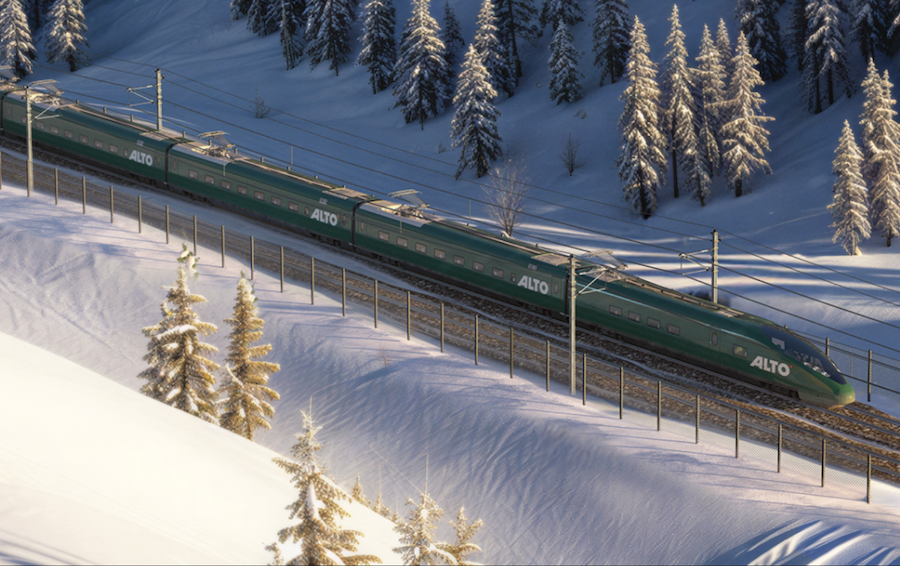
Canada is moving to smooth the way for a roughly 600-mile high-speed line that will connect Toronto and Quebec City with trains running at top speeds of at least 186 mph. Canada’s Transport Minister, Steven Mackinnon, announced this week that work is expected to begin on the line’s first, 125-mile segment—running from Montreal to Ottawa—in 2029.
The country’s Liberal Party has proposed a bill, currently under review in Parliament, that would accelerate planning, design, and engineering on the line by exempting the project from review by the Canadian Transportation Agency.
Pre-approving the project will reduce or eliminate processes that often stall major projects. And it would give Alto—the “Crown corporation” created to build the line—enhanced powers to purchase the right of way. For example, it could expropriate land without first negotiating with landowners, and the relevant minister of public services would not be required to hold a public hearing to respond to objections (as is currently the case).
Alto estimates that the region that will be served by the line is home to 18 million people, or roughly 60 percent of Canada’s adult population. The line will cut the travel time between Toronto and Quebec City to about 4.5 hours (versus a drive time of nearly 8.5 hours). The popular Toronto-Montreal route will be about 3 hours (versus 5.5 hours driving).
Alto held its first public meeting in August, after former Prime Minister Justin Trudeau announced the project’s launch in February. Officials initially estimated then that the full line would be completed by the early 2040s.
Since then, they’ve aimed to build support for the project by eliminating obstacles and accelerating the project’s timeline. Notably, the high-speed line became part of Canada’s Major Projects Office (MPO), which launched in August and supports transformative infrastructure projects in Canada. On the Alto line specifically, it will help streamline the engineering, regulatory, and permitting work needed to begin construction.
Skeptics have pushed back on Alto’s ambitious plans based on Canada’s many false starts and broken promises regarding HSR in the past, the practical challenges of establishing a route for the line, and the technical complexities of building it.
Get Involved
Tell Congress: It’s time to reconnect the country with high-speed and regional rail!
Amtrak and VIA Rail: brothers by a different mother
For all the political tensions between Canada and the US recently—and the differences between them across many realms—the two countries have a very similar relationship to railroad development.
As with Amtrak, Canada’s conventional passenger-rail trains—operated by VIA Rail—run on tracks owned by freight railroads. And VIA Rail, like Amtrak, is criticized for its low speeds and poor on-time performance record. This week, for example, VIA Rail made news because passengers were stranded on one of its trains overnight—for 12 hours—because of a broken-down train ahead of it on the tracks. VIA’s ontime performance from 2018 to 2022 ranged from 57 to 72 percent, versus about 90 percent for European passenger trains. Amtrak’s average ontime performance is 75 percent.
Canadian officials have said that they expect the VIA trains will continue to run once the Toronto-Quebec City high-speed line is operational.
In the realm of high-speed rail, California’s project actually puts the US ahead of Canada, where proposals have been floated for decades without any tangible results or concrete movement forward.
That and similar failures to build infrastructure in Canada have led to Canada’s own version of “abundance” debate in the US, sparked by the recent book with that title by Ezra Klein and Derek Thompson.
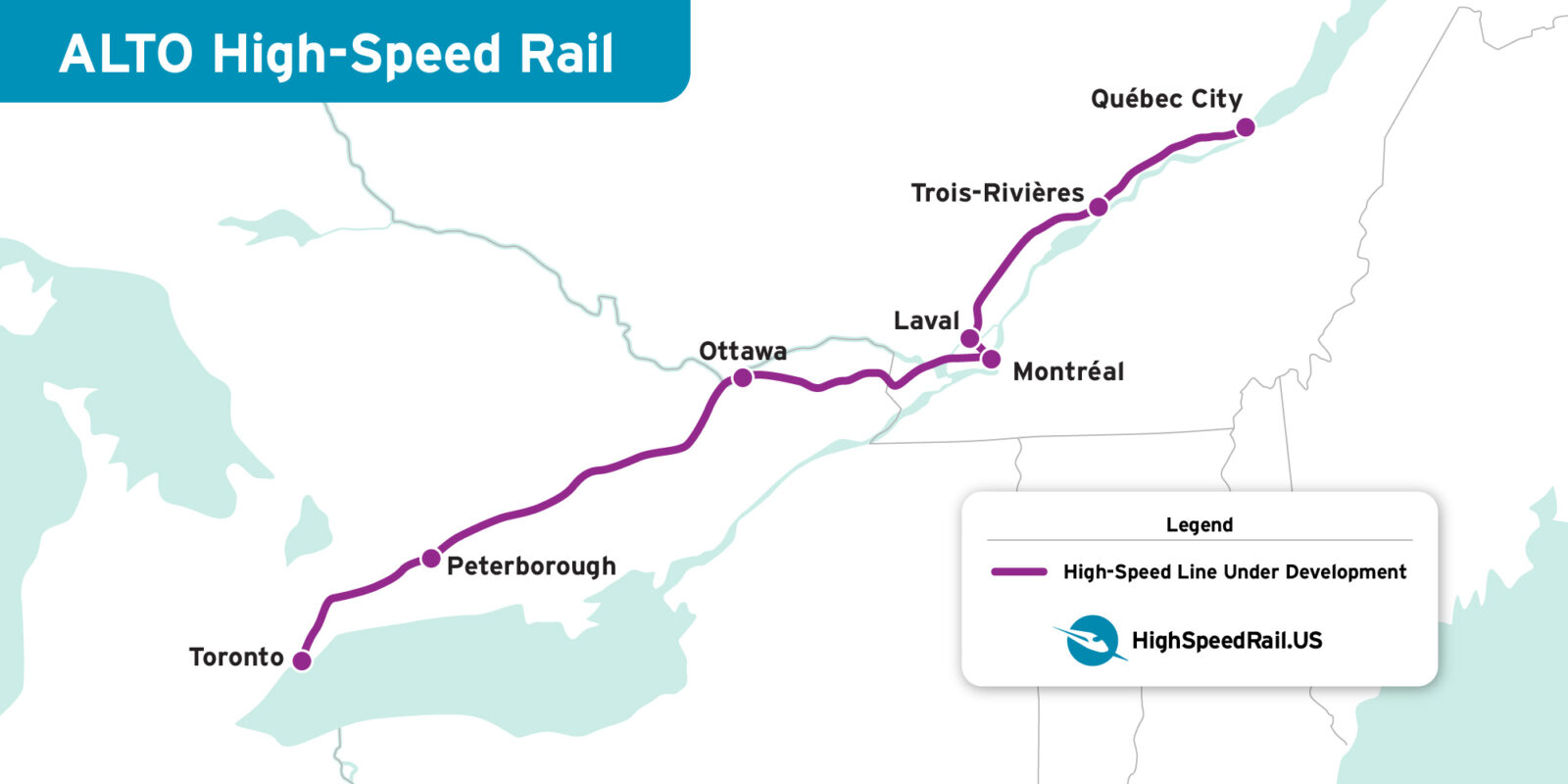
Canada is planning a roughly 600-mile high-speed line that will connect Toronto and Quebec City with trains running at top speeds of at least 186 mph.
Canada’s many wrong turns
The Abundance authors use delays in California’s project as a case study in how red tape and regulation often derail infrastructure projects in the US. Meanwhile, observers in Canada also point to HSR to underscore the country’s infrastructure failures—and understand the sources.
For example, on a recent CBC podcast devoted to the topic, transportation planner Reece Martin argued that Canada often commissions study after study as a way to delay building HSR. “This is just lighting enormous amounts of taxpayer money on fire,” he said. Canada has also failed to learn the lessons of the countries that are building high-speed rail most successfully, such as France.
“We’ve adopted a lot of practices that were originally created in the United Kingdom, like public-private partnerships,” Martin said. And that has “taken us down the path the United Kingdom has gone down, which is of projects that get more and more expensive because public-private partnerships don’t actually make projects more affordable.”
Martin also observed that the key to success in France—and other countries at the cutting edge of HSR—is that “they learn from their mistakes and they keep building. . . . The issue in Canada is that we’re afraid to invest, we’re afraid to take any risks. The status quo—it doesn’t work well, but it works. So people ask, ‘Why should we take the risk?’”
Trains = abundance
Despite all that, there is a strong consensus that the payoffs of high-speed rail would be immense.
A report released this year, for example, found that the Toronto-Quebec City line would boost Canada’s GDP by about $25 billion (Canadian) annually. That’s more than 1 percent of national GDP. It would also spur the building of more than 60,000 residential units near stations.
So high-speed rail harmonizes with the “abundance” agenda by boosting economic growth, building the tax base, adding to the housing supply, and increasing productivity—while also reducing the number of car trips and short-haul flights between cities on the line. Passenger rail’s current mode share on the popular Toronto-Montreal route, for example, is currently just 10 percent. It is projected to rise to 40 percent when Alto is operational, with the share of short-haul flights declining from 32 to 19 percent.
As an Alto-produced publication pitched the benefits, “Imagine finding a job in a different city without needing to relocate or sharing your knowledge and passion with 700,000 students attending more than 30 colleges and universities along the Corridor.”
Workers, students, and families could travel throughout the 600-mile corridor “without an expensive and exhausting journey, without worrying about whether you will make it there on time, without the crippling frustration of highway congestion, costly flight delays or cancellations, and without the anxiety of missing those important moments.”
Let’s do more than imagine it. Please join the Alliance in bringing trains’ “abundance” to communities across North America.
The Latest from HSRA
Our Latest Blog Posts
Check out the latest news, updates, and high speed rail insights from our blog!