You can provide feedback to IDOT through October 2026. The Illinois Department of Transportation (IDOT) is working to update the 2023 State Rail Plan, with a final draft expected July 2027. State rail plans set future goals for freight and passenger rail. They can be...
Madison, WI Station Site Is Crucial to Developing Regional Rail

The City of Madison tackles the station location challenge
The City of Madison Department of Transportation recently released a study of potential train station sites. It identified a first choice and a “Plan B” alternative from a list of nine contenders. Two other sites could be reconsidered if the top two prove unworkable.
The study is a great opportunity for Madison’s civic leaders and advocates to adopt an optimistic vision for the city’s future.
That vision should prioritize shifting how people travel — from cars to trains — with the goal of giving everyone in the region easy, affordable access to Madison without requiring a car.
This is an ambitious goal, given that the Wisconsin Legislature has long been hostile to passenger rail. But isn’t it time to demand and prepare for a new era of train travel in Wisconsin?
What if Madison’s train station were the busiest place in town, with trains to and from Milwaukee and Chicago every hour, and to and from St. Paul at least 10 times each day?
What if Madison’s civic, business, and activist communities got behind a transformative proposal like this, and worked with communities statewide to build support for it?
What if this coalition motivated and supported similar efforts across the country?
It’s possible. Right now, the Alliance and its partners are pushing for bolder visions for great train service—and stations—in towns and cities throughout America.
By joining us, you’ll support these efforts—and build stronger organizing muscle for great trains.
Join Us!
Your involvement will help push bolder visions for great train service—and stations—throughout America!
4x the ridership
Madison is supporting two related service proposals—one by the Wisconsin Department of Transportation and one by Amtrak.
- The Wisconsin Department of Transportation is in Step 1 of the Corridor ID process for the Milwaukee – Madison – Eau Claire – St. Paul corridor. Initially, three or four daily Chicago – Milwaukee Hiawatha trains would extend to Madison. A launch is possible in 2032, if the Legislature funds the necessary work. Trains would continue to St. Paul at a later date.
- Amtrak is considering extending just two daily Chicago – Milwaukee Hiawatha round trips to Madison. This service is at least five years away.
The Madison Department of Transportation study assumes a modest 250,000 passengers per year, which is comparable to several similar cities that have only a few trains per day. Since the Legislature has shown little will to invest in better train service, that assumption is reasonable.
But if there were fast, frequent trains going to more places throughout the region, the picture would look completely different. Passenger counts could quadruple.
For example: The study mentions a potential direct route to Chicago via Janesville, Wisconsin. With the addition of a convenient connection, it could also provide service to O’Hare Airport.
The state isn’t currently considering that route. But with reasonable investments, the Janesville route could provide hourly departures and a two-hour trip to Chicago’s Ogilvie Station. That’s an hour faster than the proposed three-hour trip to Chicago’s Union Station via Milwaukee and half the time of today’s four-hour bus trip.
If this and frequent service to Milwaukee, Green Bay, and St. Paul, were in play, Madison’s station would handle more than 1 million passengers annually.
Madison’s preferred station location
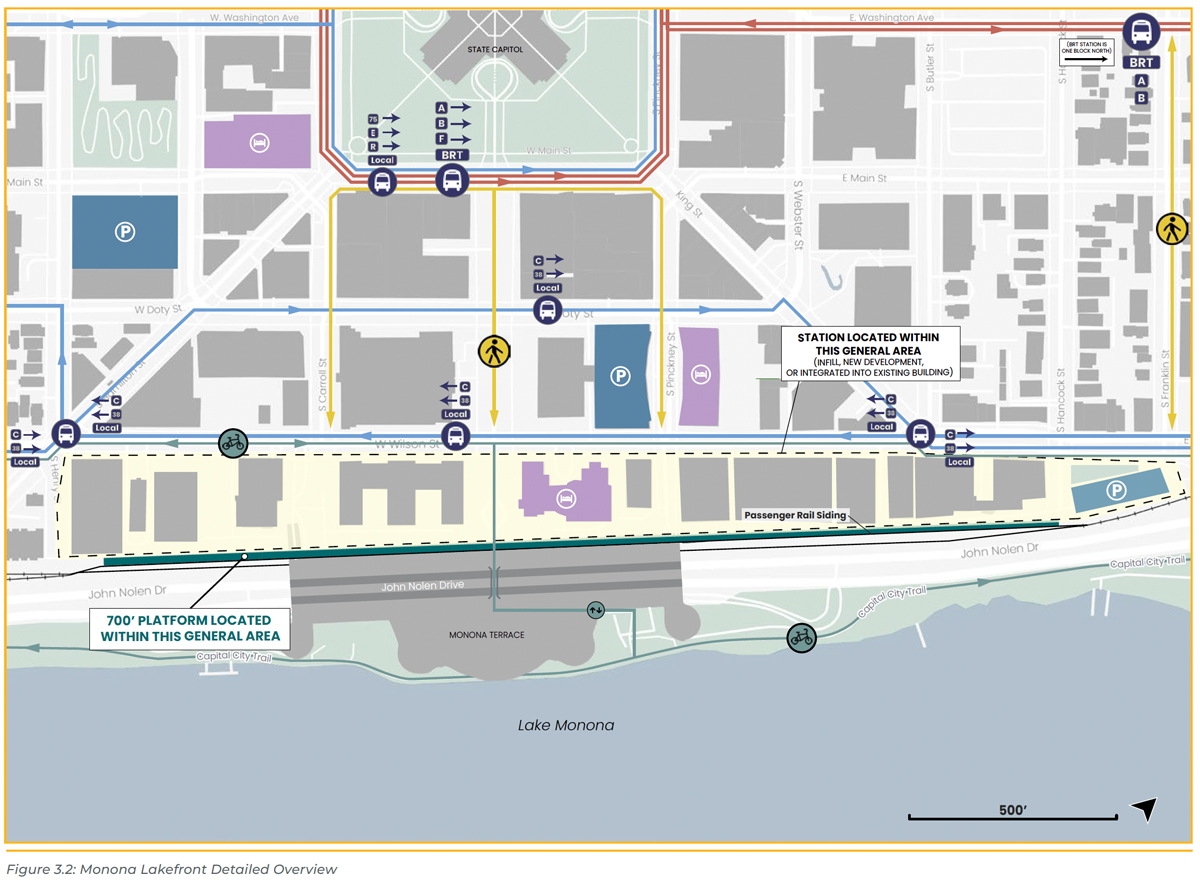
Madison’s preferred location, called Monona Lakefront, is under the Monona Terrace Convention Center. The site has a lot of appeal:
- It’s a few blocks from the State Capitol.
- It’s a short walk to the University of Wisconsin.
- Several bus routes run nearby.
- There’s an existing parking garage.
Christof Spieler, Madison’s director of transportation, told the Wisconsin State Journal that a downtown station “really does the best in terms of getting people to Madison.”
On the other hand, the site is constrained by:
- A six-lane state highway on one side and a bluff on the other.
- Columns supporting Monona Terrace and its parking garage.
- A dangerous highway crossing at one end.
The upshot is that there’s barely enough room for a single, short station platform.
The study did not identify a location for the station building or how to connect it to the platform. But since will be on the bluff, it will require elevators.
The study also notes that a storage track for overnighting trains will be needed but isn’t available at the Monona Lakefront.
Most importantly, there is no room at this site to grow beyond the minimal starter services proposed by Amtrak and the Wisconsin Department of Transportation.
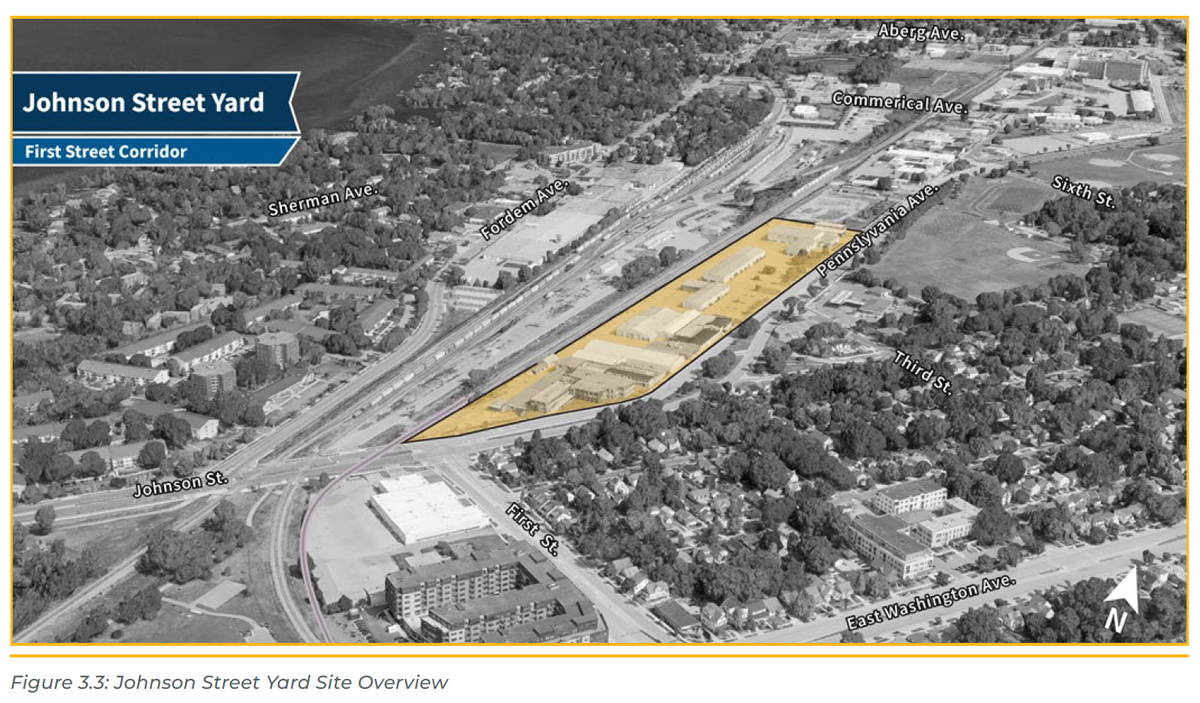
Plan B: Johnson Street Yard
The city report identified the Johnson Street Yard as its second choice. The great advantage of Johnson Street Yard is its size. It’s large enough to build the needed facilities.
But, according to the study, “it would be much less convenient for students and people living downtown, and the site would be very inconvenient for anybody traveling to or from the south or west side of Madison.” Also, “trains ending in Madison would lose ridership and revenue compared to a downtown option.”
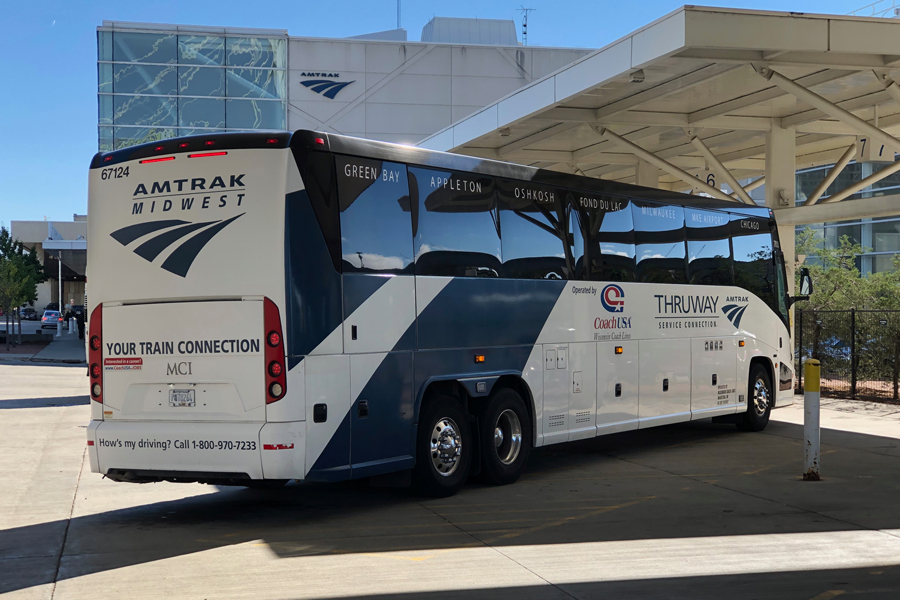
Milwaukee Intermodal Terminal is a nearby example of a great railway station.
What a next-level station would look like
In Madison, a transformative station will have these features, at minimum:
Multiple tracks and platforms: If three train routes serve Madison, there will be at least six train movements during the peak hour—i.e., a train to and from each of Chicago, Milwaukee, and St. Paul – which means at least four tracks and two center-island platforms will be needed.
Intercity and transit bus connections: Madison has no bus station. Instead, several intercity bus lines stop curbside on the University of Wisconsin campus. Having a combined train station and inter-city bus station, as Milwaukee has, will make the bus more attractive and make connections between trains and buses more convenient. Connections to multiple transit routes, including the city’s express bus corridor, are also essential.
“Kiss and ride” convenience: It should be easy to access the station by taxi, ride-hail, and personal drop-offs.
Walkability: Walking and rolling access to downtown is of course essential.
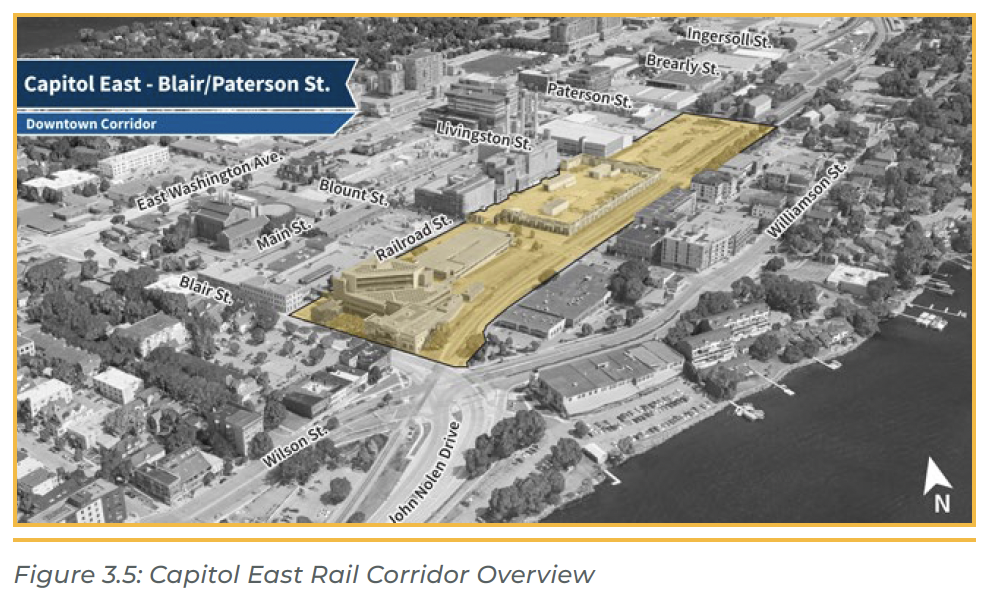
One site deserves a much closer look
With these aims for the station in mind, the Capitol East Rail Corridor, not recommended in the report but not rejected, looks much more attractive.
Owned by Madison Gas and Electric, it stretches three blocks—from Blair Street to Patterson Street. The former Chicago and North Western Railway station, which has been converted to office space, is at the west end. The two eastern blocks are a storage yard that was the site of the coal pile for the decommissioned generating plant.
From the city’s perspective, the downsides are that it will require closing two streets and may have impacts on operations for Madison Gas and Electric, which means the utility company might not be willing to sell.
But the upside potential is huge.
For starters, construction will be simpler—and therefore less expensive – than both the Monona Lakefront and Johnson Street Yards sites.
More importantly, there appears to be enough space to build a multi-track railway station, an integrated bus station, and a convenient location for drop-offs and pick-ups by car. There’s even a large parking garage next door.
It’s also just a couple of blocks to the city’s new express bus corridor. And it’s a reasonable walk to downtown and the University of Wisconsin.
Some next steps
Madison’s study has placed the conversation about regional rail on center stage. Now it’s time to act. A coalition of civic and business leaders could advance the effort with concrete actions:
- Support Amtrak’s efforts to launch basic service as soon as possible.
- Push for Thruway buses that are timed to meet each train at Milwaukee, with a single Amtrak ticket.
- Provide input into the Milwaukee – St. Paul Corridor ID process to push for more meaningful outcomes sooner.
- Get the Madison – Janesville – Chicago Corridor added to the Wisconsin Department of Transportation agenda.
- Persuade the Legislature to fund engineering work and increased operations throughout the state.
These are significant steps toward establishing regional rail in Wisconsin.
Longer-term, we’ll need strong, committed advocacy dedicated to the prosperity of Madison, the state and the region.
By planning wisely and acting strategically now, we’ll create a better future for Madison—and the entire region.
Please join us to make it a reality.
Become a Member
The Latest from HSRA
Our Latest Blog Posts
Check out the latest news, updates, and high speed rail insights from our blog!