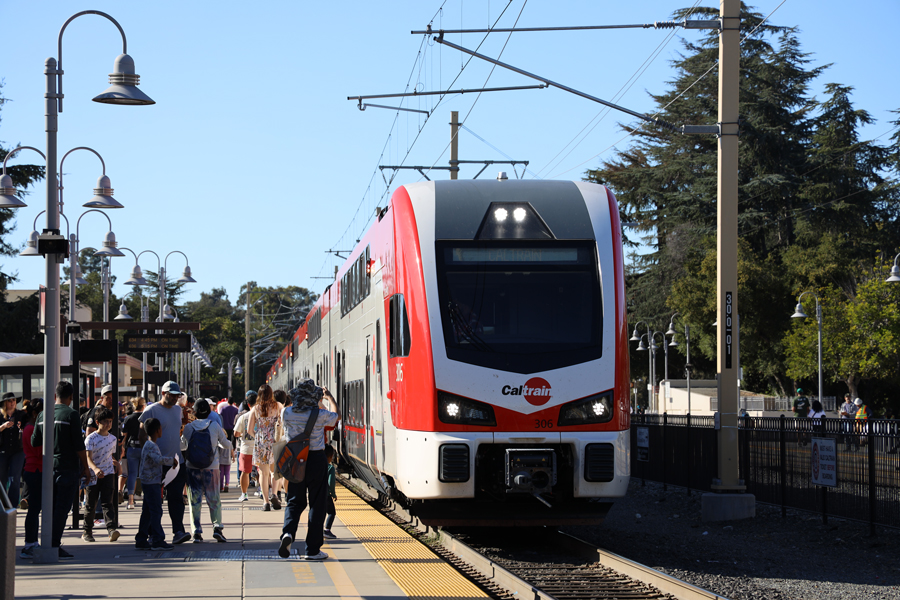
Faster speed, increased frequency, and more reliable service are causing ridership growth on Caltrain, the San Francisco Bay Area's passenger railway. The ridership increase and service upgrades are a direct result of the electrification of Caltrain’s entire fleet of...
The Union Station concourse should be a beautiful gateway to Chicago
It should also be a place where thousands of people connect between trains each day—easily and efficiently.
The current concourse serves neither purpose.
At a moment when Chicago aims to reinvent its downtown with more retail, housing, and experience-based attractions, bringing thousands more people into the heart of downtown every day—by train—is essential.
Which means city and state leaders should push Amtrak to think big about Union Station and how to make it the lifeblood of downtown’s growth and vitality.
They should start with an ambitious plan for a beautiful new concourse that prepares Union Station for a 10-fold increase in passenger traffic—and integrates train travel into the very fabric of the city’s life.
Get Involved
Tell Congress: It’s time to reconnect the country with high-speed and regional rail!
Two vital functions
Much like O’Hare International and Midway airports, Chicago Union Station performs two vital functions. The first is to serve passengers traveling to and from Chicago. In this capacity, an easy-to-use station that allows people to get from the street to the train (and vice versa) is essential.
The station’s second vital function is to help people traveling to another destination connect with their train.
Consider Chicago’s airports. About half of travelers never leave the terminals because they’re catching a connecting flight. Chicago benefits because “hub” airports handle bigger planes (which means more revenue for the city) and offer more frequent service to more places. For example, there isn’t enough demand in Chicago alone for daily service to Abu Dhabi. It’s possible only because connecting flights at O’Hare gather passengers from all over the country.
On a small scale, this happens today at Union Station. But the trains are too few and too poorly timed to make cross-region trips practical. That needs to be fixed, and connecting traffic in the concourse needs to increase dramatically.
Whether its from Naperville to Glenview, Champaign to O’Hare, Normal to Kalamazoo, or even Buffalo to Fargo—fixing Union Station is essential to creating reliable service across the country.
And fixing Union Station means building a bigger, more attractive, and easier-to-use concourse.
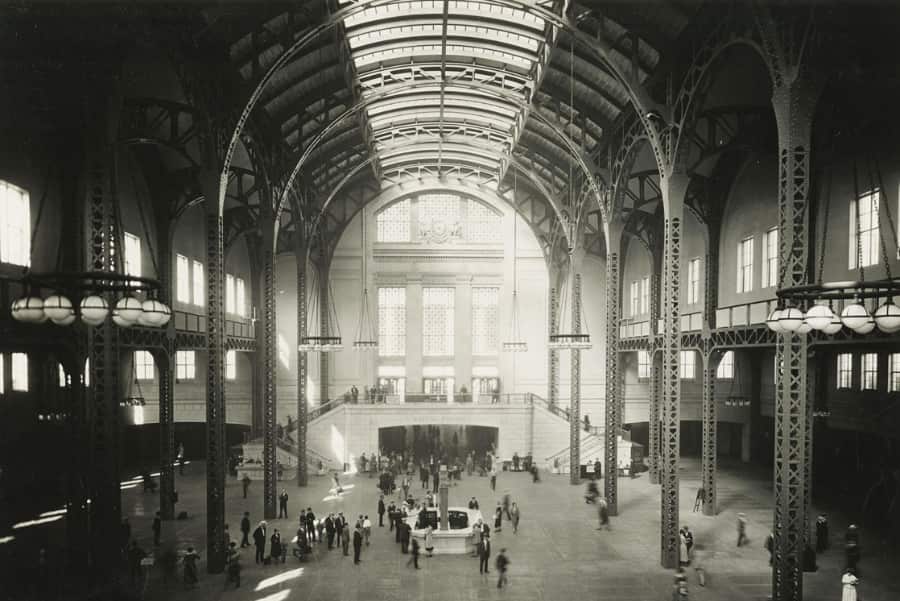
Union Station was designed as two back-to-back terminals with a open concourse in the middle.
What is the problem?
Union Station has an unusual design. In fact, it might be the only one of its kind.
The designers couldn’t imagine trains running through Chicago, apparently. So they built it as two stub-end terminals instead of a through station.
Adding insult to injury, Union Station’s spacious original concourse—with an open-floor plan—was demolished in 1969 after its owner sold the air-rights.
The concourse was then relegated to the basement of 222 S. Riverside, and it remains there—a drab collection of cramped waiting rooms and confusing passageways. Even if all the walls were removed, it would be a sea of columns blocking passenger movements.
Amtrak, which owns Union Station, recognizes the problem and is designing a range of improvements to the concourse, which have not been made public.
This is more than just an aesthetic failure. Having a great concourse is essential to region’s future.
For passenger traffic to grow at the pace we need, Union Station should serve as a hub, with passengers easily connecting between trains. The limited capacity of the current concourse prevents that—and acts as a brake on service expansion—at a time when demand for more intercity and regional trains into Chicago is surging.
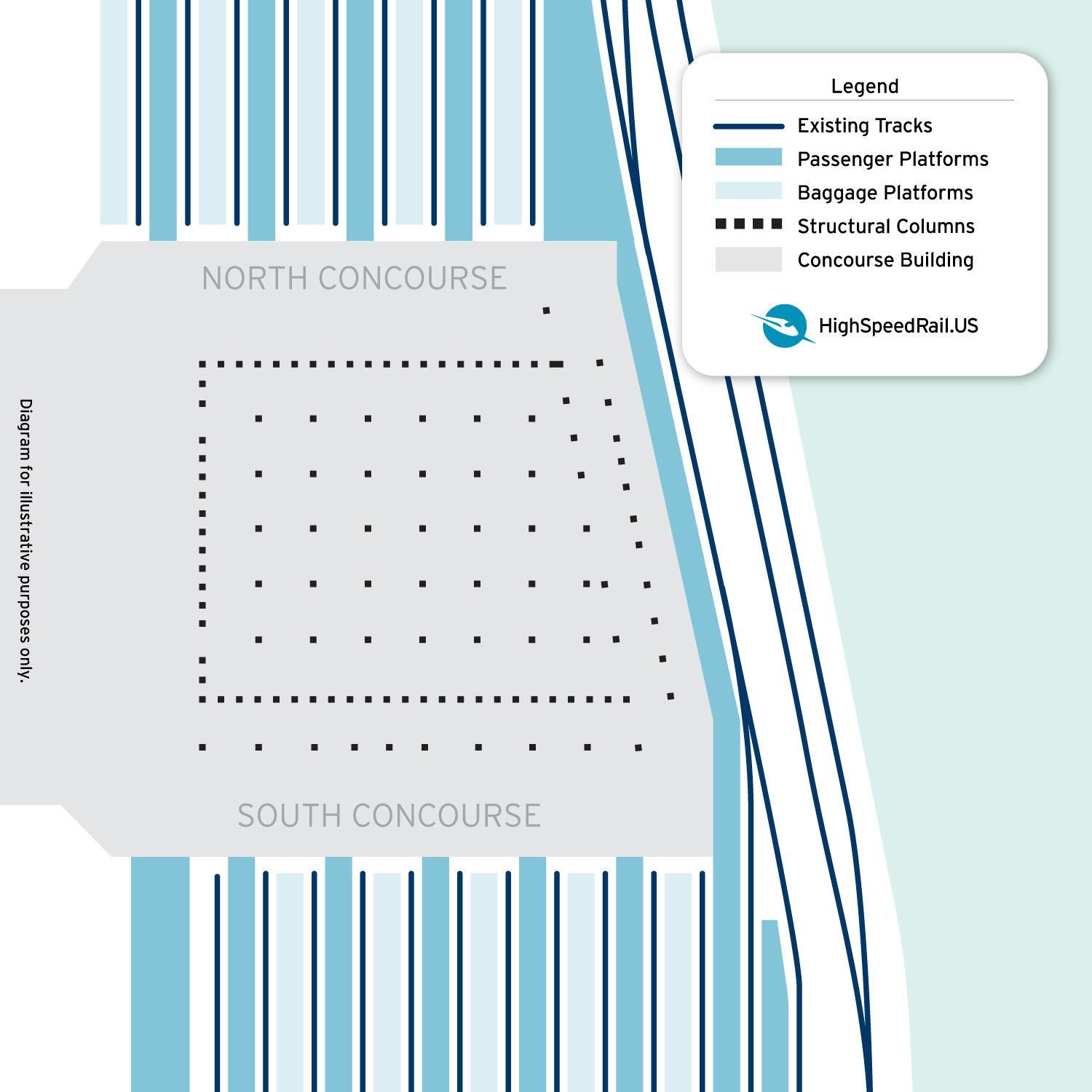
A sea of columns prevents the concourse from becoming an easy place to find your train.
A big fix is needed
For passenger traffic to grow at the pace we need, Union Station should serve as a hub, with passengers connecting easily between trains.
The limited capacity of the current concourse prevents that—and puts the brakes on service expansion—at a time when demand for more intercity and regional trains into Chicago is surging.
Ideally, Union Station would be completely rebuilt with through tracks and a concourse above. But getting that done will require modifying buildings and roads on a scale normally reserved for highway and airport infrastructure.
The Alliance has suggested some provisional fixes that include building a new station annex south of Van Buren (which will allow some trains to run through) and a direct walkway to Ogilvie Station (which will create stronger connections to the hundreds of daily departures from that facility).
And Amtrak has created its own designs for renovating Union Station. These have not been made public, but buying and razing 222 S. Riverside is clearly not on the table. Amtrak believes that the above goals can be achieved by working around the columns.
But, Amtrak’s goal is extremely limited. It hopes to simply double its own traffic by 2040.
Illinois and Chicago should intervene, push for a more ambitious goal of 10 times today’s traffic, and fight for the resources to achieve a much higher standard. With downtown vacancy rates at all-time highs—and commercial property values at a low point—this is the time to act.
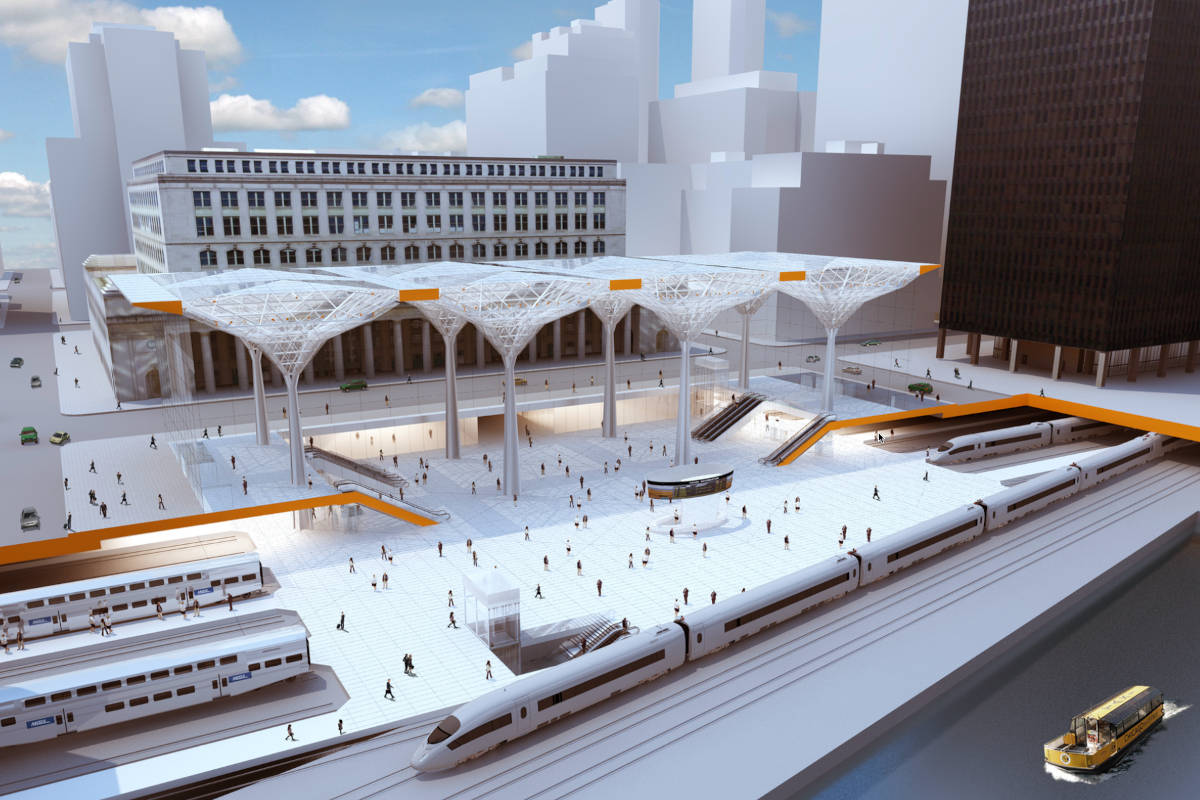
The concourse should serve as a “mixing bowl” in which passenger can easily find their way to the street or connect between trains. image: Solomon Cordwell Buenz
The stakes are immense.
A spacious and beautiful concourse will reset expectations for train travel in this region—and create the foundation for fully integrating train travel into the life of the city.
When that happens, finding and getting on a train—headed across town or across state lines—will be as easy and routine as getting in a car. It will also be faster, safer, less stressful, more comfortable, and more affordable.
And Union Station will be an economic engine of Chicago, with thousands more people moving through the facility each day. Those on their way to another destination will be able to easily find their connecting train. Many more will either walk or take transit to nearby destinations.
Either way, more trains running to Union Station will mean more people visiting—and living in—the heart of the city. They’ll shop, eat, and enjoy concerts and museums and other experiences in Chicago, which will revitalize our downtown and our economy.
The lever for making all of that happen is a new Union Station concourse.
The Latest from HSRA
Our Latest Blog Posts
Check out the latest news, updates, and high speed rail insights from our blog!