Take the SurveyWashington is designing a transformative high-speed line The Washington State Department of Transportation (WSDOT) is taking public comment on its study for a high-speed line between Portland, Seattle, and Vancouver, B.C. The study will be released in...
‘Death Train’ is scary headline, but need for safer crossings is real.
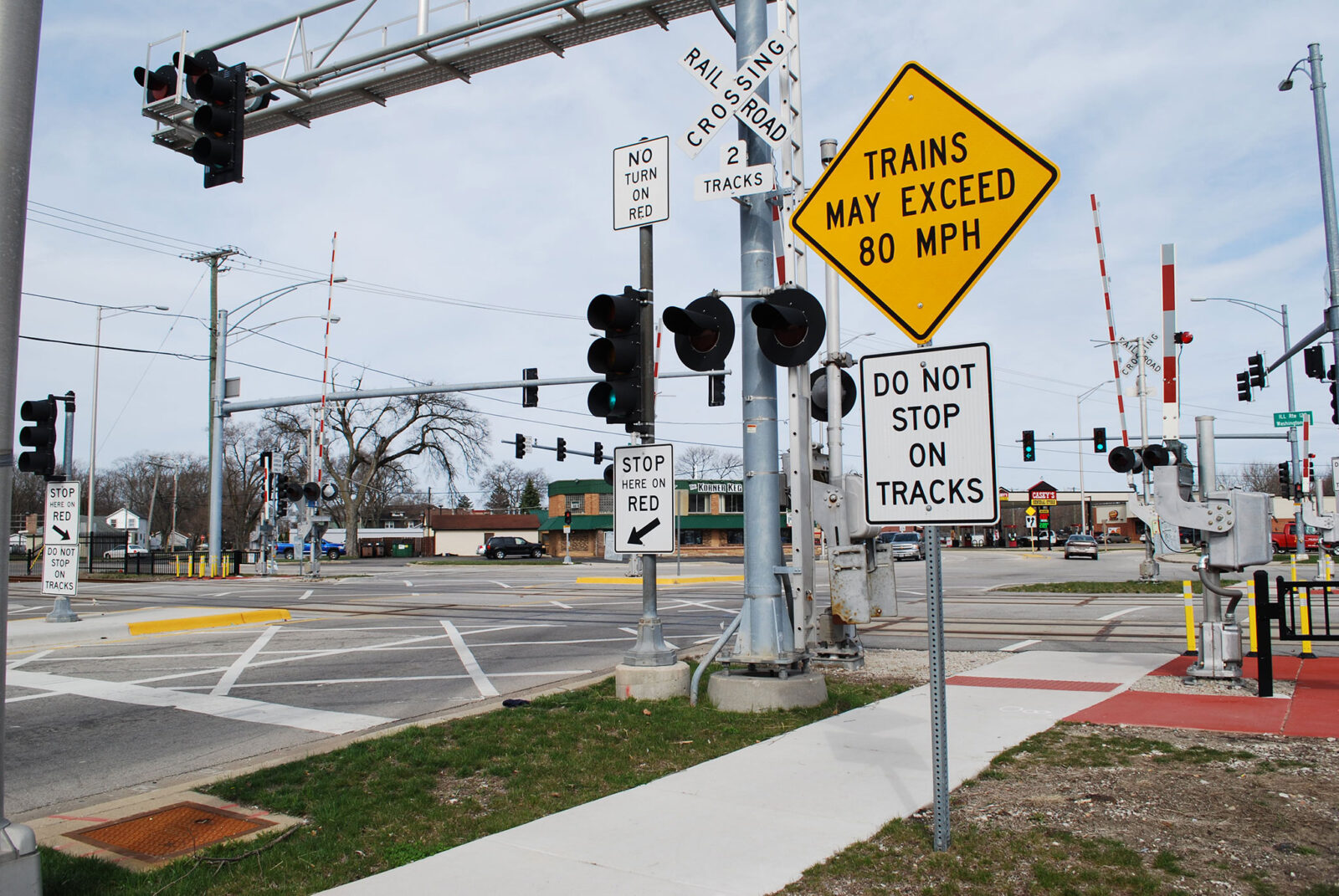
Pictured above: An upgraded highway crossing in 110 mph territory on the Chicago – St. Louis route.
The Brightline train in Florida is the “Death Train,” according to the Atlantic, owing to 185 fatalities since 2017, including 42 this year, mostly due to trains striking cars or pedestrians at grade-level crossings.
Despite its sensational headline and misidentification of Brightline as “high-speed rail,” the piece does spotlight a serious problem: The US has way too many dangerous highway/railway grade crossings.
Can you make a donation today to help get them fixed?
Often, there isn’t much sympathy for the victims: They shouldn’t have tried to cross the tracks when a train was coming. But a careful evaluation of the circumstances reveals that many crossings are set up in such a way that a driver or pedestrian can be confused, or where a moment of carelessness results in needless death.
The question here isn’t who is at fault. The question is whether and how these incidents can be prevented. It will take a big federal program to close, separate, or improve crossings across the country.
Trains striking cars and people is a national problem, and has been since the invention of trains and cars. In 2024 in the U.S. there were 262 fatalities and 763 injuries at 2,261 road-rail grade crossing collisions, according to Federal Railroad Administration data compiled by Operation Lifesaver.
Operation Lifesaver is a non-profit founded by the Union Pacific Railroad in Idaho in 1972 to promote the message “Stop, Look and Listen” at road-rail crossings.
The number of collisions and casualties – fatalities and injuries – has been steady for about 20 years, but it used to be consistently greater. The annual number of collisions has been usually in the 2,000s since 2006. It was usually in the 3,000s from 1997-2005. It was 9,461 in 1981, with 728 fatalities.
This is an important issue for us as advocates for high-speed and regional rail. Running fast, frequent trains through dense suburban and urban areas requires substantial investments in grade-crossing safety.
Here’s an example of a problem: Federal rules require a train engineer to sound the train horn 15 to 20 seconds before a road crossing, but no more than a quarter-mile away if the train is traveling over 60 mph, even if that results in a shorter warning time.
For trains traveling 90 mph, the quarter-mile warning is short – about 10 seconds. Further, a driver or pedestrian who sees a train coming may be accustomed to a 30 mph freight train, and be unable to estimate that a 90 mph passenger train is coming three times as fast, which may lead them to make poor decisions.
Again, this discussion is not about who’s to blame for poor decisions. It’s about finding ways to prevent death, injury and property damage.
There are three options:
- Construct grade-separated crossings.
- Close road-rail crossings that are little used, especially if there’s another crossing nearby.
- Upgrade road-rail crossings so that they occur at right angles, and have four-quadrant gates, median separators, longer gate arms, pedestrian gates and signal monitoring to assure the railroad knows immediately if equipment isn’t working properly.
There are examples of these measures being successfully taken. In the 1990s, North Carolina implemented the Sealed Corridor Program, which provided safety upgrades at 189 crossings between Charlotte and Raleigh. Gate violations fell by two-thirds to almost 100%, depending on the nature and extent of the upgrades. Work continues to this day on the construction of grade separations.
In Illinois, when the Amtrak route between Joliet and Alton was upgraded to 110 mph in the 2010s, a number of safety efforts were implemented, including upgrades to warning systems, new crossing surfaces, the installation of four-quadrant gates, and the closure of some crossings. The state also installed fences where the tracks run through towns to prevent pedestrians from casually crossing the tracks at un-approved locations. The fences also reduced wildlife incursions.
The High Speed Rail Alliance helped secure money for those upgrades.
Safety must not be an afterthought with highway crossings. Connecting America with great trains will take this kind of nuts-and-bolts investment.
We’ve done it before. Between 1900 and World War I, many cities successfully separated roads and railways within city limits, keeping people and vehicles off the tracks. Then, cities had the leverage to pressure private railroads to pay for upgrades.
But massive highway and housing subsidies over the past century pushed development far beyond the city boundaries. Safety upgrades have lagged far behind. Private railroads can’t or won’t fill the vacuum.
We have to push the federal government to take the lead on a national program. It’s a matter of both road and railway safety.
Can you make a donation today to help get a solution?
The Latest from HSRA
Our Latest Blog Posts
Check out the latest news, updates, and high speed rail insights from our blog!