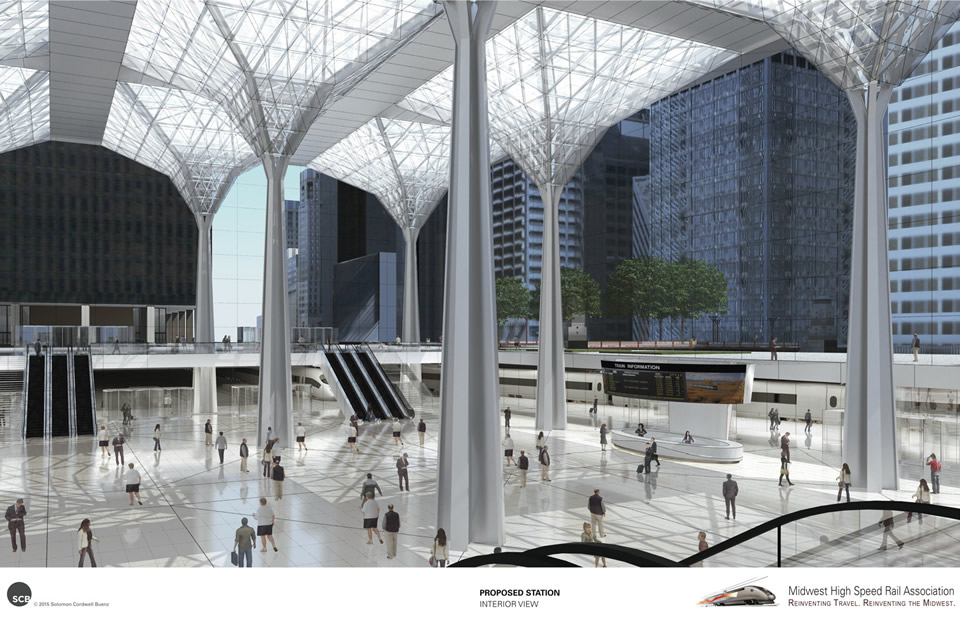
The Union Station concourse should be a beautiful gateway to Chicago It should also be a place where thousands of people connect between trains each day—easily and efficiently. The current concourse serves neither purpose. At a moment when Chicago aims to reinvent its...
It’s time to Make Chicago’s Union and Ogilvie Stations Work as One
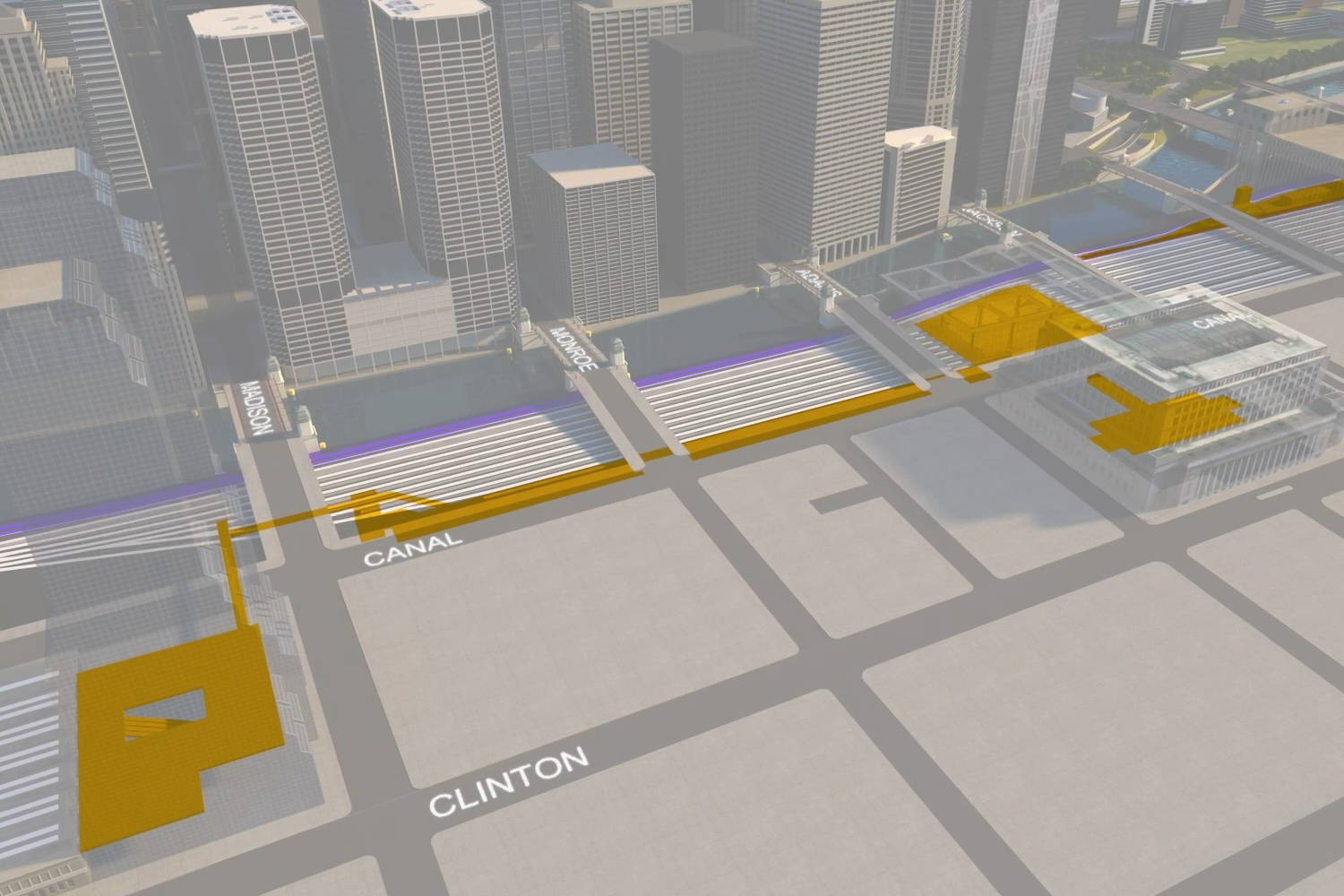
Connecting Chicago Union Station and Ogilvie Station is a low-cost gain for great trains in Chicago and the country.
They are so close together
The two busiest stations in downtown Chicago – Union Station and Ogilvie Station – are really close together. The entrance to the Union Station North Concourse is cater-corner from the Ogilvie main entrance. From main entrance to main entrance is a six-minute walk.
Yet, they don’t feel close together. They function separately, forcing passengers to go outside to get from one to the other.
The two stations should function virtually as one station, making it easy for people to connect between trains in both stations.
The result: a much-improved transportation hub in downtown Chicago, and a step towards making Union Station a transformative economic asset for the city and the region.
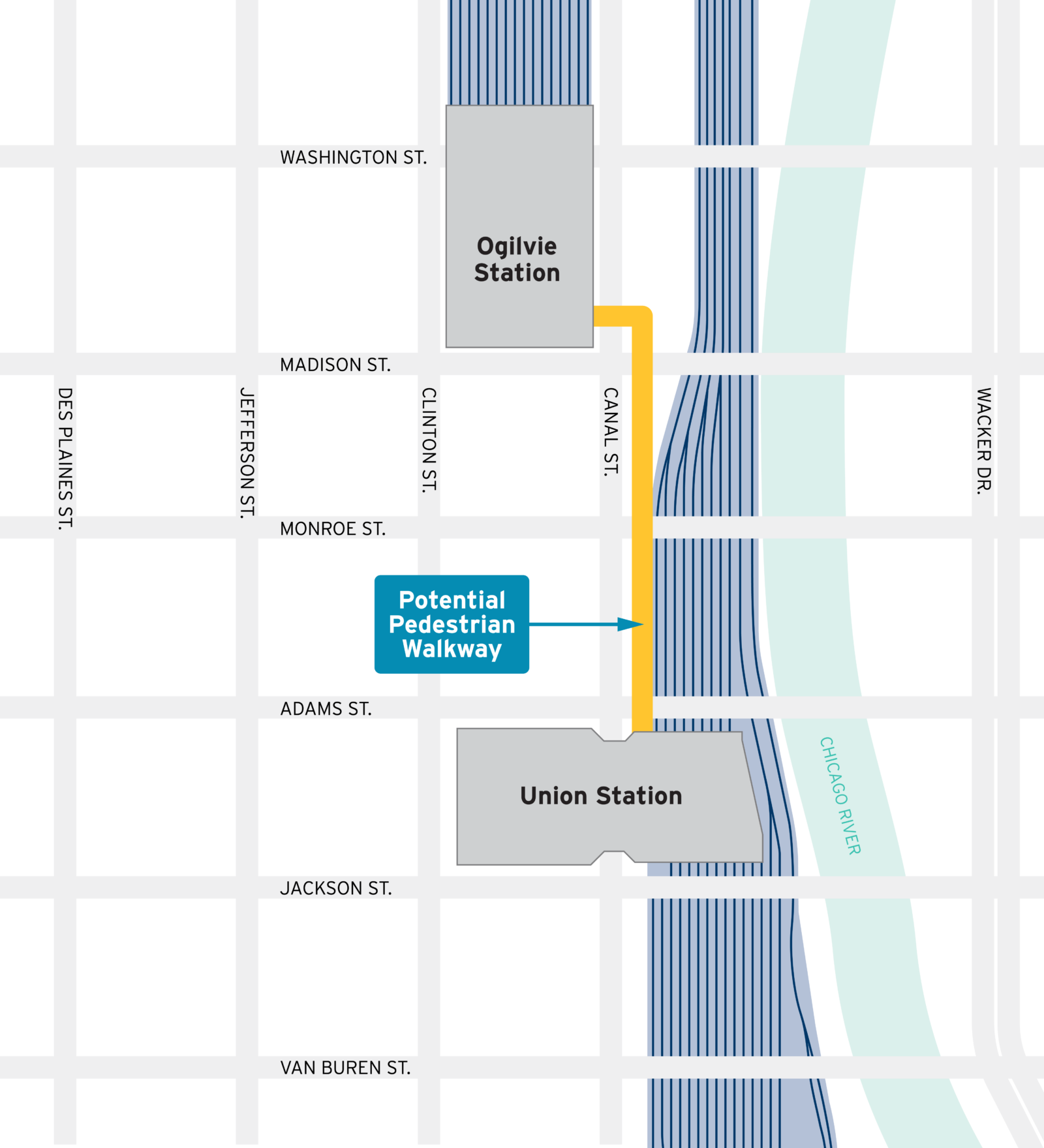
An indoor walkway would be the first step towards making Chicago Union Station and Ogilvie Station work as one.
An easy (and low-cost) improvement
Connecting the two stations should be a relatively easy fix. It requires two steps:
- Build a weather-protected walkway the connects the Union Station concourse to the Ogilvie Station concourse;
- Install shared departure boards for all trains at both stations.
With these low-cost fixes, passengers can see train times and move to platforms at both stations.
This work should be a priority; it’s an easy win for commuters and intercity rail passengers arriving and connecting in Chicago.
Building a stronger hub
Much like O’Hare International and Midway airports, Union Station and Ogilvie should perform two vital functions.
Gateway to Chicago: The first is to serve passengers traveling to and from Chicago.
National Hub: The stations’ second vital function is to help people traveling to another destination connect with their train.
Consider Chicago’s airports. About half of travelers never leave the terminals because they’re catching a connecting flight. Chicago benefits because “hub” airports handle bigger planes (which means more revenue for the city) and offer more frequent service to more places.
Making more connections
There are more than 100 trains coming into Ogilvie station every day.
Making it attractive to change between stations is an essential first step towards regional rail and will feed passengers to Amtrak’s long-distance trains.
More options northward
Integrating Ogilvie and Union would make achieving hourly departures to Madison and Milwaukee easier.
Today, there is no service to Madison. There are only seven trains a day to Milwaukee.
Two lines that originate at Ogilvie offer a solution.
Extending the Union Pacific Northwest Line roughly 60 miles from Harvard to Madison could yield a trip of under two hours. And, with only one or two freights trains on the route, achieving hourly departures is realistic.
For Milwaukee, extending Union Pacific North Line roughly 35 miles from Kenosha offers a path around the highly congested Metra and Canadian Pacific tracks that Amtrak uses today. Like the Union Pacific Nnorthwest Line, the Union Pacific North has almost no freight trains, making it a prime candidate for regional rail.
And, with unified train departure boards and ticketing, passengers can easily use trains on either route.
Building the connection
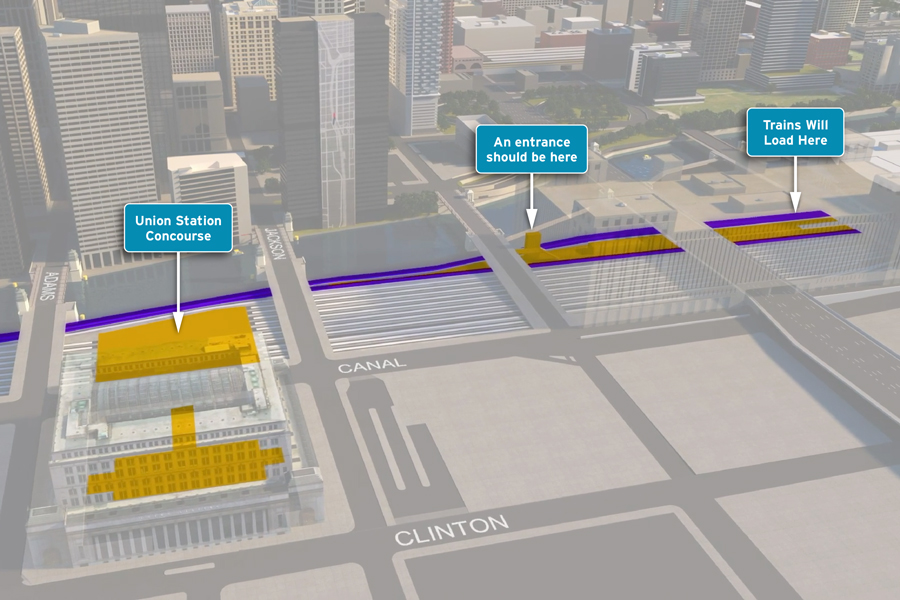
Amtrak has already proposed building an indoor walkway along Track 1 to a new elevator at the southeast corner of Canal and Madison. But then, people will still have to cross two sides of this busy intersection.
A better solution would be to continue on to an elevator in 2 N. Riverside Plaza building and connecting to the existing walkway over Canal Street. Or perhaps, a new pedestrian bridge over the intersection is required.
In any case, it will require the City of Chicago to coordinate the owners of the various properties to make it a reality.
We are not aware of any proposals to provide unified departure boards, but Amtrak and Metra should work to make it a reality.
Low-cost gains
All of this can begin soon with improvements that are relatively low cost. They are viable solutions for rapidly expanding service in downtown Chicago while planning continues for through-running downtown.
The potential gain, bringing thousands more people to the downtown hub every day, will be enormous for Chicago and its economic vitality. Clearly, this downtown travel hub is a jewel of an economic asset waiting to be exploited.
To make it happen, we need strong business-sector support. Leaders should push for doubling ridership on Metra regional rail and growing ridership 10-times on the intercity routes coming into Chicago.
Get Involved
Tell Congress: It’s time to reconnect the country with high-speed and regional rail!
The Latest from HSRA
Our Latest Blog Posts
Check out the latest news, updates, and high speed rail insights from our blog!