A Car and Driver-style comparo for people who think "zero to 200" should only apply to supercars and motorcycles Guest post by HSRA Board Treasurer Matthew Roling When I was ten years old, I had a poster up on my wall of a cherry red Porsche 911 “whale tail”—it was...
Transforming the Metra Electric South Chicago Branch into the “Quantum Line” is an easy win.
The Northern Illinois Transit Authority (NITA) begins its work this year with a mission to integrate fares, schedules, and service between Metra and CTA. It needs an early, high-impact win. And the Metra Electric South Chicago Branch needs a champion. It’s a great place for NITA to start its work.
The line is already electrified, so the hardest and most expensive part is already done. In fact, it’s more like a CTA “L” line than any of Metra’s other routes. It runs through dense neighborhoods, stops at several key institutions, and intersects with multiple east-west CTA buses.
An electrified, rapid-transit line running right through the urban core should be one of Chicago’s great competitive advantages. Other cities are willing to pay dearly for similar capacity.
Chicago has had this asset for decades. It just doesn’t use it.
NITA can deliver on the South Chicago Branch’s promise—starting soon. That would mean:
- Offering a train every 10 minutes during the day
- Running them faster
- Accepting Ventra, to fully Integrate with the CTA system.
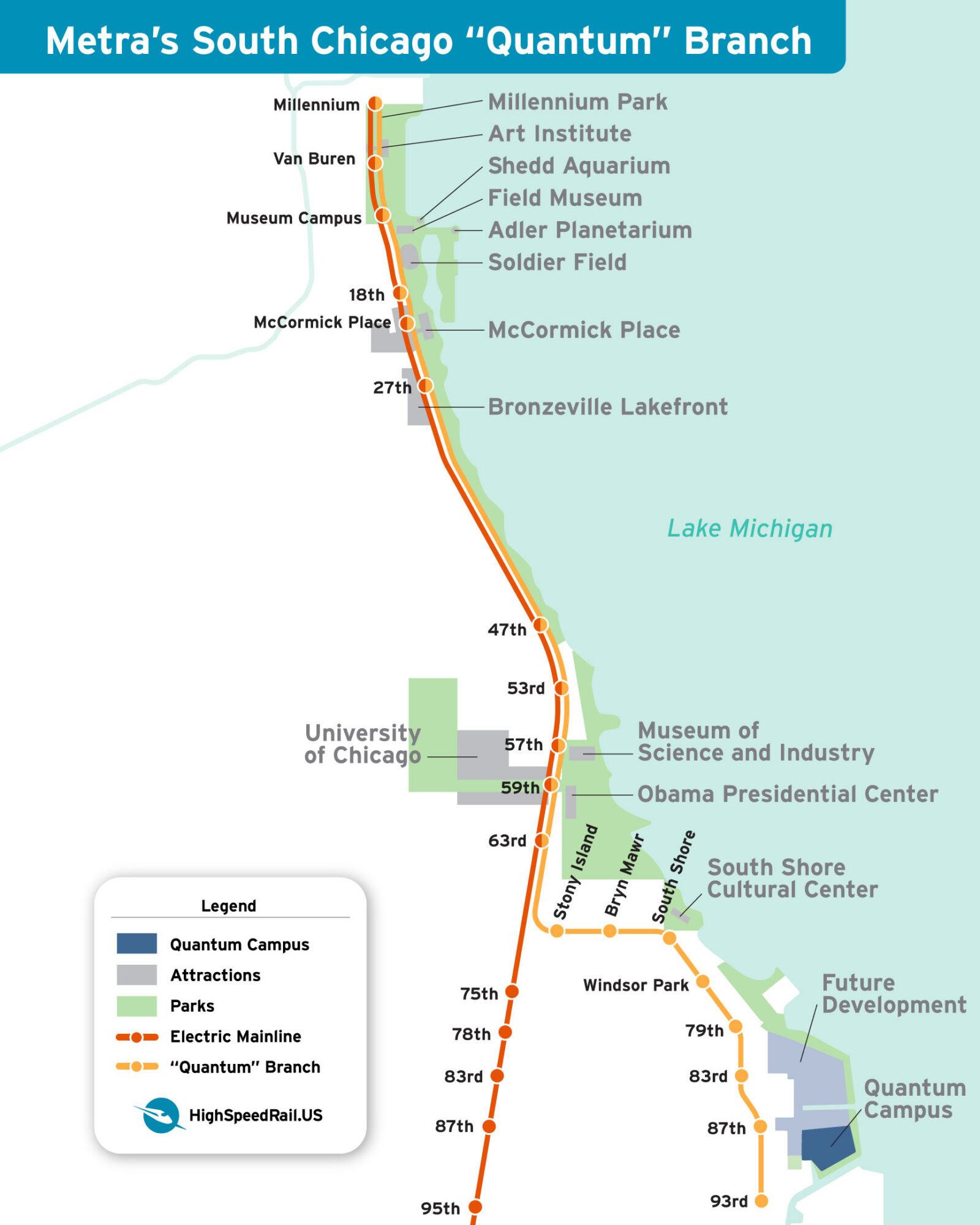
Metra’s South Chicago Branch connects Quantum and many other high-traffic destinations together.
A transformed South Chicago Branch will:
- Boost Quantum: The trains will serve Quantum Shore, a 440-acre lakefront development anchored by the Illinois Quantum and Electronics Park. It opens next year, with plans for a hospital and residential and retail space in the works. Connectivity and collaboration are key to its success. Fast, frequent trains will link it closely to the University of Chicago and downtown.
- Rebuild existing neighborhoods: South Shore and South Chicago have a combined population of a small city—about 85,000 people. More than a third of residents have no access to a vehicle. A transformed South Chicago Branch will give tens of thousands of people an easy, reliable, and affordable way to move around the city for work, school, and family obligations. And it will do what the city is spending nearly $6 billion to accomplish via the CTA Red Line extension: attract investment and jobs. An upgraded South Chicago Branch—at a small fraction of the Red Line extension’s cost—is a no-brainer.
- Connect key institutions: The city’s flagship convention center and beloved shoreline attractions—Millennium Park, Museum Campus, the Museum of Science and Industry, the Obama Presidential Center—attract millions of visitors every year. They’re vital to the city’s economy. They deserve better north/south transit than a slow and sporadic Metra line. Fast, frequent trains between them would be game-changing for tourists as well as the residents and small businesses in nearby communities.
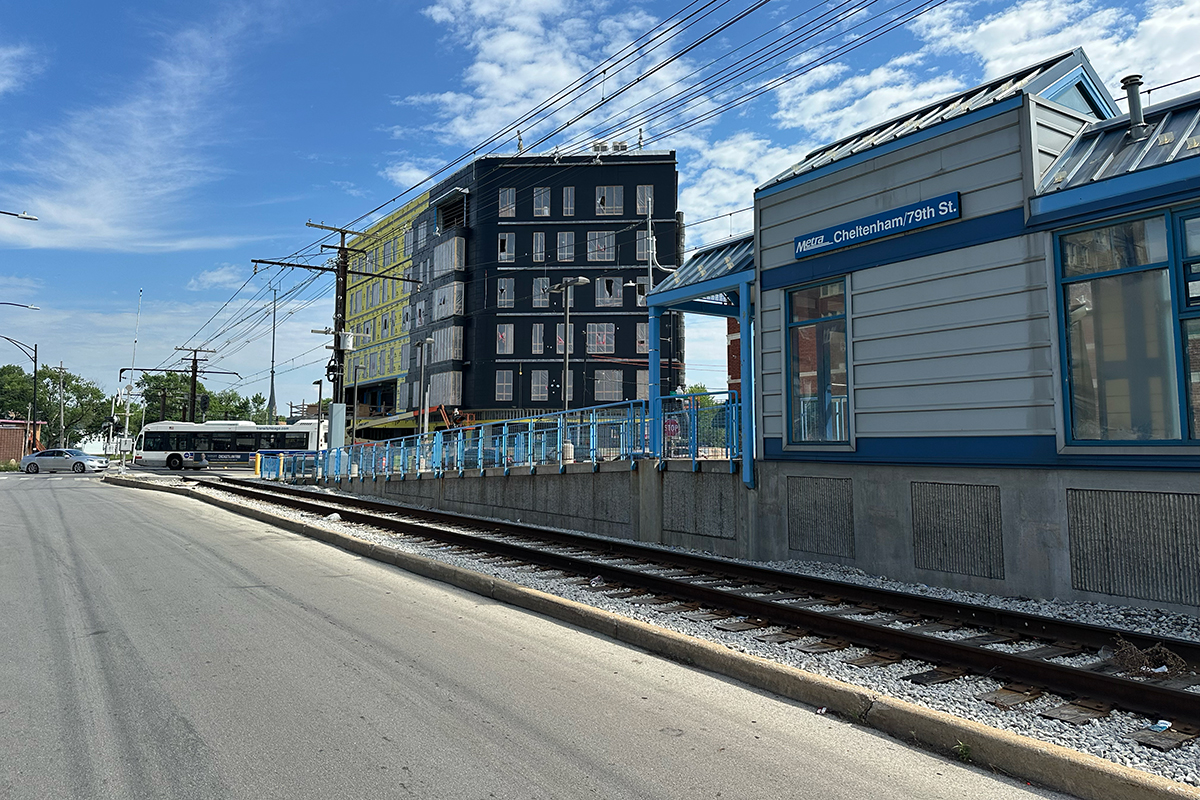
A new apartment building is under construction at the Cheltenham/79th station.
The Brown Line vs. the South Chicago Branch
Since its reconstruction in the early 2000s, the CTA Brown Line has driven strong growth in Near North/Northwest neighborhoods. The similarities between it and the South Chicago Branch are instructive. The differences are damning.
Both have level boarding, which is crucial to offering frequent service and handling high passenger volumes. Neither intersects with freight-train traffic—another key advantage.
But key differences limit the South Chicago Branch’s relevance and impact. The result is a line that’s a terrible fit with the needs of the market:
> Frequency: The Brown line operates every three minutes peak and every 15 minutes off-peak. The South Chicago Branch runs a train every 30 minutes peak and hourly off-peak.
> Fares: Metra charges $3.75 per ride compared to the Brown Line’s $2.50.
> Transfers: The South Chicago Branch has zero coordination with the CTA. Connecting passengers pay separate fares. Adding insult to injury, Metra and CTA have different payment methods.
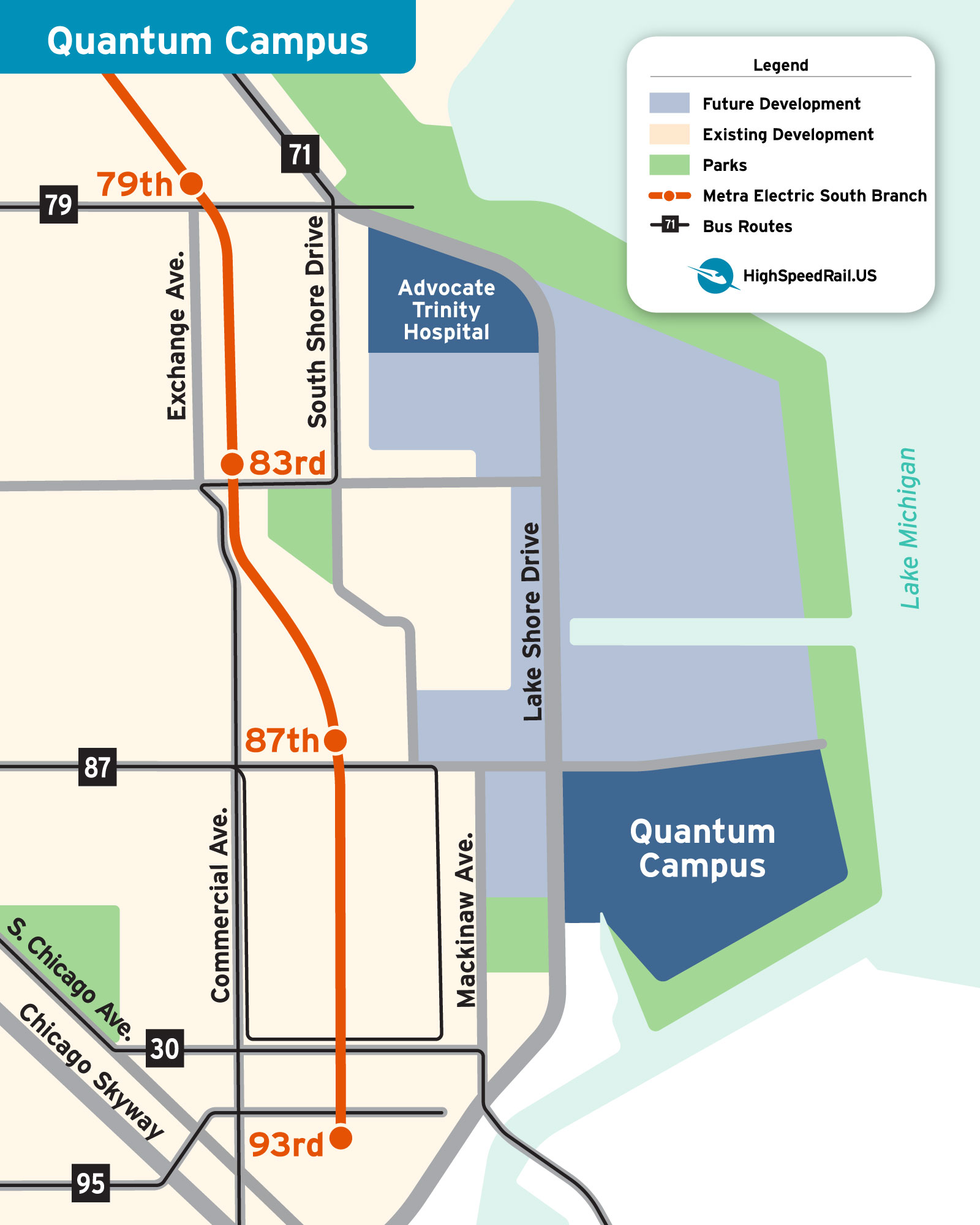
The Quantum campus should be designed to make walking to the South Chicago Branch convenient. Extending CTA bus routes and running a dedicated shuttle should also be in the mix.
Making the South Chicago Branch great
The South Chicago Branch falls so short because Metra downgraded its service in the 1980s to fit its commuter-rail model, which mainly focuses on transporting suburban commuters to their downtown jobs. Additionally, the line has been challenged by declining population in the neighborhoods its serves.
Past turf battles kept CTA and Metra from adapting services to adapt to a changing market and help people stay in the neighborhood.
Currently, Metra is moving toward “regional rail,” which uses high-frequency service on pulse schedules to make travel more convenient for all kinds of passengers, taking all kinds of trips, all throughout the day.
Now, NITA can unlock the South Chicago Branch’s potential to help create a growing and vibrant area.
The needed fixes are straightforward:
> High-frequency departures
Trains should operate on a CTA-like schedule—at least every 10 minutes during the day and every 15 minutes during off hours.
> Metra and CTA coordination
Establishing fare transfers between Metra and CTA—with the tap of a Ventra card or credit card—is crucial. And their schedules need to be coordinated for easy, timely transfers. The South Chicago Branch is a great test case for developing fare and schedule coordination between Metra and CTA—and then rolling it out across the 6-county region.
> Community collaboration to speed up trains
The street-running portions could be made faster through modest track upgrades and operational improvements. Faster trains will also require working with the community to improve grade-crossing safety. Speed increases are already in the works on the portion north of Hyde Park.
> Upgraded stations
The stations are turnstile ready—a legacy of the line’s original design as a rapid-transit route. So they’re already tap-to-pay friendly. Every station on the branch should accept Ventra tap-to-pay, creating seamless connections between the line and nearby CTA bus stops and “L” routes.
> Improve access to downtown stations
Pedestrian access to Millennium and Van Buren stations is convenient—if you know where the entrances are. Chicago should improve station visibility. Even more importantly, connections to downtown bus routes are inconvenient. The city should work to make them much more identifiable and accessible.
> Improve access to Quantum
Quantum should offer easy walking connections between campus buildings and to the intersection of 87th and Lake Shore Drive; and it should provide a shuttle between the 87th street station and campus buildings.
The starting point NITA needs
These upgrades would transform a neglected spur into a rapid-transit line that connects and serves some of the city’s key institutions—while giving some of Chicago’s most transit-dependent neighborhoods the service they should have had all along.
It’s the best proof of concept NITA could ask for: A short, electrified line in the heart of the city. It has strong demand, good bones, and a clear path to transformation. Making it work here will build the momentum and playbook for NITA to extend its work across the entire region.
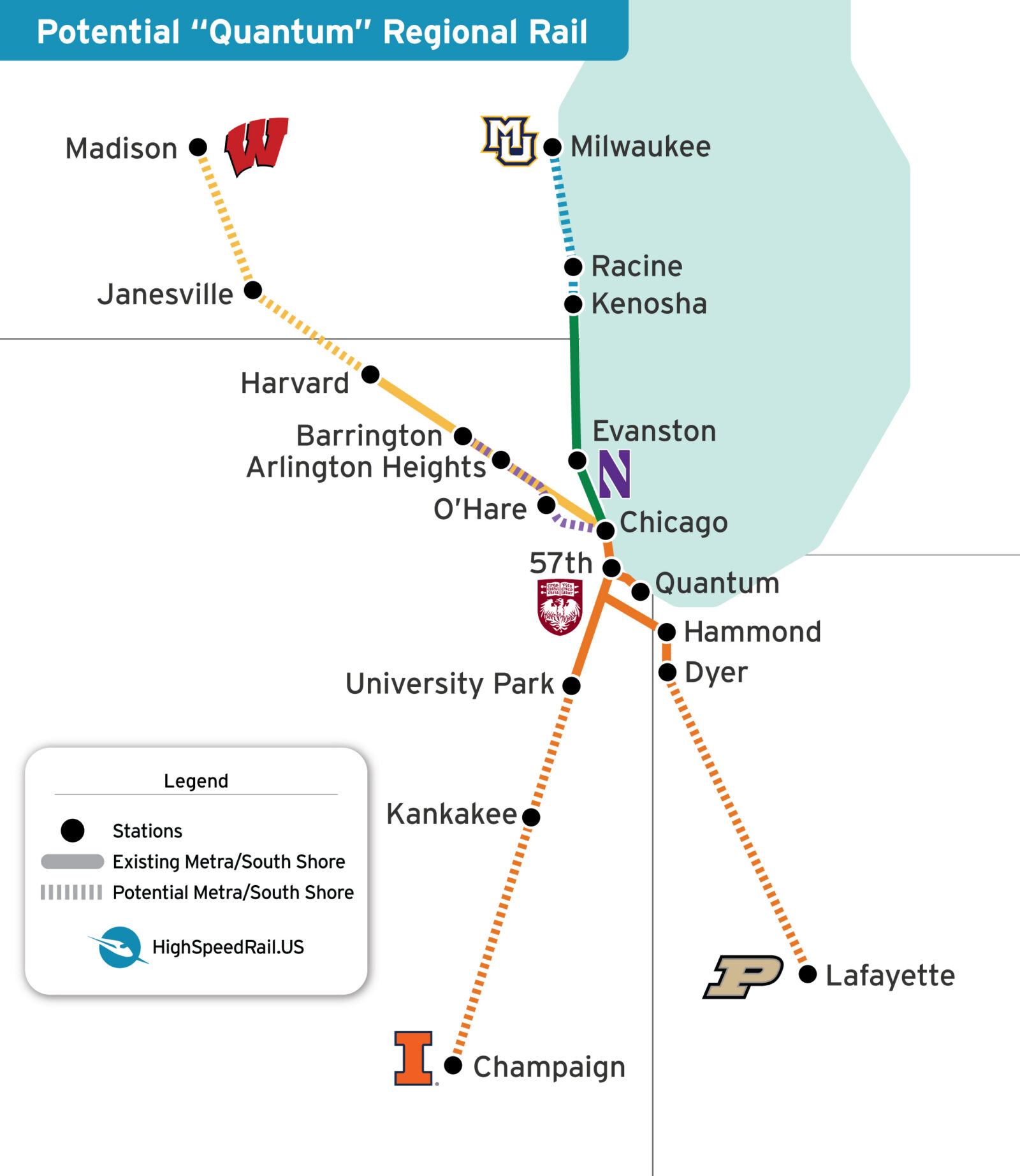
The Quantum Branch could be the first step in a regional rail network to connect the Universities involved in the Quantum project.
Get Involved
Tell Springfield: It’s time to connect the state with high-speed and regional rail!
The Latest from HSRA
Our Latest Blog Posts
Check out the latest news, updates, and high speed rail insights from our blog!