Take the SurveyWashington is designing a transformative high-speed line The Washington State Department of Transportation (WSDOT) is taking public comment on its study for a high-speed line between Portland, Seattle, and Vancouver, B.C. The study will be released in...
Nation Wising Up, Seeking Alternatives to Cars
Trains, integrated with transit, are what adults and teenagers want
We reported in October on a study that showed a surprisingly high percentage of Americans, possibly 40%, are ripe to be train passengers, because they don’t have unfettered access to a road-worthy car that they can take on a road trip for several days, or they may not be able to drive because of age (too young or too old) or disability.
The percentage of urban and suburban households living without any car is small, around 10%. Some are carless due to financial constraint, rather than choice, though this situation is actually more common in rural areas. But a new study based on a representative national survey of 2,155 respondents finds that in addition to that group, a further 18% of urban and suburban car owners in the United States express a definite interest in living car-free, while an additional 40% are open to the idea.
This means that two-thirds of American households in urban and suburban areas are not emotionally attached to their cars. If they own cars, it’s because of a built environment and paltry transit options that force car ownership on them.
The study makes comparisons with other advanced economies, suggesting that car ownership is not required for a high quality of life. In the United Kingdom and Germany, 22% of households live without a private car. In Japan it’s 25%, the Netherlands 26%, and nearly 40% in Denmark.
Those who expressed an interest in living car-free, or who were open to the idea, were likely to have lived car-free as an adult at some previous time, to ride transit regularly, and to not enjoy traveling by private car. The study found little significant association between interest in car-free living and typical socioeconomic or demographic variables.
Few places in the United States are readily amenable to car-free living, but we need to change that, starting now.
Get Involved
Tell Congress: It’s time to reconnect the country with high-speed and regional rail!
Teenagers avoiding the DMV
Meanwhile, today’s teenagers aren’t as eager to obtain a driver’s license as were teenagers of past generations. This is presented as a tragedy for their parents in an article in Business Insider, anecdotally “in a Northern California suburb,” because the parents’ responsibility as chauffeur for their offspring isn’t ending. Yet surely it was the parents, not the children, who chose to live in isolated, car-dependent, un-walkable suburbs without access to transit because it was viewed as a good place to raise children.
Now the teenagers are making a wise decision. Instead of ginning up sympathy for parents who brought this burden upon themselves, we should celebrate the kids for realizing that being forced to drive everywhere is no way to live, and we should build communities where driving is optional, and not driving is optional too – preferred, even.
The statistic on which rests the conclusion that teenagers are not securing licenses is that in 1983, roughly half of U.S. 16-year-olds held a driver’s license. That number fell to 25% in 2022, according to data from the Federal Highway Administration.
This is a market, present and future, for transit and inter-city passenger trains – along with car owners for whom the train just works better.
Where trains fit in
Inter-city passenger rail is a piece of the puzzle for those wishing they didn’t have to own a car. While it’s possible to see how a well-situated person could get around town via transit, walking, or bicycle riding, going anywhere out of town requires transportation. Some parts of the U.S. have decent commuter/regional rail, but most of the nation is lacking in this regard.
We advocate for inter-city and commuter/regional rail that is fast, frequent and affordable, and we also fight for transit systems that connect to the train, making it possible to travel without a car. We also want these systems to be excellent, such that even car owners will find them superior for many trips, and use them.
California has a plan
We are pleased to see that transportation officials in California last year published the California State Rail Plan (dated 2024, but released in January 2025). California reached a reckoning, realizing that a century of building highways as the solution to transportation demand was never going to work. Accommodating the automobile only necessitated its use by more people over more miles, which dictated further highway building, continuing the vicious cycle. The state’s economic, environmental, and quality-of-live future depends on the success of this ambitious rail plan.
The California plan comprehensively envisions fast, frequent passenger rail along corridors where the only transportation choice now is driving a car on a congested highway. The plan also values connection and coordination, so that even if passengers have to transfer from one train to another, or to or from a bus, the transfer is smooth and of little delay.
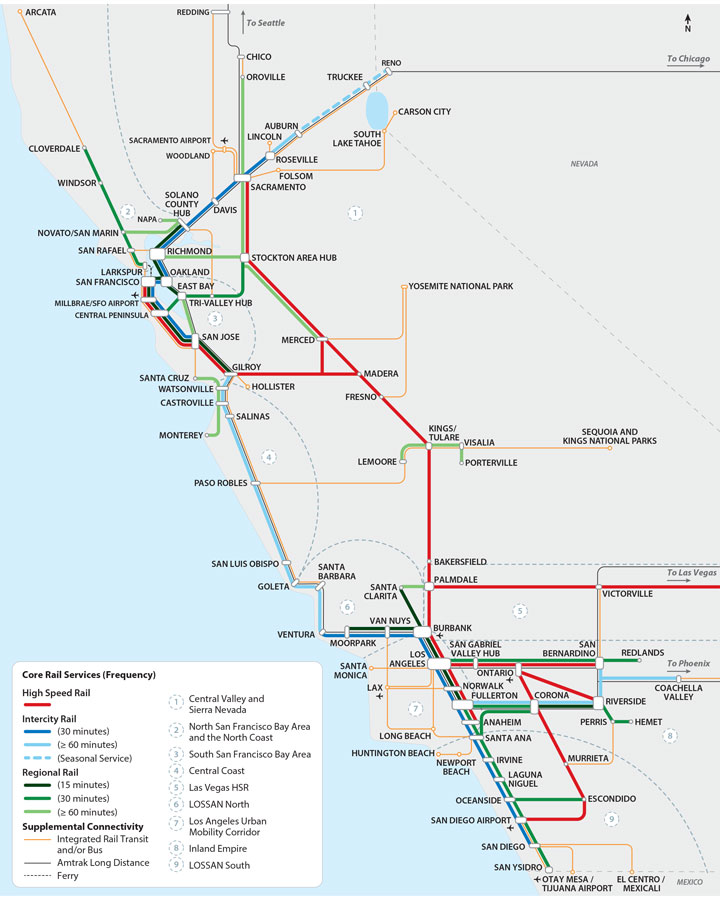
California’s Rail Plan is unique in America, and it’s an excellent model for other states to follow.
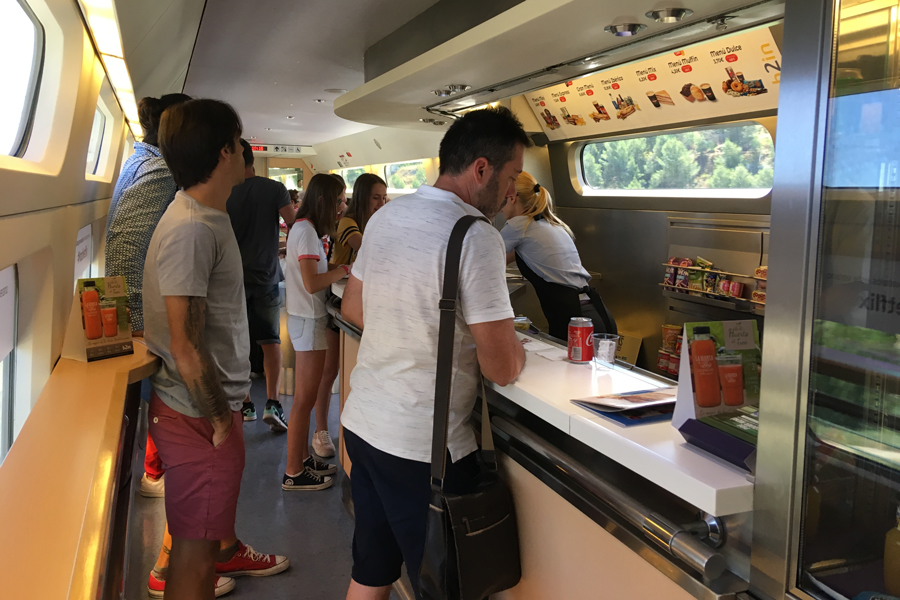
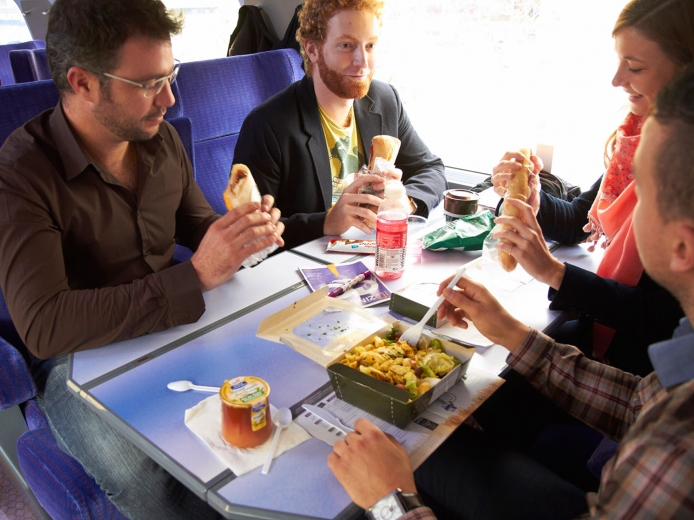
People enjoying the cafe car on a high-speed train in Spain.
Cars suck, trains are awesome
For many individual travelers, cars will continue to be a way of life for some time, but we can see why a growing number are not enthused about it. Buying and operating a car costs almost $1,000 a month, for which car owners are given the privilege of sitting in interminable traffic jams. This should not be the price of admission to society. Owning a car should not be a requirement to get anywhere and do anything.
For the teenagers, it appears that rather than being eager to drive, they’re terrified. With today’s cars, a fender bender easily can cause $10,000 in property damage. Beyond that, they don’t want to kill or be killed wielding this prodigious piece of equipment. The consequences are much greater than crashing a car in Burnout.
We hope these 16-year-olds who are not jumping into driving grow to be adults who are not keen on it either. We urge planners to keep them in mind when deciding where to locate homes, businesses and institutions, and to recognize that healthy systems of transit and inter-city trains will enable more households to live car-free.
The Latest from HSRA
Our Latest Blog Posts
Check out the latest news, updates, and high speed rail insights from our blog!