
Take the SurveyWashington is designing a transformative high-speed line The Washington State Department of Transportation (WSDOT) is taking public comment on its study for a high-speed line between Portland, Seattle, and Vancouver, B.C. The study will be released in...
There’s a new plan to connect Europe with high-speed rail. Here’s the key US takeaway.
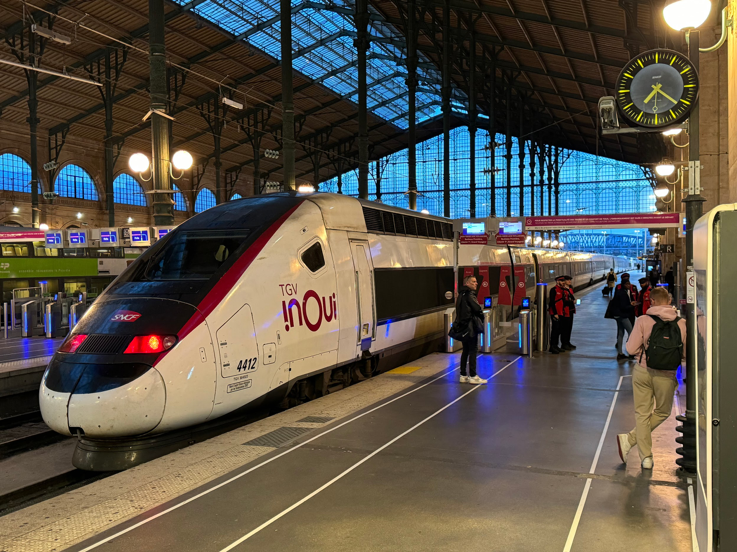
The European Commission has published its vision for a network of high-speed trains that will connect the European Union (EU) by 2040. The plan aims to break through the bottlenecks that have blocked development of strong cross-border train connections. As The Guardian notes, “despite repeated calls to boost rail travel, fast cross-border train journeys remain rare” in Europe because of “inadequate infrastructure, incompatible systems, clashing regulations, and fiendishly complicated ticketing.”
The EU’s fragmented railway development is a cautionary tale for the US. The key takeaway from the current push to overcome it is that the sooner a federal agency is empowered to plan, fund, and authorize construction of a national railway network, the better.
Put another way: The current model—with each state pursuing its own vision and plan—will lead us to the same dysfunctional place the EU is trying to claw its way out of.
Get Involved
Tell Congress: It’s time to reconnect the country with high-speed and regional rail!
In a recent Urbanist Agenda podcast, Jon Worth of the Cross Border Rail Project discussed this challenge. Worth crossed every internal EU border that it was possible to traverse by train in 2022. He has subsequently continued to document the challenges of international train travel within the EU, investigating more than 80 cross-border rail lines between early June and early August.
Asked about the biggest barriers to coordinating train service between countries, Worth said that “there are a bunch of technical barriers, right? There are four different electrification systems. There are three predominant gauges in different parts of Europe and more than a dozen signaling systems.”
Worth also noted that each nation subsidizing its own train network leads to “these absurd situations where a train ends at the first station before the border rather than the first station after the border. . . . And so you end up with this kind of narrow politics, which accompanies the kind of defensive inward-looking nature of the railway companies. And that makes quite a pernicious combination.”
Silver lining
The bright side is that the European Commission’s new plan shows a strong commitment to going all in on high-speed rail, which it defines as 250km/hr—or roughly 155 mph.
Europe currently has about 7,500 miles of high-speed rail, mostly concentrated in France, Germany, Italy, and Spain. Train service is of uneven quality in the rest of the EU.
The Commission observed that a well-connected network of high-speed trains would slash travel times between many of the EU’s major cities. For example, Berlin to Vienna (via Prague) would take 4h30m, versus 8 hours currently. Madrid to Lisbon would take 3 hours, versus 9 hours. And Madrid to Paris would take 6 hours, versus nearly 10 hours. “This will benefit not only the major hubs but also the cities between these destinations and the surrounding regions,” the Commission notes.
The new plan aims to expand HSR through several measures. In the next few months, for example, it will create a dedicated financing strategy that coordinates potential public and private investment sources. And by 2027, it will create “binding timelines” for eliminating cross-border bottlenecks. The vehicle to “coordinate and deliver the vision” will be stronger EU-level governance structures—for example, empowering the European Union Agency for Railways to authorize projects more efficiently.
The Alliance has long argued for a federal-level agency with similar powers in the US. For example, click here for the Alliance’s vision of what a national passenger-train network could look like, based on several studies conducted by the Federal Railroad Administration. As we write, “Congress needs to fund the FRA to create a plan for a national railroad network and take a strong leadership role in getting it built. It needs to be much bigger than high-speed rail. We think it should be roughly 20% high-speed and 80% shared-use.”
Recent reports underscore the point. Last year, for example, the Transit Costs Project at New York University’s Marron Institute of Urban Management argued that “the Federal Railroad Administration (FRA), a new entity within the US DOT, or Amtrak should develop an intercity rail plan that reflects national priorities . . . rather than trying to assimilate state rail plans of varying quality or relying solely on grant programs to stitch together a vision.”
In short, the state-by-state approach may be the best we can do for now. But a truly national HSR network will require a federal agency with a national plan, deep pockets, and the authority to not only launch train and transit projects but keep them moving forward.
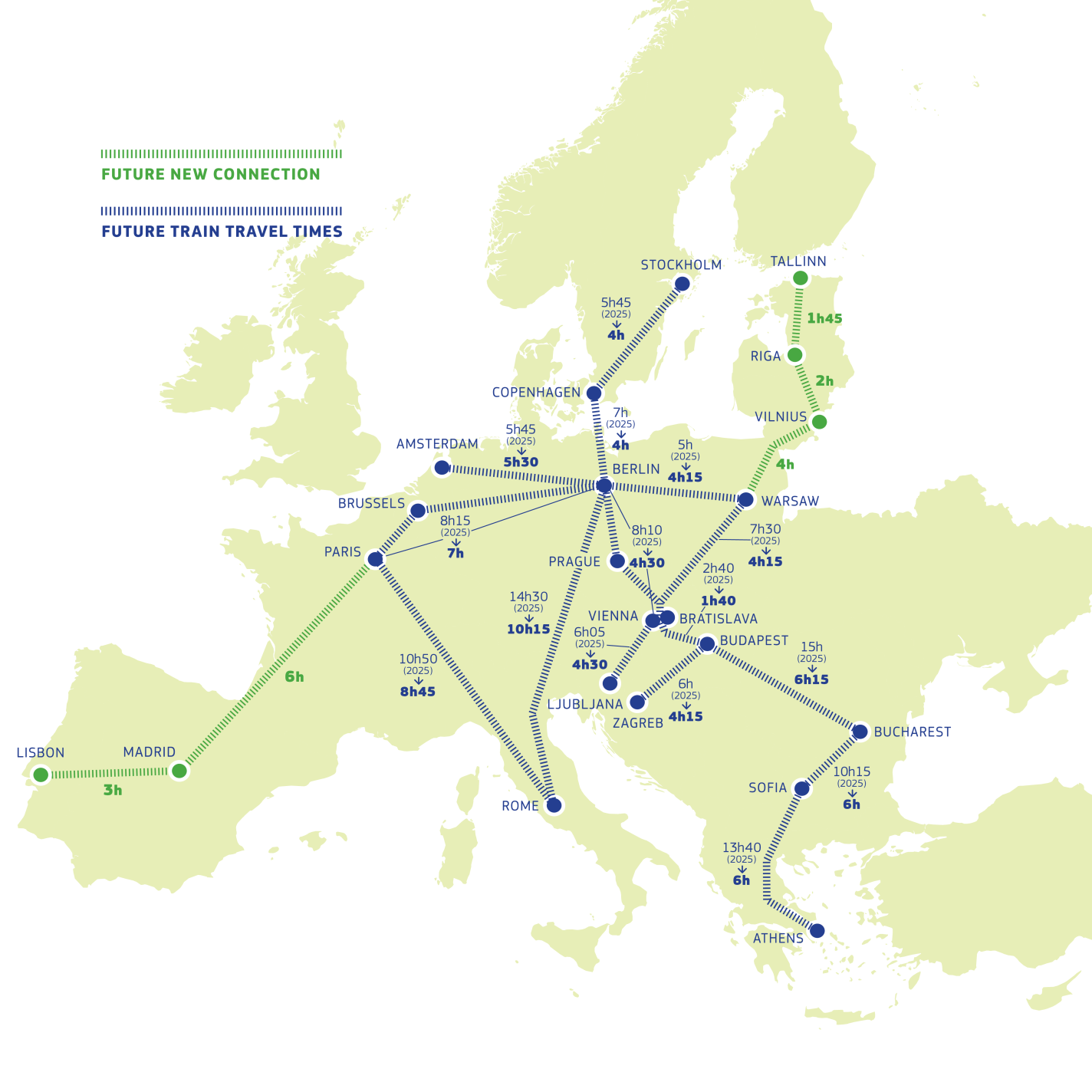
The European Commission’s vision for improving travel times and creating new railway connections throughout Europe.
The Latest from HSRA
Our Latest Blog Posts
Check out the latest news, updates, and high speed rail insights from our blog!