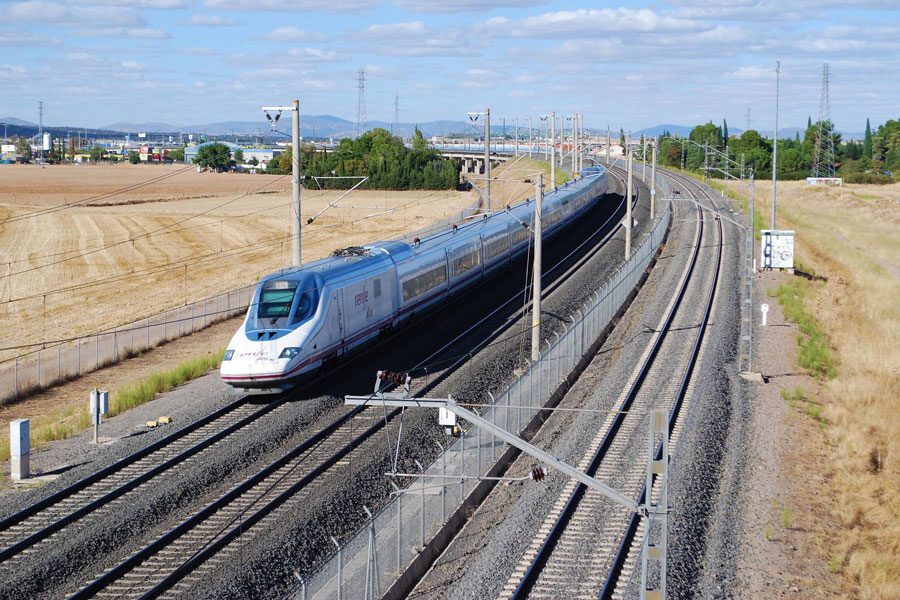

Illinois’ Passenger Rail Planning Act aims for success, not bare survival A regional rail network with high-frequency trains is vital to the future of Illinois and the Midwest. Achieving it requires planning starting now. A bill currently in the Illinois Legislature...
You Really Expect Me to Drive to Louisville?
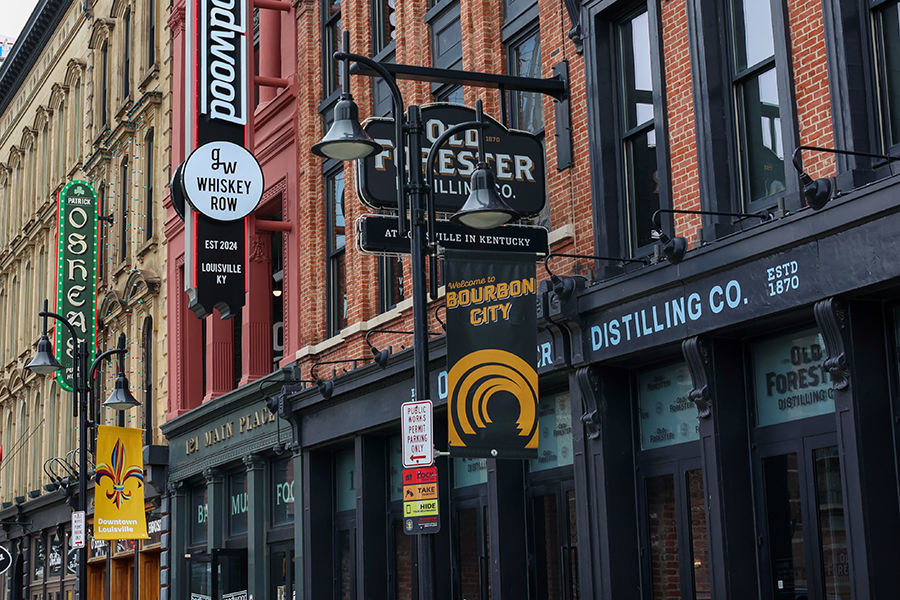
This essay by Theo Anderson is part of the “Why I Fight series,” which offers personal reflections on train advocacy by Alliance staff, members, and friends. Go here for a related rant by Anderson, “Why Can’t I Take the Train to Indy,” and go here for executive director Rick Harnish’s recent essay about Elyria, Ohio.
Set off by an ad on the “L”
I was on a Chicago L train recently, staring at a picture of a glass of bourbon, when I blurted out: “That’s crazy.”
An ad for Louisville, running along the top of the railcar, provoked the outburst. The tag line said “Short Drive. Tall Pours.”
It makes sense to pitch Louisville as a getaway destination for Chicagoans. It’s a fine city. It has an “urban bourbon trail” that the city’s tourism website calls it a “curated collection of local bars and restaurants,” with “some of the city’s largest collections of Bourbon and in most cases even Bourbon-infused cuisine.”
That’s great. But it’s crazy to call the nearly 300-mile, five-hour car trip to Louisville a “short drive.” It’s even crazier that you can’t take a train from Chicago to Louisville. There’s barely even service from Chicago to Indianapolis. You can take an Amtrak train twice a week and arrive downtown in the middle of the night.
To be fair, Indiana is the main source of this insanity. The state’s governor cut the $3 million annual subsidy for Amtrak’s Hoosier State line in 2019, which killed the only usable train service between Indianapolis and Chicago. But even that train ran just three days a week.
Sadly, Indianapolis has never been serious about offering passenger-train service, despite being right in the heart of the most railroad-dense region in the nation and 200 miles from Chicago—with a major research university, Purdue, halfway between.
A little context might help explain why this is so triggering.
Indiana moved heaven and earth, after all, to build a new highway that it believed was vital to the state’s future. It’s not crazy to believe it might one day get behind a real solution.
The weird saga of I-69
Last year, Indiana finished a 142-mile extension of Interstate 69, which runs between Evansville (in the far southwestern corner of Indiana) and Indianapolis (in the middle). I-69 currently extends through several states, including Kentucky, Tennessee, and Mississippi. It might eventually extend all the way to the Mexico border.
The Indianapolis-Evansville segment must be one of the most discussed segments of interstate in the US. There’s even a book that focuses heavily on it, Matt Dellinger’s Interstate 69, which anyone interested in trains and/or US transportation should read. It chronicles how boosters pushed Indiana to build a new segment of highway that had dubious benefits and was fiercely opposed by many of the people whose lives it would supposedly improve.
Boosters started touting the I-69 extension in 1990, claiming that southwestern Indiana was unfairly left out of early interstate planning. The lack of a highway connection to Indianapolis presumably caused young people to move away, businesses to close, and the region to deteriorate.
Dellinger’s book has loads of fascinating nuggets. Here’s one: The Republican mayor of Indianapolis from 1976 to 1992, Bill Hudnut, said that two of his big, unfulfilled dreams as mayor involved high-speed rail. He wanted a line connecting Indianapolis to Indiana University and Purdue University; and he wanted a line connecting the Indianapolis airport to the Chicago Loop.
Regarding I-69, Hudnut told Dellinger that communities along the route would benefit little from cars blasting past them on a nearby highway. “One of the principles of smart growth,” Hudnut said, is “development that is of good quality, where there’s a sense of place.”
Yet the movement’s faith and willpower eventually paid off.

The construction of I-69 was pushed by a coalition of local leaders along the route.
The key takeaway
Of course, the pro-I-69 movement believed the road would spur “quality” development and save their communities. And the key takeaway of Interstate 69 is that citizens passionately committed to an idea and vision—even a bad one—can change the status quo by refusing to accept it, organizing to change it, and keeping up the pressure until they win.
The beating heart of the movement’s early years was Washington, Indiana, a town of about 13,000 people about 100 miles southwest of Indianapolis. One of the town’s pillars, David Graham, worked hard for the I-69 segment from Indianapolis to Evansville.
Born in 1927, David Graham was educated on the East Coast but returned to Washington to pursue various interests, including farming and banking. His wife taught in the local public school. All eight of their children moved away.
It was the familiar story. The hollowing out of the region’s manufacturing base in the later twentieth century clouded the future for towns like Washington. Mayors and civic leaders in small communities across southern Indiana and nearby states built the pro-I-69 movement and sustained it through the early 1990s. It became Graham’s passion project, via the Mid- Continent Highway Coalition, when he retired from the family business in the late 1980s.
Keeping the faith was difficult. The opposition was strong and organized and included not only environmentalists but many of the region’s farmers. They rightly feared the upheaval of running an interstate highway through their land. One report projected that it would affect about 4,600 acres of farmland plus 550 acres of forest and wetland
And the project got plenty of bad press. NBC News spotlighted it in 1998 as a big waste of money, pointing out that there was a much cheaper option—i.e., upgrading US 41, which runs along Indiana’s western border and connects with I-70, which connects to Indianapolis.
Yet the movement’s faith and willpower eventually paid off. Indiana moved forward with building the new segment. From conception to completion, the work took more than 30 years and cost $4 billion, or more than twice the original estimate.
When the final stretch opened last year, a spokesperson for the Indiana Department of Transportation called the project a “generational effort, with thousands of people involved along the way, devoting countless hours to delivering a safer, more direct connection between southwest Indiana” and Indianapolis.
Chicago-Indianapolis-Louisville-Nashville?
It’s interesting to think about an alternative reality, one in which trains aren’t the ugly stepchild of the transportation sector. One where Indiana (and the region) bring the same passion and commitment to building great trains that they bring to building highways.
With hourly departures, visiting Indiana from Chicago (or vice versa) would be a transformed experience—faster, easier, more affordable, and less stressful, especially given the traffic congestion around Chicago.
But thinking about this in terms of a Chicago-Indianapolis connection is way too limited. With some energy and imagination, Indiana could use its position between Chicago and the upper South to catalyze one of the most vibrant, thriving tourism corridors in the nation.
Between Indianapolis and Louisville, Columbus is one America’s great architectural cities and easily deserves at least a day. So, in just the 300 mile stretch from Chicago to Louisville, there’s a world-class city (Chicago), a sports city with a surprisingly strong arts scene (Indianapolis), an architectural mecca (Columbus), and a city with a legendary food/bourbon district (Louisville).
But even that vision is way too limited. Nashville, a global musical capital and one of the nation’s fastest-growing cities, is just 175 miles south of Louisville. Add that to the line and you have epic possibilities for a Nashville-Louisville-Indianapolis-Chicago tourism corridor—anchored by frequent trains.
It’s easy to spitball ideas. Weeklong passes with unlimited train rides and discounts to local hotels, restaurants, and attractions in each city. Bourbon-themed drinks in the cafe cars. Trains decked out in country-music themes. Onboard meals that nod to the Chicago culinary scene.
I could do this all day.
Their certainty—and their success—put a pressing question front and center: What exactly are we fighting about—and what am I fighting for?
Why I fight
Interstate 69 is a sobering tale. Boosters like David Graham mostly acted in good faith. They hoped to build a better future (or any future) for their towns and cities. One economist who supported it told Dellinger that the “great unrequited desire” in life was to someday drive the finished interstate. “If that happens,” he said, “I will feel as if my career has been reasonably successful.”
When a road project has that kind of power over a person’s sense of self, the stakes are immense. And Dellinger’s book is full of such people. Their certainty—and their success—put a pressing question front and center: What exactly are we fighting about—and what am I fighting for?
It’s important for train advocates to have good answers.
Most importantly, I believe that trains actually deliver on the promises made for new highways. That is, they build wealth in both the cities they serve directly and in nearby rural communities.
In the case of cities, the boost to tourism would just be gravy. Trains’ primary value is in bringing development to the city centers instead of routing traffic to the outskirts and spurring construction of new box stores, gas stations, and fast-food restaurants. Core-focused development builds a city’s tax base, which allows it to invest in amenities that make it attractive to both tourists and residents, which creates a sustainable, thriving community.
For nearby rural towns, the benefits are less straightforward but real. Trains can’t pass through every town, so people in those communities will still depend on cars, shuttle buses, or intercity buses to get to the station. But a train connection to regional cities, via a short bus or car trip to the station, will open up new opportunities for workers, students, and families. Freedom from car dependence will improve their quality of life and prospects and make those communities more attractive places for families to put down roots.
There are strong safety and environmental reasons as well—i.e., the fact that trains are vastly safer than driving and spew far fewer greenhouse gases and other toxic pollutants. And in the case of Indiana, there’s a very specific reason to invest in a Chicago-Louisville corridor. One of America’s great companies, Cummins, is headquartered in Columbus, Indiana, which is situated on the railroad line between Indianapolis and Louisville. Cummins currently builds engines for trains all over the world. Shouldn’t it be the foundation for a thriving train-manufacturing sector in the Midwest?
For these reasons, a Chicago-Indianapolis-Louisville-Nashville railway corridor would have a truly epic impact on the cities and towns it serves. And, because of its pivotal location, Indiana must be the catalyst.
I-69’s story offers two core truths about getting from here to there.
One is that it will take years of organized, energized, and persistent effort. The other is that it’s possible.
And that’s why I fight for trains. I don’t believe our current reality is set in stone. I believe we can—and eventually will—find our way out of the dysfunctional transportation status quo.
That requires a leap of faith, sure. But it’s not crazy to believe that Indiana might one day get behind trains. What’s crazy is to expect me to make the “short,” five-hour drive from Chicago to Louisville on congested and dangerous highways for “tall pours.”
What’s really crazy is for Indiana to keep dumping billions of dollars into highways—and expecting different results than the broken, bypassed, hollowed-out cities and towns that they’ve already created.
Please join me in the fight for great trains connecting the country.
Become a Member
The Latest from HSRA
Our Latest Blog Posts
Check out the latest news, updates, and high speed rail insights from our blog!