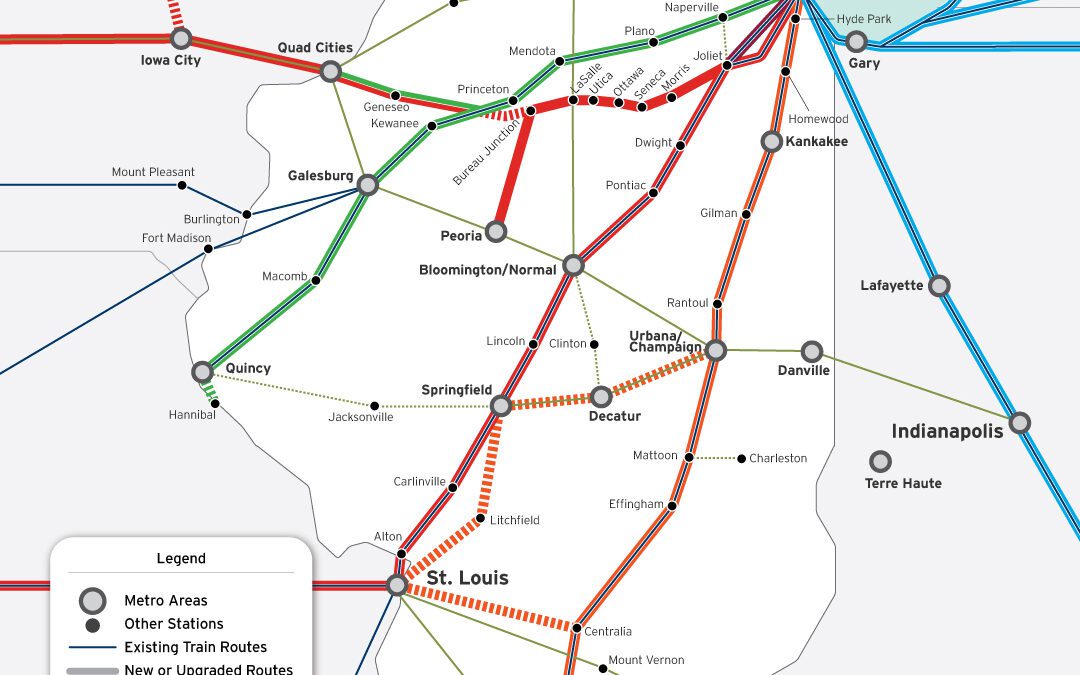
You can provide feedback to IDOT through October 2026. The Illinois Department of Transportation (IDOT) is working to update the 2023 State Rail Plan, with a final draft expected July 2027. State rail plans set future goals for freight and passenger rail. They can be...
Illinois’ Passenger Rail Planning Act aims for success, not bare survival

HB4279 and SB3285 set frequency targets regionwide
Regional rail networks with high-frequency trains are vital to the future of regions throughout the country. Getting them soon requires that planning start now.
A bill currently in the Illinois Legislature advances frequent passenger rail service by directing the Illinois Department of Transportation to plan for hourly service, at minimum, in several strategic corridors. This legislation requires the Illinois Department of Transportation to incorporate these service frequency goals into the Illinois State Rail Plan and into the Long-Range Statewide Transportation Plan.
The bill builds upon the Midwest Regional Rail Plan, published by the Federal Railroad Administration in 2021, that outlined a high-frequency network connecting Midwestern cities and states.
The legislation does not provide funding for construction, but it will give lawmakers the information they need to fund that work.
The Passenger Rail Planning Act deserves strong, vocal support from civic leaders, policymakers, and advocates interested in bringing great trains to the region.
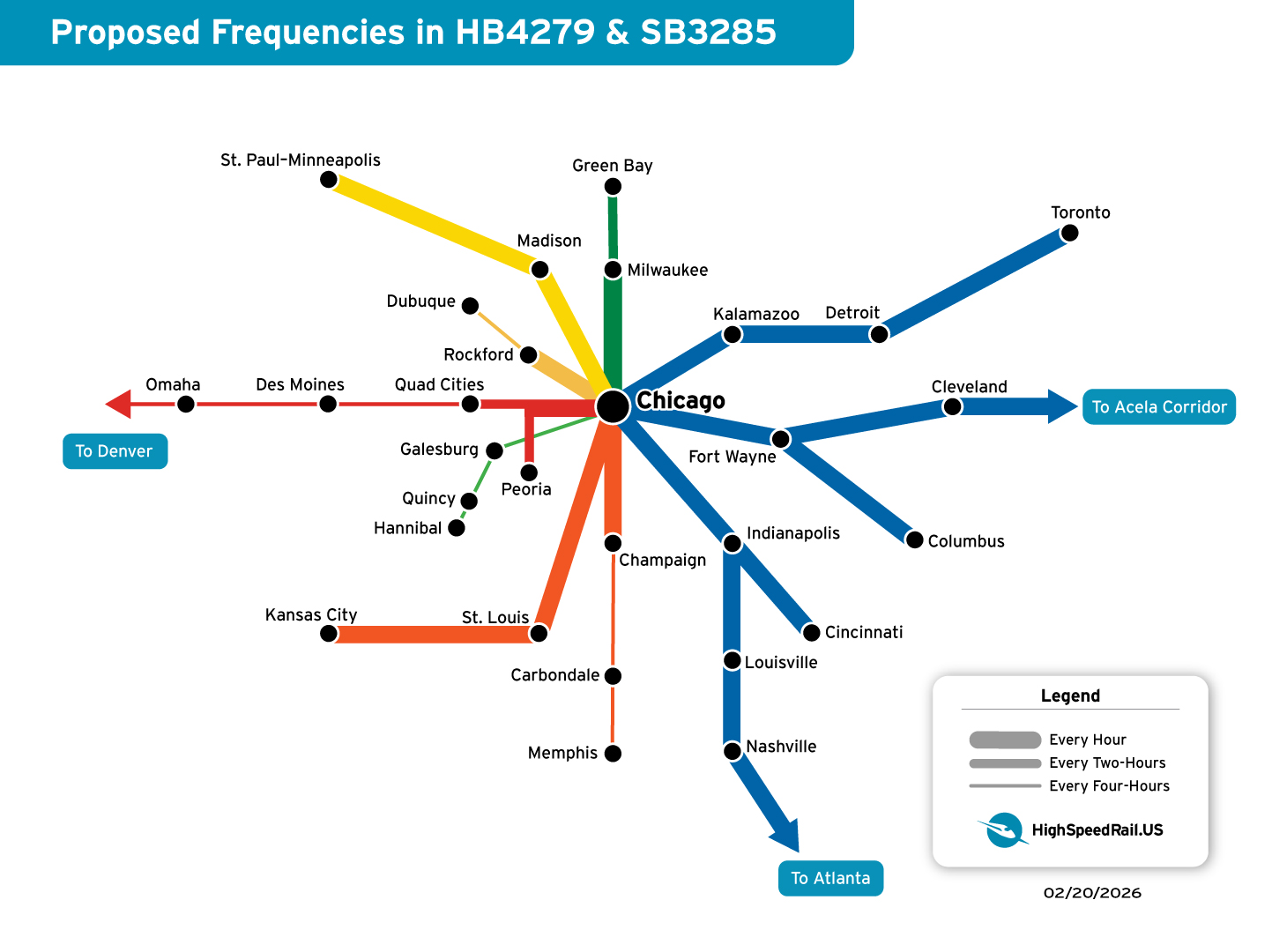
HB4279 requires requires state planners to include target service frequencies for trains radiating from Chicago. See the list.
Why an end goal is essential
“Begin with the end in mind” is a core principle in Stephen Covey’s famous Seven Habits of Highly Effective People.
Unfortunately, railroad planners in the United States take the opposite tack. Planning for intercity passenger rail is usually directed by staff at state departments of transportation. They plan based on what seems plausible given current levels of legislative support and funding, along with past practices. The governing principle is to proceed cautiously, “testing” the market and building up frequency from there.
This approach is self-defeating for three reasons.
First, it takes a decade (or more) to complete the federal review and construction process for each increment of development.
Second, projects often become expensive anyway, so the cost savings for the minimalist route are small.
Third, a route with only a few daily departures will never reach the tipping point for success.
Frequency drives ridership
Greater frequencies reduce total travel times, serve different travel markets throughout the day, and improve system reliability. They make connections with buses, planes, and other trains viable.
Most importantly, high frequency liberates people to travel when they want. More options mean more freedom. More freedom means more riders. And more riders create a virtuous cycle of more revenue, more frequency, and even more riders.
That’s why beginning with the end goal is critical.
Service can be added incrementally as new infrastructure comes online, of course. But these steps can be factored in from the outset.
IDOT urgently needs the Legislature’s input
IDOT and other agencies planning rail-corridor expansions operate under the traditional “go slow” approach, which assumes that there is little funding for railroad expansions.
As a result, they’re setting low targets for service levels and ridership.
The Legislature should direct to IDOT plan for success—not bare-bones service that will never justify expansion. Once policymakers know what a successful route will cost, the Legislature can then make an informed decision about whether to fund it and where to make compromises.
That’s why the Passenger Rail Planning Act is such an exciting and incredibly important opportunity. It will begin to shift the assumptions and practices about railroad planning in Illinois and throughout the region.
The routes
The legislation requires state planners to include these target service frequencies for trains radiating from Chicago:
- Milwaukee, at least hourly; every two hours to Green Bay.
- Madison, WI and St. Paul, MN, at least hourly.
- Rockford, at least hourly; every four hours to East Dubuque.
- East St. Louis, St. Louis and Kansas City, at least hourly.
- Champaign, at least hourly; every four hours to Carbondale and Memphis.
- Indianapolis, Louisville, Nashville, and Atlanta, at least hourly.
- Indianapolis and Cincinnati, at least hourly.
- Fort Wayne, IN and Columbus, OH, at least hourly-*
- Cleveland, at least hourly-*
- Detroit and Toronto, at least hourly.
- Moline, every two hours; every four hours to Des Moines, Omaha and Denver.
- Peoria, every two hours.
- Galesburg, Quincy and Hannibal MO, every four hours.
*-One of these would provide hourly service to the Northeast Corridor.
The Latest from HSRA
Our Latest Blog Posts
Check out the latest news, updates, and high speed rail insights from our blog!