Thank you to everyone who contacted their Illinois representatives, senator, and Gov. Pritzker this session supporting high-speed and regional rail. Gov. Pritzker has signed HB4442 into law, which extends the life of the Illinois High-Speed Railway Commission until...
Our Take on CNN’s Recent HSR Piece
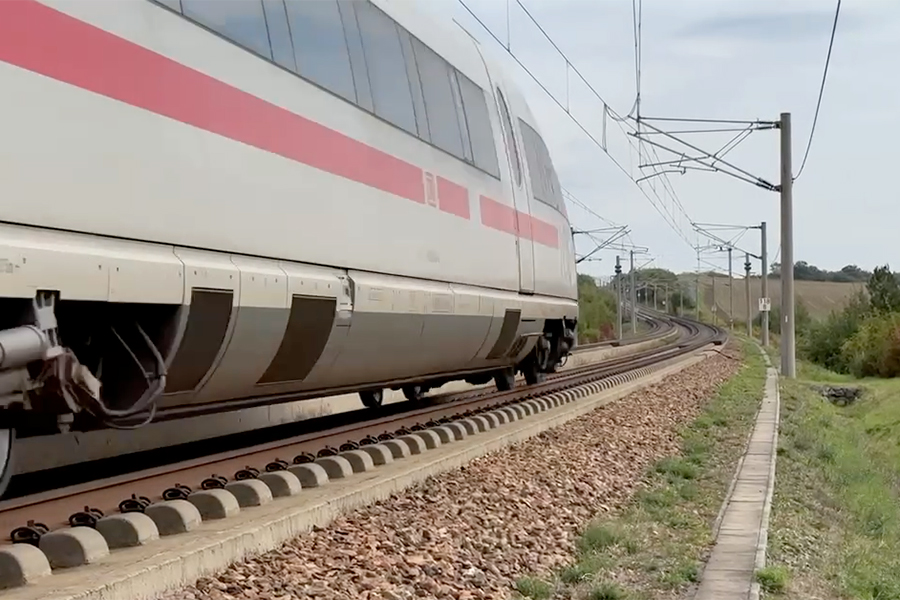
CNN recently published a piece about high-speed rail that focuses on three routes: Chicago to New York, San Francisco to Los Angeles, and Atlanta to Orlando. It notes that air travel is a mess and that high-speed trains “would offer Americans an attractive alternative” if they were an option. SF to LA is the most popular flight in the US. Atlanta to Orlando is the third most popular, and Chicago to New York is the fourth most popular.
The piece is notable mainly for the way it treats a high-speed line from Chicago to New York as obviously a good idea. It brings to mind the old saying about how ideas often move from being absurd to being mainstream: “First they ignore you, then they laugh at you, then they fight you, then you win.”
Join Us!
Your involvement will help push bolder visions for great train service—and stations—throughout America!
Chicago – New York Rises Up
CNN points out that a Chicago to NYC trip “could take just over six hours by high-speed train at an average speed of 160 mph, cutting travel time by more than 13 hours compared with the current Amtrak route.” But the chosen path routes trains through Cleveland and upstate New York to the state’s far-eastern border before turning sharply south toward New York City.
The route makes sense mainly because it would circumvent the mountains of the more direct path, i.e., straight through Pittsburgh and central Pennsylvania, which would cut roughly an hour off the travel time. At this point, though, tunneling shouldn’t pose a major barrier to connecting two of America’s great cities with great trains.
A tunnel was dug through the mountains of western Massachusetts in the 1870s. It stretches five miles and it’s still in use. And today, Europe has an aggressive tunneling program designed to “develop a new trans-national, pan-European economy and polity,” as the Alliance recently noted. Those tunnels are dozens of miles long.
We can do this. It’s just a matter of will.
The need for (more than) speed
One quibble with the CNN feature is that it reinforces the mistaken (but very common) idea that high-speed rail is primarily about connecting big cities with fast trains. It is about that, obviously. But it’s about much more.
It’s about creating a coordinated system of great trains, transit, and intercity buses that make transportation safe, affordable, and easily accessible for everyone. We call this the integrated network approach.
High-speed trains are the anchor because they make it possible for people to get anywhere in a region safely and affordably. At the same time, they help build a culture where communities of all sizes are connected by train and transit options of all kinds. That’s because when people take high-speed trains, they use conventional trains and transit more often.
So high-speed rail spurs investment in better train, transit, and intercity bus systems broadly. Caltrain, for example, has become a world-class transit system in the Bay Area because of ripple-out effects from California’s high-speed rail project.
In this integrated network approach, frequency is just as important as speed. In order for trains to be a real alternative to driving, after all, people must be able to show up at a station and assume there will be a departure relatively soon.
They fight you, then you win.
That quibble aside, it’s great that CNN spotlights California HSR—a project that’s not only underway but moving forward at a steady clip.
Last week, for example, the California High Speed Rail Authority issued a Request For Proposals for a $3.5 billion contract to build the track, catenary electrical system, train control, and communications system for the project’s first, 119-mile segment in the Central Valley. Proposals are due in early March. The RFP puts the project on “an accelerated path to laying the first true high-speed rail track in the Western Hemisphere next year,” Authority CEO Ian Choudri said.
Which means the California project is gaining steam despite its many critics and detractors—including the Trump administration and Tesla CEO Elon Musk.
A few days after its HSR piece, CNN published a story that focuses on various efforts to create a workable hyperloop system, 12 years after Musk first announced his intention to build it. The piece observed that the problem for hyperloop and maglev technologies is that they “simply cannot yet match current rail networks’ unbeatable combination of high average speeds, huge people-moving capacity, cost, compatibility with existing tracks, and center-city hubs.”
But it’s doubtful that was ever Musk’s aim. As a writer for Time noted, he “has a history of floating false solutions to the drawbacks of our over-reliance on cars that stifle efforts to give people other options. . . . Musk admitted to his biographer Ashlee Vance that Hyperloop was all about trying to get legislators to cancel plans for high-speed rail in California—even though he had no plans to build it.”
But it turns out that it’s hard to keep a great idea down, They ignore you, laugh at you, fight you—and then you win.
Please join us in fighting for great trains throughout the country.
Become a Member
The Latest from HSRA
Our Latest Blog Posts
Check out the latest news, updates, and high speed rail insights from our blog!