
Illinois’ Passenger Rail Planning Act aims for success, not bare survival A regional rail network with high-frequency trains is vital to the future of Illinois and the Midwest. Achieving it requires planning starting now. A bill currently in the Illinois Legislature...
11 Favorite Books, Articles, and Podcasts From 2025
The movement for fast, frequent, and affordable trains in North America is profoundly shaped by funding streams and budget priorities at all levels of government. Our list this year reflects that truth.
Our strong spotlight on cars and highways is especially relevant in a year when the chairman of the House Transportation and Infrastructure Committee, Rep. Sam Graves (R-MO), said that he wants to defund all non-car-related infrastructure in the new surface transportation authorization bill. “Infrastructure” means “building roads and bridges, laying asphalt, pouring concrete,” Graves said. “We’re not spending money on murals and train stations or bike paths or walking paths. We’re going to spend money on traditional infrastructure—that’s roads and bridges.”
Bringing great trains to North America will mean moving beyond that cramped and antiquated vision of infrastructure—and creating better, healthier ways of living and moving around for everyone.
Here are eleven essays, books, and podcasts that helped advance the cause in 2025.
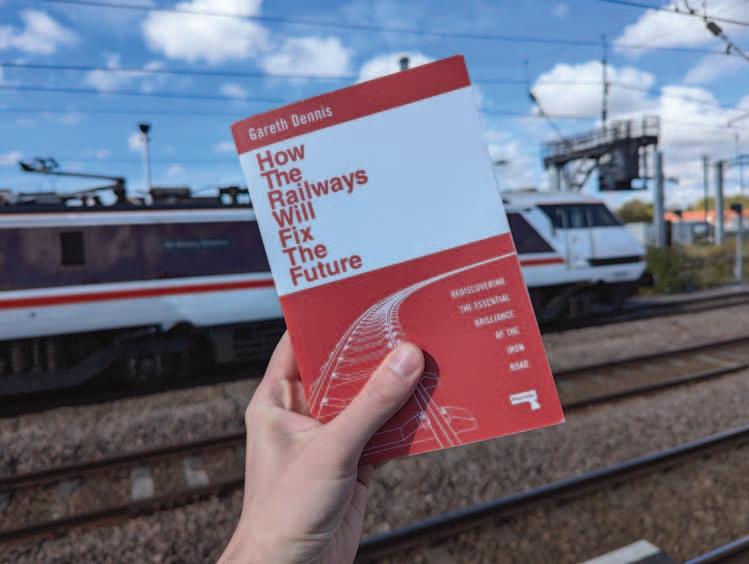
#1) How the Railways Will Fix the Future: Rediscovering the Essential Brilliance of the Iron Road (Penguin Random House)
Gareth Dennis, the host of the RailNatter podcast, authored perhaps the most important book of the year. See our webinar and related blog post.
#2) “Learning from California: Lessons Drawn from California for Other Large Infrastructure Projects (Mineta Transportation Institute).
Author Boris Lipkin offers six lessons from California high-speed rail, including No. 2: “Funding drives outcomes.” Lipkin notes that “decisions on how we fund projects have the most weight in dictating what will get built and in what order.” For example, California began building its San Francisco-Los Angeles line because of a funding decision by the federal government. “By choosing the Central Valley (and this decision remains a source of controversy), the federal government answered the question of ‘Where should California high-speed rail start construction?’ and created the new question of ‘How do we maximize the benefit of the investment that has been made in the Central Valley?’” Lipkin writes. “The particular difficulty with this decision is that while there were (and are) good reasons to have chosen the Central Valley (prime amongst them being the need to have a long enough and straight enough test track to prove the safety case for trains running at 220 mph), connecting the Central Valley to the major population centers in Los Angeles and the Bay Area remains a difficult proposition.” Yet much of the line’s potential benefits lay in connecting the line to those major population centers. The entire report is well worth reading.
#3) New York Times, March 25, Living Car-Free in Arizona, on Purpose and Happily.
The Times profiles Culdesac Tempe, “the first neighborhood purposely built to be car free.” Its CEO, Ryan Johnson, says that living in a walkable place is “one of the best things we can do for climate, health, happiness, low cost of living, even low cost of government.” Residents use the nearby light rail system and a variety of other options—especially buses, scooters, and e-bikes—to get around. The development had 22 retail shops and nearly 300 apartment units, with another 450 planned, at the time of publication. An adviser to Strong Towns, Edward Erfurt, observes that “we’ve just had this experiment for the last eight decades where we’ve opted to prioritize an isolated transportation system versus our natural way of working together as humans.” Strong Towns featured Culdesac Tempe in a podcast episode in June.
#4) Freeway Exit, Apr. 8, “Freeways and loneliness.”
The claim that highways create isolation and disconnectedness is rarely backed up with evidence. Data science professor Luca Aiello discusses his study that aims to do that, based on the social connections of Twitter users in 50 cities in the early 2010s. He found that the presence of highways had a measurable, negative impact on the density of social ties. “With this study, we can really put a number of how much your ability to move around and connect locally is disrupted by this slight increase in your opportunity to move long range,” Aiello says. “Do we really want to hold on to that small advantage while sacrificing our air, the beauty of our neighborhoods, and also our chances to meet more people locally and experience our cities in ways that are happier and healthier?” A print version of the research can be found here.
#5) Volts, May 28, “Parking Reform in Washington, Parking Reform Everywhere!”
Host David Roberts notes that “the more land devoted to concrete car stalls, the less devoted to everything else, including uses that create much more tax revenue. Excess parking creates urban and suburban dead zones.” He talks with Alan Durning, executive director of the Seattle-based Sightline Institute, and senior researcher Catie Gould about the Parking Reform and Modernization Act, which recently became law in Washington state. It eliminates or caps parking minimums for new developments in cities of at least 30,000 people. Towns and cities are prohibited from imposing parking-minimums mandates, in particular for small residences and businesses and many essential facilities, like childcare centers. Durning offers that “parking connects to everything that we care about in the world. It connects to economic opportunity and prosperity. It connects to climate [and] it attaches to and is important to the cost of housing and the opportunities to start and operate small businesses.”
#6) Reconnect America, Aug. 9, “How to Fix the U.S. Railroad Problem—and the Country.”
Journalist Phillip Longman discusses his Washington Monthly piece, which argues that the deregulation of the freight railroads in the 1970s and 80s has had a profound, disastrous impact. “Rail ceased for many shippers to be a reliable, affordable means of freight transportation, and people were left behind,” host Bill Moyer notes. “Revisiting the principles of this regulatory regime again today could be key to revitalizing the American Heartland, bringing jobs back from overseas, and lowering costs for us all by talking on monopolistic control over supply chains.” See also Longman’s follow-up piece to the original article, “Make Transportation Fair Again.”
#7) Strong Towns, Oct. 20, “What the Perfect Tuba teaches Us About Community and Resilience.”
Podcast host and Strong Towns executive director Chuck Marohn talks with writer Sam Quinones about his new book, The Perfect Tuba: Forging Fulfillment from the Bass Horn, Band, and Hard Work. Marohn calls it “one of the greatest books I’ve ever read” and observes that it has “nothing to do with Strong Towns but everything to do with Strong Towns.” Quinones chronicles the quest for perfection in building and playing the tuba over several decades and in multiple communities. “Most people don’t play the tuba because they wanted to. They play the tuba because they’re late for band class on the first day of seventh grade or sixth grade,” Quinones says. “And that’s why I wanted to write about them, too, because they nevertheless find this deep, enduring passion for this instrument” and then model “hard work, persistence through failure, patience, focus—all of these attitudes that we as a culture have gotten away from.”
#8) Miami Herald, “Killer Train,” Oct. 27, “Why Florida’s Brightline passenger train is deadliest in US | Miami Herald.”
The Herald’s analysis notes that 182 people had been killed by Brightline trains since they began running in South Florida in 2017, or about one fatality every two weeks. The death toll is largely a result of inadequate safeguards at crossings, and local quiet zone laws that forbid train horns in certain areas. About 40% were suicides, according to medical examiners. Most of those killed were walking or on a bike. Brightline has faced at least a dozen lawsuits as a result of the deaths and injuries but has not been found at fault in court. Significantly, there have been no fatalities in the segment where the trains run at up to 125 mph and are required to be fenced off from cars and pedestrians. (In other segments of the line, trains run at 110 and 79 mph; no fencing is required at those speeds.) The Alliance has long argued for more investments in grade separation and crossing-safety infrastructure. See our related blog post here, for example, and see this post on California’s Capitol Corridor, in which railroad consultant Gene Skoropowski calls for a national grade-crossing elimination program. It “would put American companies and workers to work on projects that can’t be off-shored,” he says.
#9) 99% Invisible, Dec. 2, “U is for Urbanism.”
Journalist Anna Kode joins host Roman Mars to discuss the ways Sesame Street illustrates the principles of healthy urban design laid out by Jane Jacobs in The Death and Life of Great American Cities. The episode is both a summary of Sesame Street’s backstory and a primer on the ideas of one of America’s most influential writers, activists, and urban theorists. Read Kode’s related article here.
#10) Life After Cars (Penguin Random House).
Authors Sarah Goodyear, Doug Gordon, and Aaron Naparstek note early on that history is written the by victors, and “in many ways, there is no bigger victor in American history than cars, especially when one considers how completely they have shaped the economy, pop culture, politics, the built environment, the natural landscape, and even the climate.” The book offers an extensive account of the harms and absurdities of car culture but also aims to encourage alternatives through case studies of cities, communities, and advocates working for reform. Some of the book’s most illuminating and hopeful material involves parking reform. The authors cite data from the Parking Reform Network indicating that nearly 100 cities globally have eliminated parking minimum requirements. They also observe that the recent successes in this realm are “a great example of the contagion phase in political diffusion theory, which explains how policy innovations spread exponentially.” In short, a policy innovation rapidly enters the political mainstream when the public sees its value and legislatures begin to adopt it. See also the related Volts podcast (noted above) on parking reform and the Volts podcast with authors Goodyear and Gordon about Life After Cars.
#11) Why Nothing Works: Who Killed Progress and How to Bring it Back (Hachette Book Group.)
Author Marc Dunkelman discusses (in this Alliance webinar about his book) the “central tension in American life” between Jeffersonian and Hamiltonian impulses. The Jeffersonian impulse disperses and distributes power among local communities; Hamiltonianism centralizes and concentrates power in federal institutions and bureaucracies. The Progressive Era of the early 20th Century was defined by a Hamiltonian push to invest power in the federal government as a counterweight to the growing power of corporations and concentrated wealth. Dunkelman argues that the later 20th Century was marked by grassroots efforts to redistribute power to local communities, and he attributes our current struggles to excesses by this movement. That is, there are too many competing interests, turf battles, and regulations—and too few agencies and institutions with the power to mediate. “Over the course of the last 50 years,” he says, “what we’ve done to eliminate the scourge of centralized power is to diffuse power again, so that almost anyone who has a problem has some sort of mechanism to stop the project they don’t like.” See also Dunkelman’s briefer version of this thesis, focused on New York’s Penn Station.
Bonus 2010s flashback:
A decade ago, a University of Chicago behavioral scientist, Nicholas Epley, made a splash with research on the social and therapeutic benefits of small, random interactions with strangers, based on research that he and colleagues conducted on Chicago buses and trains. Summaries of the research appeared in general-interest publications through the mid- and later- 2010s, including Smithsonian and the BBC. “Our commuters estimated that only about 40% of their fellow train passengers would be willing to talk to them. Yet every participant in our experiment who actually tried to talk to a stranger found the person sitting next to them was happy to chat,” Epley and Juliana Schroeder wrote for the BBC. “In fact, research suggests that we consistently underestimate how much a new person likes us following an initial conversation.” See a related, 2015 essay for Next City by Danya Sherman: What Long-Distance Trains Teach Us About Public Space in America.”
The Latest from HSRA
Our Latest Blog Posts
Check out the latest news, updates, and high speed rail insights from our blog!