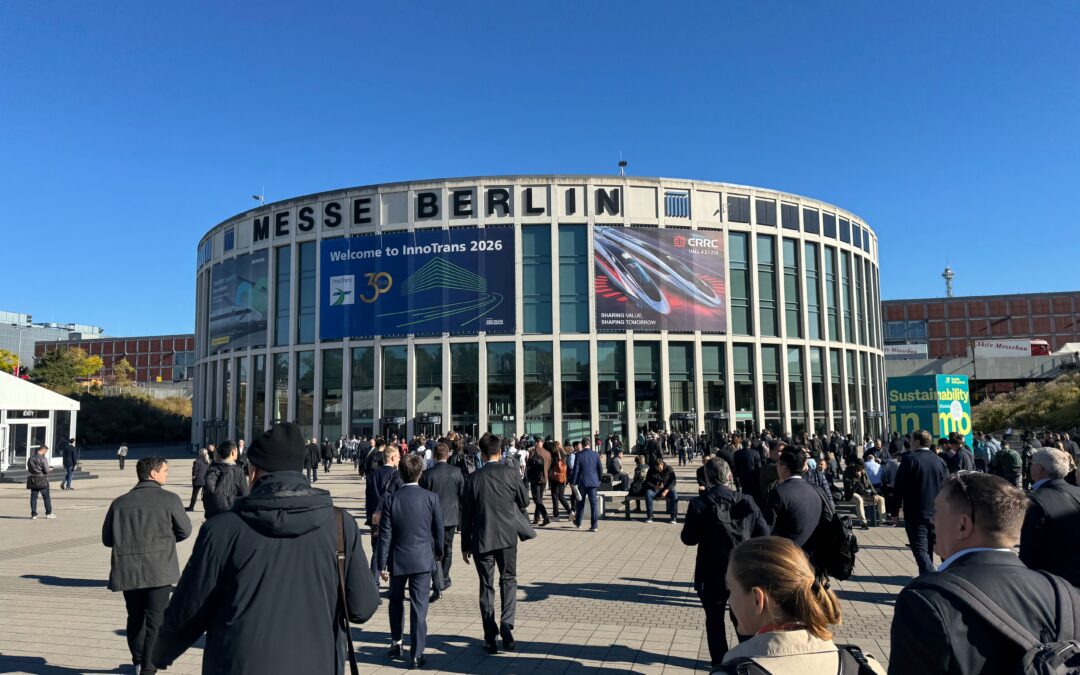
U.S. Takeaways From the Largest Railway Trade Show on Earth By Jordan Pokorney, Manager of Outreach & Engagement There’s nothing like InnoTrans. Held every two years since 1996 at the massive Messe Berlin, InnoTrans is where the latest transit technology is...
Washington DOT Seeking Comments on Cascadia Bullet Train


Washington is designing a transformative high-speed line
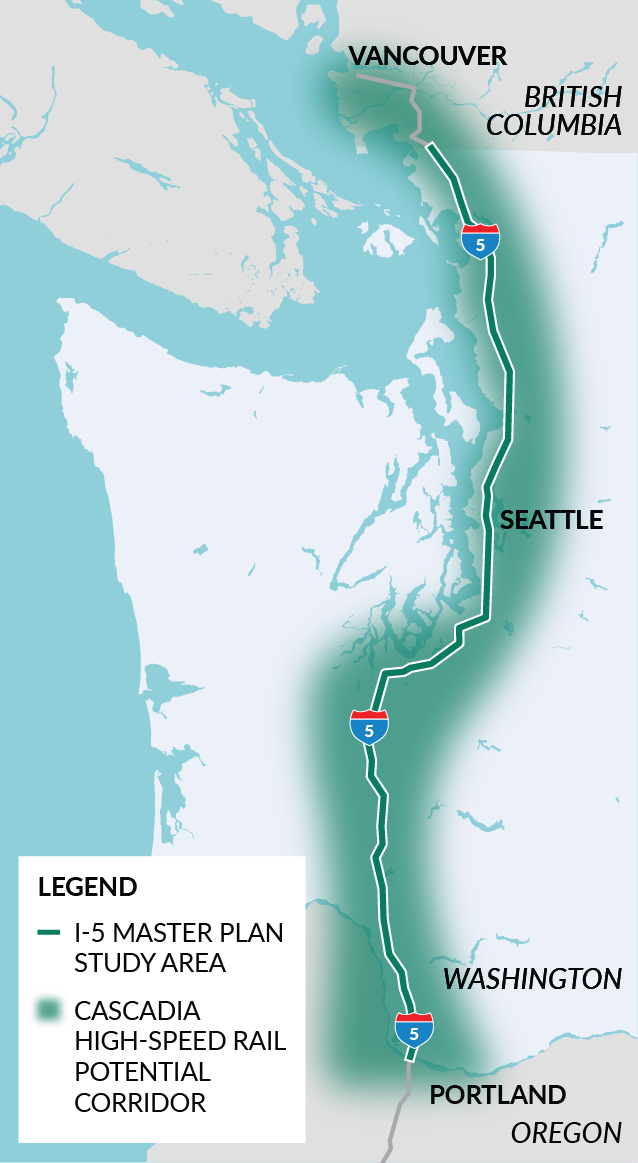
The Washington State Department of Transportation (WSDOT) is taking public comment on its study for a high-speed line between Portland, Seattle, and Vancouver, B.C. The study will be released in 2028. Go here to find the brief survey, which is active through November 13.
The momentum for high-speed rail is driven primarily by rising congestion in the region’s main transportation corridor, Interstate 5. The business community, labor organizations, and some environmental groups have been strong supporters.
The Cascadia megaregion—including the metro areas of Portland, Seattle, and Vancouver, B.C.—is projected to add roughly 3.4 million people by 2050, an increase of about 25 percent over 2025, according to a Cascadia High-Speed Rail Market Analysis. The same analysis found that 80 percent of I-5 in Washington will experience “medium/high congestion” by 2050, up from 59 percent currently. The forecast for Oregon is even starker: There will be “severe” congestion on 78 percent of I-5 by 2045, five years ahead of Washington’s time horizon. That figure was 33 percent in 2019.
The region is now served by Amtrak’s Cascades line, which had nearly a million riders in FY 2025. That was third-highest ridership among Amtrak’s state-supported routes outside the Northeast, and the fifth-highest overall. Even so, cars account for more than 98 percent of all trips of 100 to 300 miles in the corridor. Planes and trains account for just 1 percent each.
Current status
The Federal Railroad Administration (FRA) awarded $50 million to WSDOT in December 2024 to create a service development plan for Cascadia High-Speed Rail. Washington State contributed another $5.5 million.
Scheduled for release in 2028, the study will lay out potential routes and funding models, and it will offer possible service options, including the number of daily round-trips and stops between Portland and Vancouver. It will also include cost-estimate ranges and propose a phased-implementation plan. It will not suggest stations or recommend a specific route. WSDOT emphasizes that the high-speed line is designed to complement rather than replace the existing Amtrak Cascades service.
Early discussions of the project often described it as “ultra” high-speed rail and said it would reach speeds up to 250 mph. Recent discussions cite a potential range between 160 and 250 mph. Broadly, the aim is to cut travel times between the line’s three hubs to roughly an hour per segment; that is, a trip between Seattle and either Portland or Vancouver should take about an hour. Driving and flight times for those trips are roughly 2.5 to 3 hours, factoring in airport terminal time, Most Amtrak trains take 3 to 4 hours.
Simultaneous with the service development plan, WSDOT is working on an I-5 Master Plan to “identify current and future transportation needs along I-5” and “consider how I-5 can better connect to transit, passenger rail, walking, biking and other transportation modes.”
Together, the I-5 Master Plan and Cascadia High-Speed Rail project are known as the Cascadia Program. WSDOT notes that “this transformative vision, which seeks to fundamentally improve regional mobility and economic competitiveness, depends heavily on collaborative input,” and it “encourages residents, business owners and others who travel the region” to share their thoughts. Again, the online survey is available through November 13.
Need for HSR
The region will add 1.8 million jobs by 2050, according to the Cascadia High-Speed Rail Market Analysis. At the same time, car trips in the corridor are time-consuming, expensive, and getting worse. Seattle-area drivers lost an average of 68 hours to congestion in 2025, according to data from the Kirkland, Wash.-based traffic analytics company INRIX. That’s 19 hours above the national average and 8 percent worse than 2024, giving Seattle the 10th worst congestion in the US and the 22nd worst globally. Portland drivers lost 41 hours, and two of the nation’s top 31 truck bottlenecks are on I-5 in Portland.
A 2026 analysis by ConsumerAffairs found that Seattle-area drivers had the fifth-highest commuting cost in the nation—about $10,000, versus the national average of $6,770. Portland ranked 21st, with an average commuting cost of nearly $7,500. San Francisco had the highest commuting cost, with an average of about $10,900.
Amtrak’s Cascades line, which stops at 16 stations between Vancouver, B.C., and Eugene, Oregon, could serve commuters in theory. Unfortunately, it’s slow. The fastest direct train from Portland to Vancouver, B.C., takes about 8 hours. It’s also unreliable—largely because of heavy freight traffic on the line. In 2025, trains in the Oregon portion had an on-time performance rate of 70 percent; in the Washington segment, the rate was just 61 percent. The average for all state-supported Amtrak routes was 78 percent.
Cost estimates
The most recent published cost estimate for the line is $24 to 42 billion. That’s from a 2017 feasibility study, but a 2023 independent review for the Legislature’s Joint Transportation Committee concluded that the cost would depend on how much of the route is tunneled. The review revised the original estimate to between $36 and $63 billion, in 2023 dollars, and found that a “state of the art” alignment requiring roughly 30 percent tunneling could cost between $36 billion and $150 billion.
WSDOT has not published a new cost estimate. The 2028 Service Development Plan is expected to offer high-level cost ranges.
For comparison, WSDOT’s 2019 business case put the cost of adding a lane to I-5 in each direction within Washington—277 miles—at $108 billion in 2018 dollars. (The total distance between Portland and Vancouver, B.C. is roughly 315 miles.) Briefing state legislators on the plan in 2019, WSDOT’s then-Secretary Roger Millar framed the tradeoff bluntly: widening I-5 from the Oregon border to British Columbia would cost “$110 billion-ish,” would “probably take as long as it would take to build a high-speed rail system between the communities,” and the new lanes “would probably be full of traffic by the time we got finished building it. And it would still take you all day to get from Portland to Vancouver, B.C.”
Supporters
Cascadia High Speed Rail requires both cross-state and cross-border cooperation, and WSDOT is working with several partners to create its service study. They include the Oregon Department of Transportation, Oregon Metro, and the Ministry of Transportation and Transit in British Columbia.
A key strength of the project in building broad, regional support has been the Cascadia Innovation Corridor (CIC), an advocacy group with the goal of making Cascadia “the world’s first sustainable mega-region, as characterized by robust economic growth, reduced greenhouse gas emissions, and affordable housing for all residents.”
Microsoft’s vice chair and president, Brad Smith, spoke at CIC’s 2025 annual conference, which included a special event devoted to high-speed rail and was designed to give attendees “strategies to take back to your communities” and opportunities “to build relationships with other mayors, county executives, transportation and planning leaders, and private sector stakeholders.”
Microsoft has been a key supporter of the high-speed line for a decade. It gave nearly $575,000 toward the initial feasibility study, conducted between 2017 and 2019. “Everywhere you go in the world people are thinking big, and the fundamental question we should always ask ourselves is, ‘Why not us?’” Smith said of high-speed rail at the CIC’s 2019 conference.
In a 2024 interview, he noted that “the future I think we should all pursue is one where somebody can get on a train in Portland and get off the train in Seattle in less than an hour, even with two or three stops in between. . . . We have support from leaders up and down this corridor. We just have to resolve we can do this and we’re committed to making it happen.”
Another advocacy nonprofit that supports the project, Cascadia High-Speed Rail, lists more than 40 businesses and business-advocacy groups in its coalition—including Amazon, Costco, J.P. Morgan Chase, and Nordstrom—plus seven labor organizations, eight local government entities, and four “transportation and environment” groups.
Challenges
Some groups have pushed back on the HSR proposal, on the theory that the money could be better spent on improving Amtrak’s Cascades route. An essay in the Seattle Times summed up this perspective. The authors argued that upgrading the Cascades to achieve the goals set by the Washington State legislature in 1993 would cost about $15 billion and require about 300 acres of land.
“That’s one-tenth of the cost,” they wrote, “and one-tenth the new land requirement” of a high-speed line. “We need Amtrak Cascades upgrades by 2030, not ultra high-speed rail in 2050, for our health and climate.” The 1993 legislation established a “high-speed ground transportation program,” with the goal of achieving a 2.5-hour train ride between Portland and Seattle by 2010 and a 2-hour ride by 2020. (Neither target was met.)
Moving beyond either/or
WSDOT has perpetuated the either/or framing of the high-speed line’s opponents. It officially describes the projects as “complementary” (as noted above), but it has largely treated the Cascades line and Cascadia High-Speed Rail as discrete projects. For example, it got both projects accepted into the FRA’s Corridor ID program—separately—in 2023. But discussions of the high-speed line have been underway since 2016.
Conceiving and planning them from the outset as a unified, phased project would help break down this false binary. Tunneling, for example, will be the most expensive element of both upgrading the Cascades route and building a high-speed line. Any HSR routing options should take that reality into account.
The challenge, in short, isn’t deciding which of these projects is more worthy of investment. Both are well worth it. The great challenge is to conceive and plan them now in a way that maximizes their potential—and minimizes their costs—down the line.
Get Involved
Tell Congress: It’s time to reconnect the country with high-speed and regional rail!
The Latest from HSRA
Our Latest Blog Posts
Check out the latest news, updates, and high speed rail insights from our blog!