Take the SurveyWashington is designing a transformative high-speed line The Washington State Department of Transportation (WSDOT) is taking public comment on its study for a high-speed line between Portland, Seattle, and Vancouver, B.C. The study will be released in...
FRA Administrator Half Right, Half Wrong About Speed
Both eliminating slow zones and building new high-speed lines are urgent.
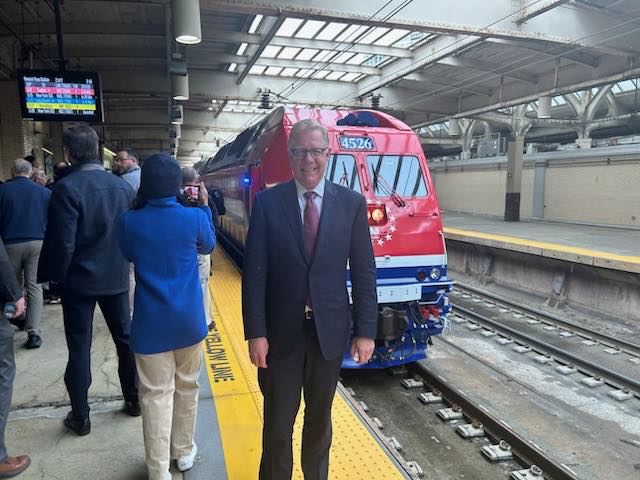
“It’s not about how fast you go, it’s about how slow you don’t go,” David A. Fink, administrator of the Federal Railroad Administration, said last week in New Jersey, aboard a ceremonial cutover train ride on the new Portal North Bridge over the Hackensack River, on the Northeast Corridor between Secaucus and Kearney.
He’s right about the need to un-clog the passenger-rail system, so that trains aren’t stopped waiting for clearance. But when we hear “It’s not about how fast you go,” it sounds like low expectations.
It’s another way of saying: We’ll never have high-speed rail. We’ll never have what’s common in other parts of the world: trains that travel 200+ mph on dedicated rights of way. No matter how much the public says they want it, and no matter how much faster, safer, and more pleasant trips on these trains would be compared to driving, we simply can’t have them.
When Americans are asked, though, they do say they want trains that go faster. By a wide margin. This is a political winner.
We urge the Administration to raise its expectations for the level of rider demand created by trains of world-leading speed, frequency, reliability, and comfort.
The United States is neither too big nor too car-brained to develop high-speed lines along many corridors. To rattle off a few: how about New York to Chicago, Washington to Miami, St. Paul to Miami, Chicago to Toronto and St. Louis, Dallas to Houston, Vancouver to Portland, San Francisco to Anaheim—and, of course, the Northeast Corridor?
It is a realistic goal for these routes to be served by hourly trains running at 220 mph and delivering passengers in half the time it takes to drive. And these routes are commercially viable because—unlike a plane, which travels mostly from point to point—a train route with 10 stops serves potentially dozens of markets.
Get Involved
Tell Congress: It’s time to reconnect the country with high-speed and regional rail!
A “yes, and” approach to great trains
So it IS about how fast you can go. And it’s time for the U.S. to join the advanced world of passenger rail.
However, “it’s about how slow you don’t go” is correct. The administrator made his remarks at the opening of a new bridge that will break a bottleneck on the Northeast Corridor. Our country’s rail system is peppered with similar slow zones, pinch points, congested areas, bottlenecks, and conflicts between passenger and freight trains that slow or stop passenger trains. These impediments are a drag on both average speed and reliability.
The Transit Costs Project at New York University recently published a proposal to boost the performance of the Northeast Corridor by modernizing the rolling stock and making dozens of improvements, large and small, to the tracks, stations, electrical catenary and schedule. These upgrades would shorten the trip from Boston to Washington by almost three hours. It’s a savvy strategy. The Federal Railroad Administration and state transportation agencies should pursue it vigorously—in the Northeast Corridor and throughout the nation.
Anyone who has ever driven on a long road trip knows what a killer even a short stop is for your average speed. If your cruise control is on 75 mph for two hours straight, a 10-minute stop to go to the rest room—don’t kid yourself, it’ll always be 10 minutes—brings down your average speed to 69 mph. A stop for gas and everything – 20 minutes – brings your average down to 64 mph.
It’s the same for trains. A train that moves steadily, staying on schedule, is just sunk when it encounters a wait for a freight train to cross; or has to sit in a siding waiting for a train going the other direction on a single track to pass; or if part of the route has a top speed of 40 mph because of old, rotten tracks.
Passengers hate it. They wake up, look around, see they’re stopped in the middle of a corn field or an industrial area, and know their chance of arriving on schedule is ruined. The only question is how late they’ll be, because a delay in one location can cause a train to miss its slot and experience further delays down the line.
Station stops already bring average speed below top speed—no complaints about that. But unscheduled stops due to congestion on a single track, or a freight train that won’t fit on a siding (“no-fitters,” in industry lingo), are problems that can be solved with engineering, construction, and money.
As we’ve said before, the United States needs a program to identify these speed obstacles and fix them like the urgent problem they are—with new tracks, double and triple mainline tracks, more and longer sidings to accommodate today’s protracted freight trains, more crossovers, and grade separations to reduce conflicts.
Ultimately, though, trains won’t go fast enough to achieve a significant mode shift in travel—away from driving and flying—unless the nation builds new railroads. So the administrator should think big about high-speed rail and the need for new railways, especially outside the Northeast Corridor.
The Latest from HSRA
Our Latest Blog Posts
Check out the latest news, updates, and high speed rail insights from our blog!