Take the SurveyWashington is designing a transformative high-speed line The Washington State Department of Transportation (WSDOT) is taking public comment on its study for a high-speed line between Portland, Seattle, and Vancouver, B.C. The study will be released in...
National Passenger Rail Policy Left to Local Volunteers
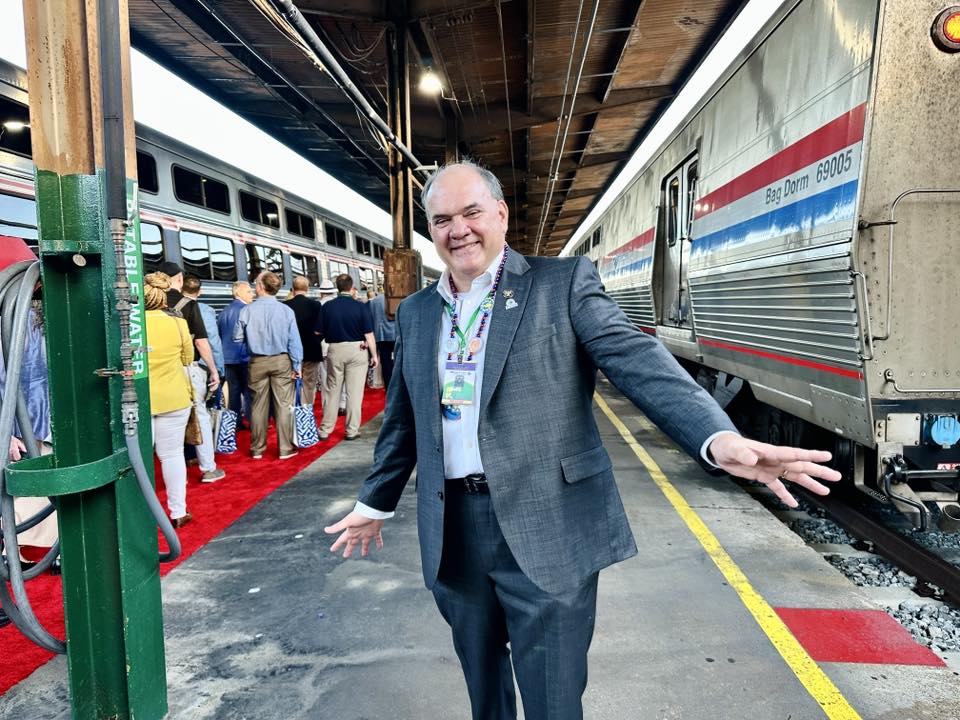
Chairman behind Amtrak’s Mardi Gras Service says federal government should do more
Knox Ross, the chairman of the Southern Rail Commission, is a volunteer. He sometimes gets reimbursed for travel expenses if he goes to Washington, sometimes not. In his day job, he’s a certified public accountant, a principal in the firm Ross & Betts, which specializes in individual, small business, and farm accounting and taxation. He also served as mayor of Pelahatchie, MS from 2001-16.
The other 17 members of the Commission, representing Alabama, Louisiana, and Mississippi, are also volunteers. Yet this group of everyday citizens, some with political or government experience, pulled together and restored passenger rail service between Mobile, AL and New Orleans last year, which had been suspended 20 years prior in the aftermath of Hurricane Katrina.
The effort to establish the Mardi Gras Service, which runs two round trips a day, began in earnest around 2011. “Little did we know how hard this would be, that we would go through multiple presidents of host railroads, that we would go through [Surface Transportation Board] hearings, we would go through talking to different states about funding this whole thing,” Ross told viewers of a High Speed Rail Alliance webinar on March 27, hosted by Executive Director Rick Harnish.
Get Involved
Tell Congress: It’s time to reconnect the country with high-speed and regional rail!
Amtrak, states, and the federal government
Ross said much of the public is unaware of the limitations of Amtrak. While the company owns and operates the Northeast Corridor, it also runs 14 long-distance routes on tracks leased from freight railroads. Amtrak also operates shorter-distance, state-supported services, which are subsidized by a state or multiple states and run mostly on freight railroads, though some run partially on commuter lines.
Amtrak can offer some technical or coordination assistance if someone calls and asks, but not a lot. “If I weren’t doing this, I would assume that Amtrak’s out there saying, ‘Alright, we need to find new places to run trains.’ Well, no, it’s really the opposite, and this is not meant as a criticism in any way, I’m just telling you how it is. It’s up to the states, or the organizations like ours, or advocacy organizations to say we want service on this route.”
Ross says the Amtrak service development staff does a good job, but getting service in your local area requires a bottom-up approach.
For example, the federal government is not completely lacking in support for Amtrak corridor service. There’s the Federal Railroad Administration Corridor Identification and Development Program, the Consolidated Rail Infrastructure and Safety Improvements Program, and the Restoration and Enhancement Grant Program, all of which provide help to get service up and running—but states have to apply for it.
Washington does not determine which new passenger rail routes would be good for the nation. Again, the current pipeline for service expansion starts from the bottom up, with states and coalitions taking the lead. We would like to see the federal government take on more leadership in growing out the passenger rail network, especially for routes that cross state lines—and we are not alone in this sentiment.
“Do I think that the federal government should do more in guiding this and supporting it? Absolutely I do,” Ross said. “You shouldn’t have people like me out there doing this. I’m just some yahoo from Mississippi. I learned it on the fly. In a perfect world, you would constantly be looking at city pairs, and saying we need to connect these city pairs, and it is something of national import that we put together these city pairs.”
State departments of transportation are often focused entirely on highways. “I think there is much more of a role for the federal government to play,” Ross said. “We shouldn’t be relying on the states to do a lot of this stuff. It’s just really not in their wheelhouse.”
Building the coalition
Ross has been a member of the Southern Rail Commission since 2011 and chairman since 2015. During his 15 years on the Commission, he has made alliances with elected officials whose constituents have wanted passenger rail service restored on the Gulf Coast, including former Mississippi Gov. Phil Bryant, and the late U.S. Sen. Thad Cochran of Mississippi. “Now we have a different set of political champions, in Louisiana, [Sen.] Bill Cassidy, the senator there is a great champion of it, as well as [Sen.] Cindy Hyde-Smith in Mississippi,” he said.
Ross says statewide political support in Alabama is lacking, but mayors in Birmingham and Tuscaloosa are allies. “We try to stay in good graces of everybody,” he said.
In 2016, the commission ran an inspection train to examine the Mardi Gras route, “and this is where we really began to learn and understand that this was not a political thing that one political persuasion was for this,” Ross said. “This is one of the few things that you can work on that both political parties and everybody else, just pick’ em, they’re usually all for this. They very much see the benefit in it, and these small communities saw it especially.”
More routes on the horizon
Meanwhile, the Southern Rail Commission is considering several options for expansion:
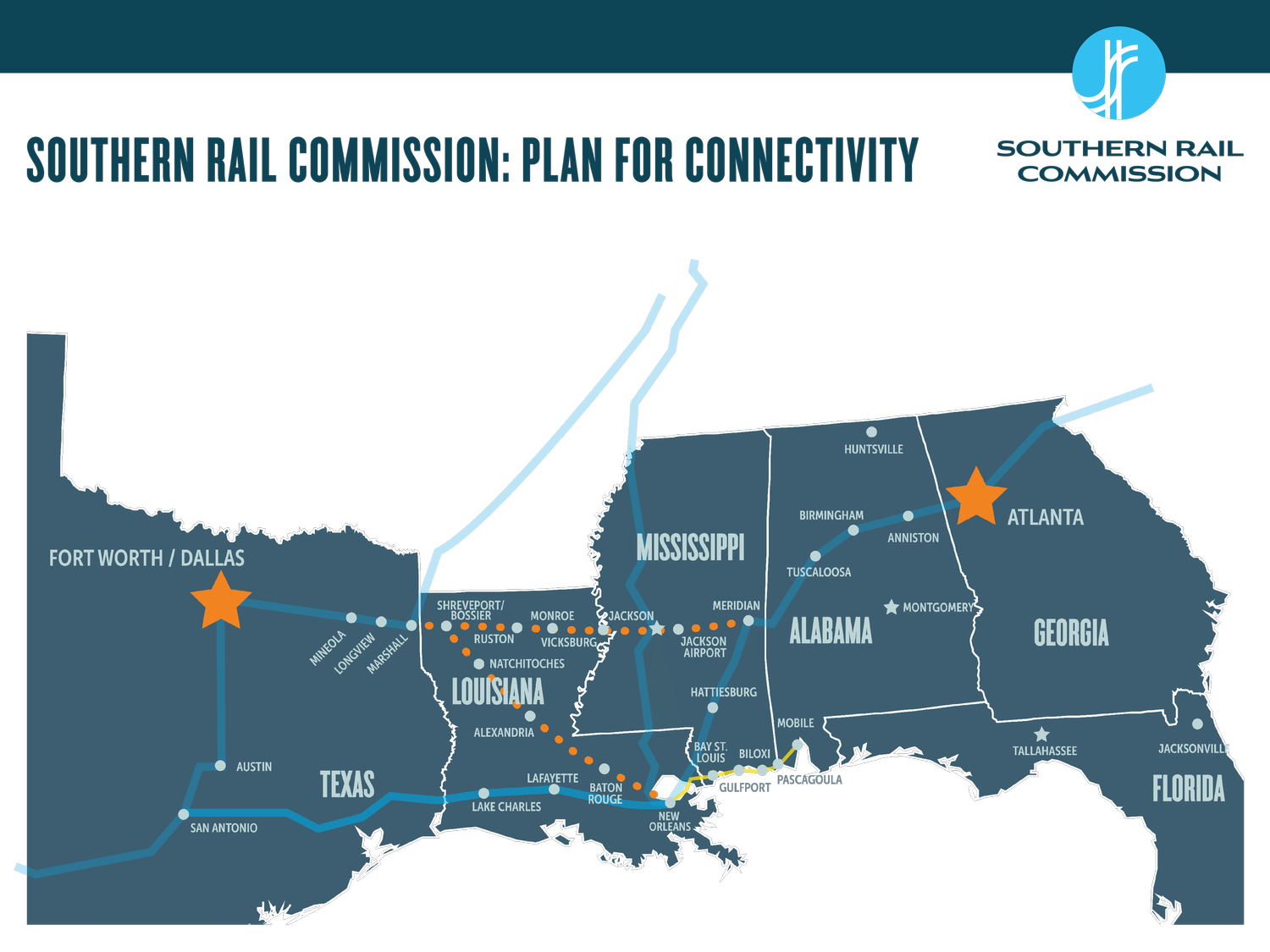
- Baton Rouge to New Orleans, a route which has been studied many times since 1984. The merger of Canadian Pacific and Kansas City Southern, which formed the CPKC in 2023, resulted in an agreement to allow one passenger round trip daily, but the railroad would be open to more with capacity improvements.
- Meridian, MS to Fort Worth, TX. The Amtrak Crescent, with daily service between New York City and New Orleans, would split at Meridian, with half the train going to New Orleans and half to Fort Worth, presumably sharing the route with the Texas Eagle from Marshall, TX to Fort Worth.
- Atlanta to Dallas. Ross says a representative of the Federal Railroad Administration attended a Southern Rail Commission board meeting and brought a map displaying city pairs of who travels where around the South. “What we discovered was there was this big thick black line that people traveled between Dallas and Atlanta,” Ross said. So that’s where we need to concentrate our efforts.”
- Florida. While planning for the Mardi Gras Service, the commission has found interest in serving Pensacola and Tallahassee, and even further into Florida, possibly to Jacksonville or Orlando.
The Latest from HSRA
Our Latest Blog Posts
Check out the latest news, updates, and high speed rail insights from our blog!