Take the SurveyWashington is designing a transformative high-speed line The Washington State Department of Transportation (WSDOT) is taking public comment on its study for a high-speed line between Portland, Seattle, and Vancouver, B.C. The study will be released in...
Amtrak and New Jersey Transit began transferring the second track from the Portal Bridge to a new, fixed span over the Hackensack River on October 9. When this “cutover” work is complete on the new Portal North Bridge, the old swing bridge will be permanently retired.
The new bridge is a two-track, 50-foot-high, fixed three-arch span that runs nearly 2.5 miles, including approaches. It eliminates a critical chokepoint in the Northeast Corridor (NEC). The bridge is “a miracle,” one expert on the corridor, David Alff, told the New York Times. “It’s a monument, a commitment to public works and a testament to good planning and to everyone who keeps the corridor running.” Alff is a professor at SUNY-Buffalo and wrote The Northeast Corridor, a 2024 history of the line.
The old bridge carried more than 450 daily trains and 200,000 daily riders. The Times recently described it as “one of the worst bottlenecks along the Northeast Corridor.” Workers had to “slam tracks back into place with sledgehammers,” and it frequently jammed, causing delays all through the corridor.
The new bridge is rated for 90 mph, versus 60 mph for the old bridge.
The Portal North Bridge has no movable parts, so there is no opening for marine traffic—and thus no mechanism to fail. Cutover work on the first track began in February 2026. The bridge opened to riders three days early because overhead wire failures on the old span were causing hours-long delays. It was the first major bridge cutover in a series to come.
The Portal North Bridge is part of a wider overhaul and upgrade of rail infrastructure throughout the NEC, which is 457 miles long (from Boston to D.C.) and carried more than 800,000 passengers daily in 2019. Amtrak has nearly 30 projects in either the concept or construction stage in the NEC, including a major tunnel project in Baltimore and several chokepoint bridges in Maryland, as the Alliance reported separately.
The Maryland projects are scheduled for completion in the mid-2030s. In conjunction with the massive Gateway Program underway in New York and New Jersey, they promise faster, more reliable train service throughout the corridor over the next decade. Significantly more trains will run as well: Amtrak’s goal is to serve 66 million passengers—roughly double its current ridership—by 2040.
The total Portal North Bridge project cost is about $1.73 billion, with $766.5 million coming from the Federal Transit Administration. The rest is split among New Jersey, New York, Amtrak, and the US Department of Transportation.
Amtrak and NJ Transit have reduced service during the work and expect to return to a normal schedule in mid-November.
Guaranteed funding means lower costs
The Portal North Bridge’s story underscores the need for not only more money for railroad projects in the US but guaranteed, pre-authorized funding streams in the new federal surface transportation bill. (Learn more and sign our petition here.)
The bridge design was ready in 2014; the environmental review cleared in August 2017; and site preparation began that October. Then the project sat for four years. Work began October 2021 after the Infrastructure Investment and Jobs Act supplied the money.
That specific delay points to a larger challenge: Passenger-rail projects in the US have no guaranteed stream of federal money, the way highways do, so they wait in line and compete for appropriations that arrive (or don’t) on a political schedule.
And delays multiply the costs. A 2002 study of 258 transport projects found that rail projects overran their budgets by 44.7 percent on average. More recent research by the study’s author, Oxford’s Bent Flyvbjerg, found that each additional year of construction correlated with a 4.6 percent increase in cost overruns.
Guaranteed funding is especially relevant in the case of the Portal North Bridge, because a second span is part of the Gateway Program’s vision for expanding capacity in the NEC. It calls for two separate, two-track spans over the Hackensack—Portal North and Portal South—to operate in conjunction with two new Hudson Tunnel tubes, now under construction and expected to open in 2035.
However, Portal South has no funding and no construction timeline. The opening of Portal North Bridge is a great success, and it eliminates a critical bottleneck in the NEC. But adding capacity will mean following through with construction of the Portal South Bridge.
How to make it happen
The surface transportation bill—now being debated in Congress, with passage expected in 2027—can ensure that work on Portal South Bridge gets underway and proceeds on a steady schedule.
That’s why the Alliance is pushing for passenger rail and transit to receive the same pre-authorized, advanced appropriations that highway projects have long enjoyed. It’s the difference between a project waiting years for funding, while costs spiral, and one that doesn’t have to wait at all.
Help make that future a reality by signIng our petition and joining the Alliance.
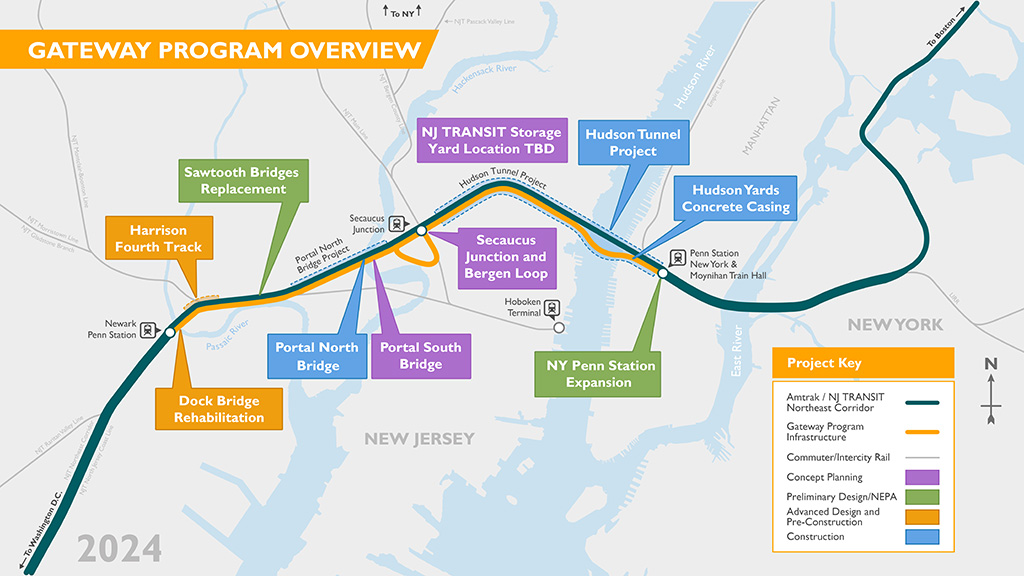
A map of the Gateway Program, which is a series of rail infrastructure projects that will improve the most congested 10-mile section of the Northeast Corridor. Credit: Amtrak
Subscribe to Our Weekly Newsletter
Your #1 source for the latest news in high-speed and regional rail – and how you can get involvedThe Latest from HSRA
Our Latest Blog Posts
Check out the latest news, updates, and high speed rail insights from our blog!