You can provide feedback to IDOT through October 2026. The Illinois Department of Transportation (IDOT) is working to update the 2023 State Rail Plan, with a final draft expected July 2027. State rail plans set future goals for freight and passenger rail. They can be...
First of three critical projects is under construction
Maryland has quietly become one of the key sites of railway upgrades in the Northeast Corridor (NEC).
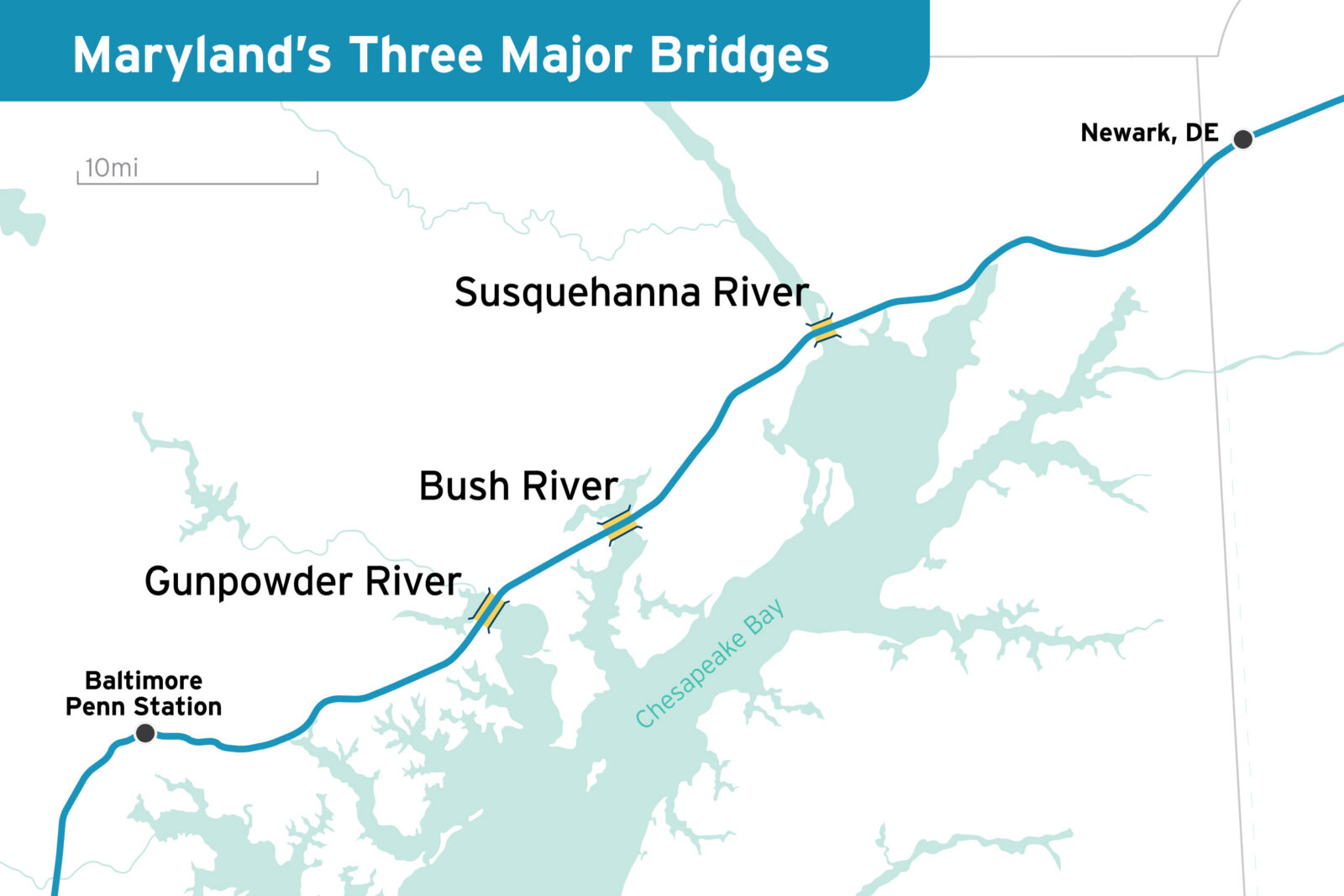
Three consecutive water crossings on a 35-mile stretch between Baltimore and the Susquehanna River will soon be rebuilt or replaced: the Gunpowder River Bridge, Bush River Bridge, and Susquehanna River Bridge. This is in addition to the massive B&P Tunnel Replacement Program now underway in Baltimore (as the Alliance recently described).
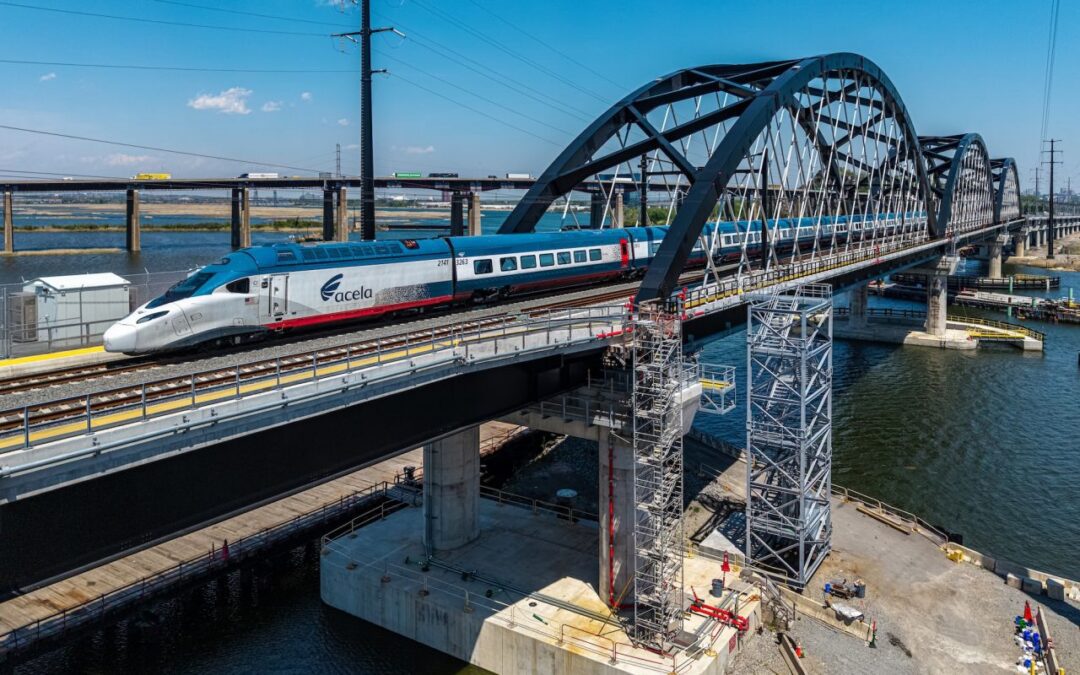
At each crossing, Amtrak’s plans call for a fixed bridge carrying four tracks (up from two). The largest of the three projects, the Susquehanna, is now underway. Early construction began in July 2024, following removal of the remaining piers from an 1866 predecessor to the current bridge. The target completion date is 2036.
Planning for the bridge began in 2013. It was then funded through the Infrastructure and Investment Act, which Congress passed in 2021. That timeline underscores the critical need for states to have projects ready to go when federal funding becomes available.
The current crossing is a two-track deck truss that is 120 years old and more than 4,000 feet long. Amtrak calls it a “serious bottleneck,” since three tracks narrow to two at the bridge. Trains slow to 90 mph to cross it, and the swing span must be opened manually for taller marine traffic. With seventeen fixed spans and a single swing span over the navigation channel, it carries about 110 trains daily—including 80 to 90 Amtrak, 12 to 14 MARC, and 8 to 10 Norfolk Southern trains. (MARC is the Maryland Area Regional Commuter system.)
The replacement will consist of two new, two-track fixed bridges, which will double the corridor’s capacity at the crossing and provide 60 feet of vertical clearance. One span is designed to 125 mph speeds, primarily MARC trains and freight service; the other is designed to handle 160 mph Amtrak/Acela trains.
The project also includes modernizing five miles of track and three interlockings around the bridge. The cost is approximately $2.7 billion, $2.1 billion of which was awarded through the IIJA in 2023.
Amtrak announced this week that it has selected HNTB for architectural and engineering services for the Bush River and Gunpowder River bridges. The process “will include community engagement to inform the final design.” Both bridges were built in 1913, and each carries more than 100 trains per day (Amtrak, MARC, and Norfolk Southern). Both bridges limit trains to about 125 mph. Both will be expanded from two tracks to four tracks. Construction on both is expected to begin around 2030 and will be done by the mid-2030s. An Amtrak executive noted that both are “important examples of Amtrak’s long-term vision to modernize the Northeast Corridor’s century-old tunnels, bridges, and more.”
At Bush River, Amtrak will replace a half-mile, two-track movable drawbridge built in 1913 with a new, fixed, high-level bridge that can support speeds up to 160 mph. Currently, the mechanical span requires a 20-person crew to open it for marine traffic on summer weekends. The Federal Railroad Administration’s projected cost is $750 million. At Gunpowder River, Amtrak will replace a bridge that currently has just twelve feet of vertical clearance with a fixed-span bridge that can support speeds of at least 145 mph. The FRA’s projected cost is $1.3 billion.
Amtrak believes both projects will increase speeds, capacity, and reliability by not only doubling the tracks but upgrading the track alignment, signal systems, and electric-traction infrastructure.
Takeaways
Amtrak’s new Airo and NextGen Acela trains get the media spotlight, with good reason: State-of-the-art trains make for great visuals and video clips. Bridges and signal systems—not so much. But the truth is that nuts and bolts infrastructure is as important as fast trains in building a great railroad.
The reason Acela reaches its top speed of 160 mph on just 40 of the NEC’s 457 miles isn’t the equipment. It’s that, currently, just four short stretches of corridor—in Rhode Island, Massachusetts, and New Jersey—are built to allow it. (Acela’s best average speed anywhere on the corridor is 103 mph, on the 69 miles between Baltimore and Wilmington.)
Infrastructure—the unglamorous, nuts-and-bolts half of the railroad—determines whether the more glamorous half can do what it was built to do.
But what the new bridges will not do is add more service. The number of trains crossing them is set by Amtrak’s operating plan, not by the number of tracks. Amtrak has a stated goal of doubling ridership to 66 million by 2040, up from its FY 2025 ridership of 34.5 million. But it has no published target for increased service in Maryland.
MARC, for its part, has proposed the most ambitious expansion in its history—a $13.7 billion, 25-year plan for both expansion and repair projects. It would increase service on the Penn and Brunswick lines and extend service into Virginia, Delaware, West Virginia, and western Maryland. But the plan has no funding behind it.
In short, the number of Amtrak and MARC trains running through Maryland, once it eliminates the bottlenecks, will still come down to political will and funding.
Why Maryland?
It’s worth underscoring: These projects are moving forward because Maryland had done the necessary groundwork.
The Susquehanna replacement began conceptual design in 2013. The Federal Railroad Administration, the Maryland Department of Transportation, and Amtrak jointly screened alternatives. The project had cleared environmental review—and moved into advanced engineering and permitting—by 2017. When the IIJA passed, four years later, the project was already on the FRA’s NEC Project Inventory as a high priority. Amtrak awarded the major construction and demolition contracts in 2023.
The Bush and Gunpowder projects, meanwhile, both appear on the Federal Railroad Administration’s Northeast Corridor Project Inventory as Major Backlog Projects, the category reserved for major bridges and tunnels that can’t be maintained through routine work. Both received federal awards through the IIJA for planning and project development: $19 million for Bush River and $30 million for Gunpowder.
The IIJA didn’t create these projects, in other words. The $2.1 billion for the Susquehanna, in particular, went to a project that had been in the works for a decade. Which is often true: the states that build are the states that have invested in plans—for years and sometimes decades—with nothing to show for it but studies and surveys.
Maryland was ready get to work—plans in hand—when Washington was finally ready to invest. It was prepared. The money followed.
Get Involved
Tell Congress: It’s time to reconnect the country with high-speed and regional rail!
The Latest from HSRA
Our Latest Blog Posts
Check out the latest news, updates, and high speed rail insights from our blog!