

Take the SurveyWashington is designing a transformative high-speed line The Washington State Department of Transportation (WSDOT) is taking public comment on its study for a high-speed line between Portland, Seattle, and Vancouver, B.C. The study will be released in...
North Carolina Study Finds Asheville Passenger Rail Expansion Would be Good for the Economy
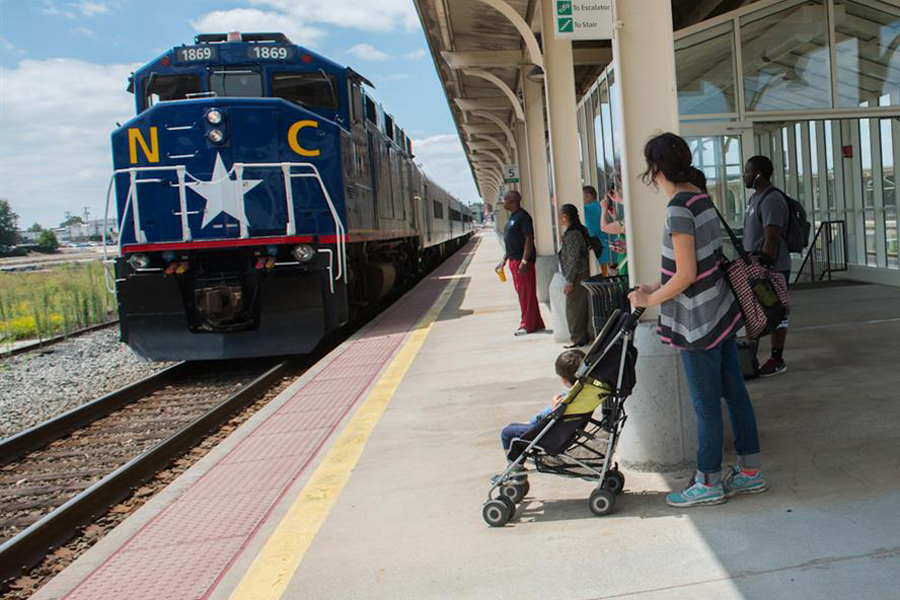
State has several legs in various stages of consideration
North Carolina has long been aware of the value of supporting passenger rail in the state. Now there are hard numbers to quantify that value on a “new” route.
Even though the route examined is neither high speed nor high frequency, it still projects to recover in economic development well more than it would cost to construct and operate. From this, we extrapolate that with passenger rail in general, the better the quality of service – faster, more frequent – the greater yet would be the economic benefit.
The numbers come from a study by the North Carolina Department of Transportation of the potential economic impact of building a passenger rail line from Asheville to Salisbury, where it would connect with the Amtrak long-distance Crescent route and the state-supported Carolinian and Piedmont trains. Previous passenger service on this route, instituted in the 1890s, was discontinued by the Southern Railway, predecessor of the Norfolk Southern, in 1975.
Efforts of one sort or another to restore service began in the 1990s. None has borne fruit yet, though the inclusion of this proposal in the Federal Railroad Administration Corridor Identification and Development Program, and the release of the economic study, appear to have energized backers, who say the start of service may be seven to 12 years out, according to the Asheville Citizen Times.
Get Involved
Tell Congress: It’s time to reconnect the country with high-speed and regional rail!
The state conducted a feasibility study, published in 2023, which outlined the basic plan:
- Distance: 139 miles on Norfolk Southern tracks, four to six intermediate stops, as yet undetermined.
- Travel time: 3:25 minutes to 3:48. The biggest slow spot would be for navigating the Old Fort Loops, a 16-mile stretch east of Asheville that consists of a series of switchback loops traversing an 1,100-foot grade on the existing track, which Norfolk Southern is rebuilding. By car, the trip takes 2:15 to 2:35, depending on traffic.
- Capital cost: $665 million (in 2023 dollars).
- Operating costs for three daily round trips: $5 million-$9.7 million annually (in 2023 dollars).
– and that’s just what can be measured in dollars. The benefit of building a sustainable economy in the communities served, potential real estate development around stations, as well as environmental, safety, and quality-of-life measures, would be of further value beyond the scope of the study.
The construction impact is pegged at 5,280 jobs, $360.5 million in employee earnings, $1.05 billion in total economic output, and $33.6 million in state and local tax revenue.
Ongoing annual benefits would be 305 jobs supported each year, $19.9 million in annual employee earnings, $59.8 million in annual economic output, and $1.8 million in recurring state and local tax revenue.
The North Carolina Department of Transportation called the corridor a “critical connection” between Asheville and the Charlotte metropolitan area, the Piedmont Triad, the Research Triangle, and the Blue Ridge region. The department has called Asheville the “most requested location” not already served in the state.
“Communities along the route, from Asheville to Morganton to Statesville, stand to benefit substantially from renewed access to passenger rail,” the report states. “Increased tourism, expanded foot traffic, and greater visibility will boost local economies, particularly in towns that blend historic character with cultural and recreational attractions. In Asheville, one of the state’s top destinations, improved rail access could support further tourism growth while connecting the city to untapped visitor markets across central and eastern North Carolina.”
As we said, this is not an ideal passenger rail proposal. The service is not as fast or as frequent as we’d like, and given the terrain and population, maybe it won’t be. Yet it STILL projects to turn around every dollar invested into a sound recovery, and then some.
Even while the project is still in the development stage, the city of Salisbury is making plans to accommodate more train passengers. The city plans to renovate the Salisbury station building to expand the waiting area, and to build a second platform with a connecting tunnel, by 2027.
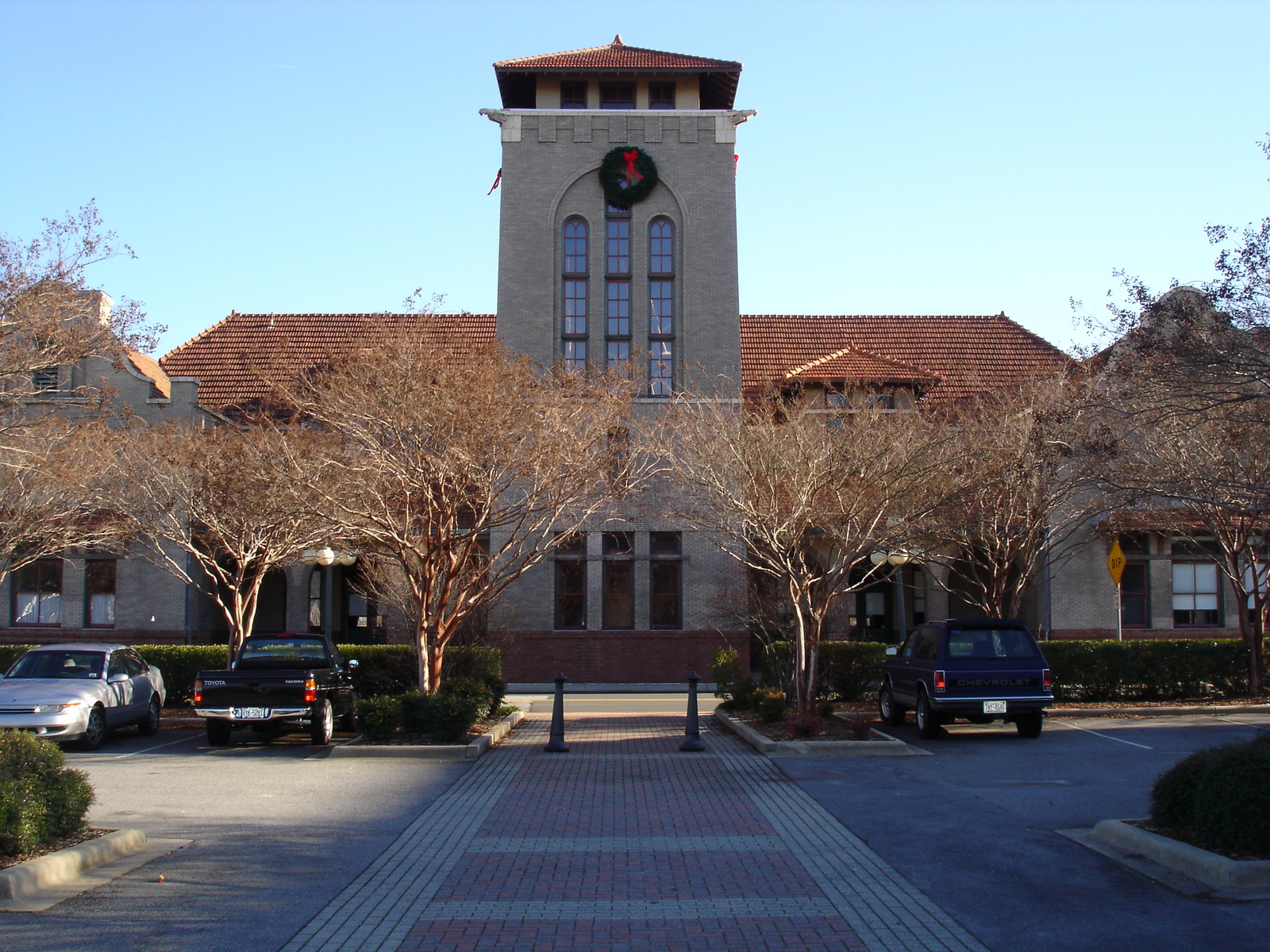
The Salisbury, NC train station entrance. Photo Credit: Mackensen, CC BY-SA 3.0, via Wikimedia Commons
North Carolina is looking for more
North Carolina is eager to expand passenger rail service in the state, which now consists of once-daily round trips by the Crescent, Floridian, Silver Meteor and Palmetto, the state-supported Carolinian, and the state-supported Piedmonts, with four round trips each day between Charlotte and Raleigh.
A 2024 report by the Institute for Transportation Research and Education at North Carolina State University showed 970,000 boardings and alightings per year at the state’s 16 stations. Charlotte, Raleigh and Greensboro are the busiest stations.
In addition, the state has seven proposals accepted into the Corridor ID Program, including the S-Line, a disused former CSX route that is being constructed to serve 110 mph passenger trains, and provide a more direct route between Raleigh and Richmond. This would be part of the Southeast High-Speed Rail Corridor from Washington, DC to Jacksonville, FL. (We don’t consider 110 mph to be “high speed,” but it’s “accelerated” vs. the standard freight tracks that allow a top speed of 79 mph.)
Other Corridor ID plans in North Carolina, besides Asheville to Salisbury, include Raleigh to Wilmington, Raleigh to Fayetteville, Raleigh to Winston-Salem, Charlotte to Kings Mountain, and the North Carolina portion of Charlotte to Atlanta.
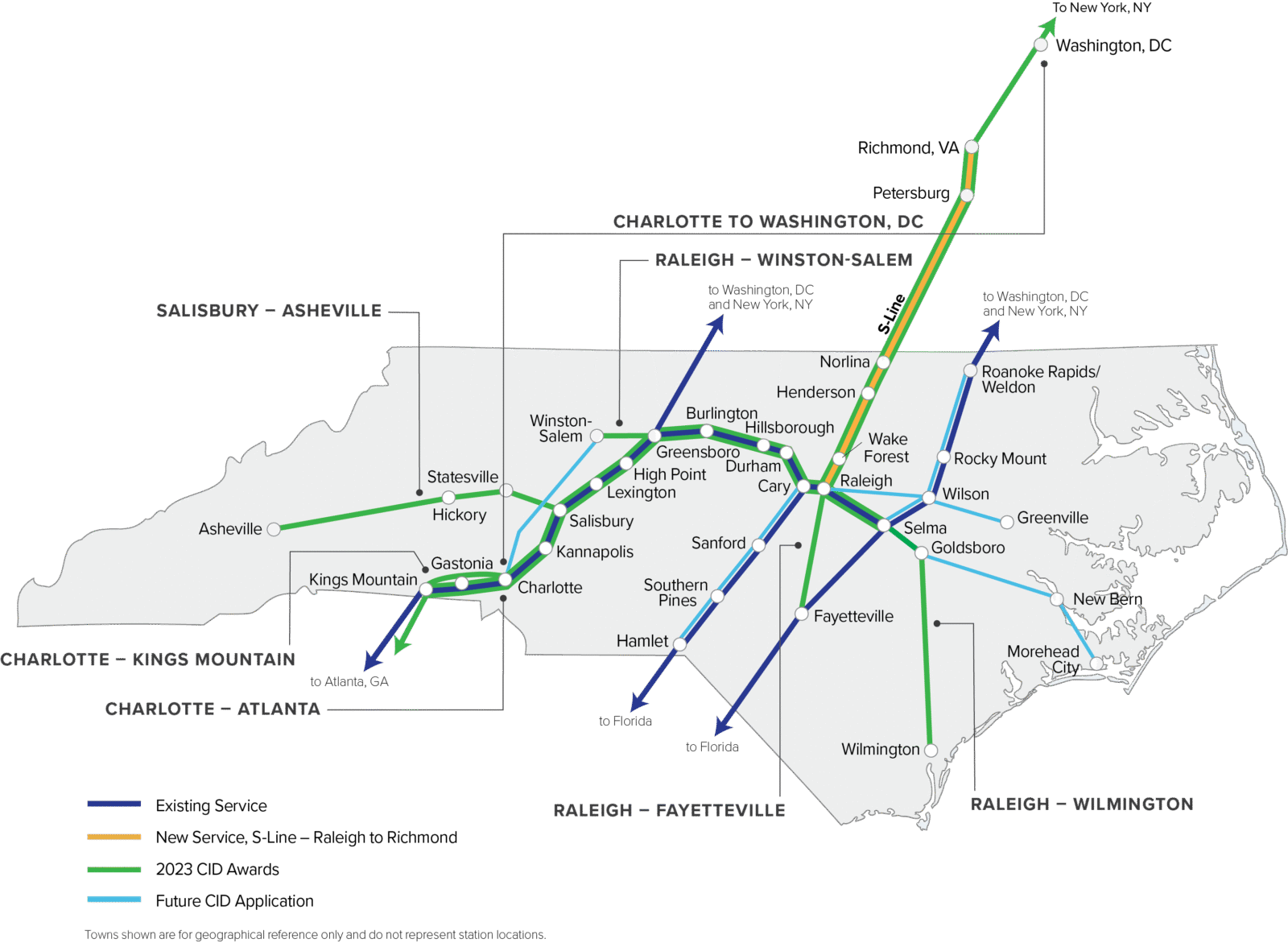
This map shows the routes advancing through the Corridor ID and Development program
The Latest from HSRA
Our Latest Blog Posts
Check out the latest news, updates, and high speed rail insights from our blog!


_station_front.jpg)