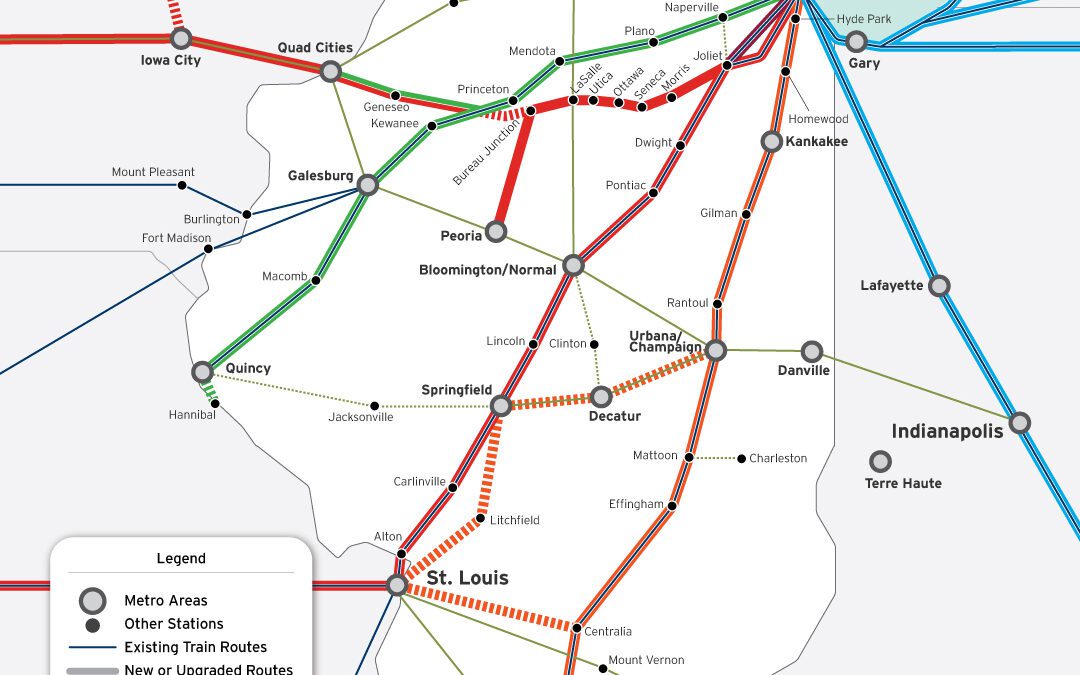
You can provide feedback to IDOT through October 2026. The Illinois Department of Transportation (IDOT) is working to update the 2023 State Rail Plan, with a final draft expected July 2027. State rail plans set future goals for freight and passenger rail. They can be...
Seven Reasons Planning for Frequency is Essential

“Frequency is freedom”
—Jarrett Walker, Human Transit
Frequency, combined with consistent headways, drives ridership.
Greater frequencies reduce total travel times, serve different travel markets throughout the day, and improve system reliability. They make connections with buses, planes, and other trains viable.
Most importantly, frequency liberates travelers from a single make-or-break departure time. This freedom draws riders and creates a virtuous cycle of more ridership, more revenue, and more frequency.
Jump to the seven reasons frequency drives ridership
Riders say they value frequency more than anything else, according to a study by Rice University. In fact, there’s a rule of thumb in the transportation planning business that if you double the frequency, you triple the ridership.
Consistent “headways”—the time between one departure and the next—are also key.
If one train departs at noon and the next train departs at 1 p.m., the headway is 1 hour. Minimum acceptable headways change by the length of a journey. If your time on the train will be only 30 minutes, waiting an hour for a train is too long. For a two-hour trip, hourly departures are probably ok. For very long trips into rural areas, morning and evening departures can be sufficient.
Plan for frequent departures from the beginning
Given that it takes a decade (or more) to complete the federal review and construction process for each increment of development, it’s critical that states plan for high-frequency service and consistent headways from the very beginning.
The plan can include ramping up service levels as new infrastructure is built—but it should be planned from the beginning.
Otherwise, a route with just one or two daily departures won’t cross the tipping point to success. Most people will drive instead.
The seven reasons frequency is essential
Analyst Jarrett Walker identifies seven keys to great trains and transit: 1) It takes me when I want to go 2) it takes me where I want to go 3) It’s a good use of my time 4) It’s a good use of my money 5) It respects me 6) I can trust it and 7) It gives me freedom to change my plans.
Taking these point by point illustrates why frequency is so critical:
It takes me WHEN I want to go
People travel at all times of day and can’t be tied to a schedule based on old ideas of peak-period, peak-direction demand. Business travelers might depart before sunrise; commuters during rush hour; and students, leisure travelers, and shoppers during the middle of the day. More departures offer more choices to more travel markets.
It takes me WHERE I want to go
Getting passengers where they need to go requires a robust network of trains, buses, and even airplanes. Because each mode feeds riders to the others, frequency greases the skids and allows the systems work together as a seamless, integrated whole. A train that makes just one daily run to the airport, for example, is of little use to most people catching a flight that day. Most people will drive or take a ride share. But hourly departures make the train a great option for all travelers—no matter when their flight leaves.
It’s a good use of my time
Total travel time includes every stage of the journey, from the moment you depart to the moment you arrive—including the time spent waiting for the train. Increased frequencies translate into much faster trips.
Consider the trip from Indianapolis to Chicago: Driving takes about 3.5 hours. A high-speed train would take less than 1.5 hours (en route). If train frequency is every 3 hours, the average wait time will be 1.5 hours, and total travel time between stations will average 3 hours (1.5 hours of waiting and 1.5 hours on the train). For some people, though, total travel time will be 4.5 hours (3 hours of waiting and 1.5 hours on the train). That’s an hour longer than driving, even on a high-speed train.
The calculus changes radically when trains depart every hour. The wait time will be 30 minutes, on average. So the average total travel time will be 2 hours. That’s 1.5 hours faster than driving.
It’s a good use of my money
Frequency creates efficiencies of scale that allow train operators to keep costs—and ticket prices—low. Building or improving railways involves significant upfront capital costs for building tracks and signals, easing hills and curves, eliminating grade-level road and railroad crossings, and electrification. The more trains running on a route, the more revenue the line generates, which translates into lower capital costs per round trip. And the same is true of operations. When trains run frequently, railcar personnel spend more time in revenue service and have less down time.
It respects me
Frequency speaks volumes about not only a community’s priorities but a train operator’s attitude toward customers. Offering one or two runs a day says: You’re a captured audience with few if any other options. Offering frequent service says: You’re a valued customer, and we’re working hard—and investing wisely—to make this train your best option and your first choice.
I can trust it
Greater frequencies mean greater reliability. If your train was scheduled to depart at noon but won’t arrive until 2 p.m. and the next train departs at 3 p.m., you’ll wait at least 2 hours—and possibly 3—to board a train. Nothing erodes trust and angers travelers like long waits in a train station (i.e., the driving equivalent of sitting in an hours-long traffic jam). But if departures are hourly—or even every 30 minutes—the wait will be brief, even if the original train is cancelled.
It gives me freedom to change my plans.
Say your meeting ends early and you make a last-minute shopping detour on the way home; or you want to linger over dinner with friends; or the concert goes on longer than you expected. Train schedules should be robust enough to accommodate these and a thousand other possibilities. And there should be at least one early morning and late-night option that probably has low ridership—but gives riders a safety net when plan A falls through.
Get Involved
Tell Congress: It’s time to reconnect the country with high-speed and regional rail!
The Latest from HSRA
Our Latest Blog Posts
Check out the latest news, updates, and high speed rail insights from our blog!