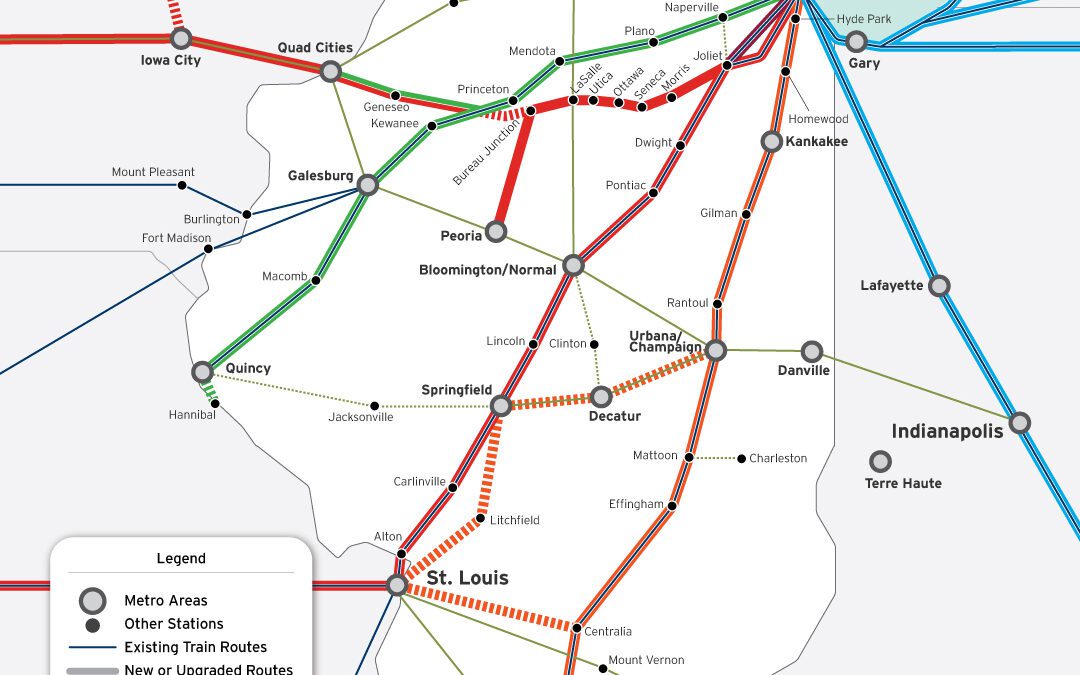
You can provide feedback to IDOT through October 2026. The Illinois Department of Transportation (IDOT) is working to update the 2023 State Rail Plan, with a final draft expected July 2027. State rail plans set future goals for freight and passenger rail. They can be...
The Latest on Alto, North America’s Third High-Speed Line
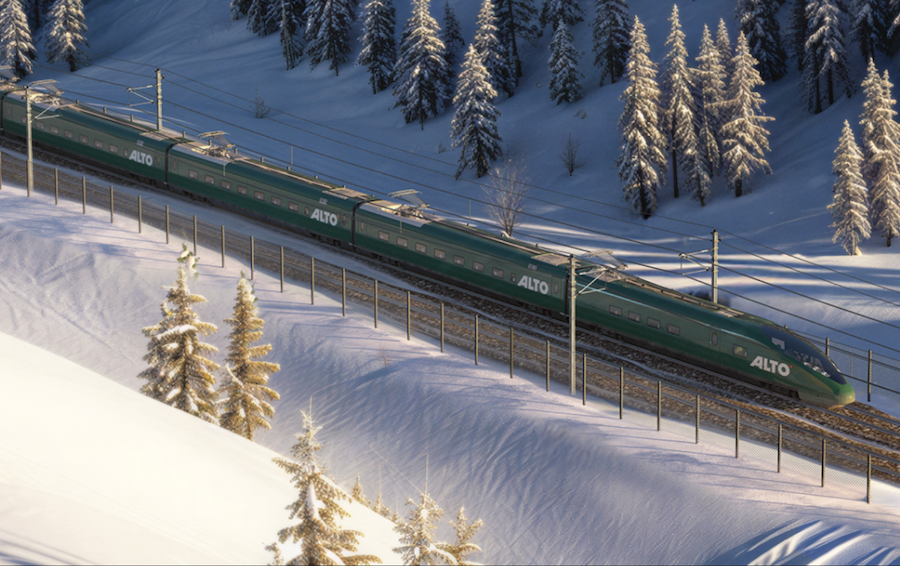
Since early January, Canada’s planned high-speed rail project from Toronto to Quebec City—called Alto—has been holding open houses and online sessions to gather public input. Here’s the latest:
Overview
Alto held its first public meeting last August and expects to begin construction on the line’s first segment—from Ottawa to Montreal—in 2029. It could be operational by 2035, with the full, roughly 600-mile line from Toronto to Quebec City operational as early as 2041. There will be five stops in addition to the endpoint cities: Peterborough, Ottawa, Montreal, Laval, and Trois-Rivières. The corridor is home to about 18 million people, or roughly 60% of the country’s adult population. Although Alto has named the seven cities that will be directly served by the line, it hasn’t settled on the precise route alignment or station siting, and it has not released an estimate of ticket costs.
The trains will run at 186 mph, which will cut the travel time from Toronto to Montreal to three hours, versus 5½ hours driving. Alto will likely use the Shinkansen high-speed rail model, which means the trains will run on fenced-off, dedicated tracks—versus the European model, in which high-speed and conventional trains sometimes share tracks. As a result, Canada’s equivalent of Amtrak—VIA Rail—will not be affected by the new line. Alto is part of Canada’s Major Projects Office, which launched last year with the mission of helping streamline the engineering, regulatory, and permitting processes for substantial projects.
Current status:
Alto is broadly popular in Canada. A survey last fall found that 73% of respondents expressed support, with 31% expressing strong support. But the recent series of open houses and online sessions has also revealed a diverse and energetic opposition, based on a variety of factors.
Some landowners are angry that their land will be expropriated and because the line will divide their property; some environmentalists fear that the line will destroy fragile ecosystems, wetlands, and forests; and some activists believe that a better use of the estimated $90 billion (CAD) would be to upgrade and expand existing VIA Rail service.
Broadly, opinions fall along a rural/urban divide. In addition to the factors noted above, a significant source of opposition is that rural residents believe the east-west line will create a barrier between communities to its north and the south throughout Ontario, especially if there are few tunnels and bridges. For example, in early March a Canadian publication reported that “a grassroots coalition of farmers, small-town residents and municipal councillors say the corridor would sever their communities, prompt hundreds of land expropriations and offer locals few benefits,” and residents worry that “the walled-off, 1,000-kilometre track will block country roads and create longer, bottleneck-prone drives for commuters and first responders.”
But there is opposition, as well, from communities that want the line to run through their city or town. The Corridor Train Alliance (CTA), for example, is pressing Alto to route the line along Ontario’s Highway 401 right of way or the Canadian National Railroad, or both, which hug the Lake Ontario shoreline and are significantly south of Alto’s proposed alignment from Toronto to Ottawa. CTA wants Alto to build new tracks through the corridor—to eliminate freight-traffic delays—and focus on offering frequent, reliable service rather than running true high-speed trains. This alignment, according to CTA, “serves where more people live; reinforces established economic centres; minimizes new fragmentation of farmland . . . [and] delivers maximum public benefit with least environmental impact.”
It remains to be seen what directions the protests go, how large they will grow, and what effect they will have, if any.
Three early takeaways for the movement:
Alto will be the second high-speed line in North America built by a public entity, after California High Speed Rail. (A private company is building the Brightline West line from Las Vegas to the outskirts of Los Angeles.) So it will be an invaluable case study for other projects as they develop over the next few years. Here are three early takeaways:
- Nothing erodes goodwill and mobilizes opposition to a project like a lack of transparency and accountability. In a lengthy essay about Alto’s long path to its current status, the Canadian transportation analyst Johnny Renton faults Alto’s leadership for largely freezing the public out until the recent series of open houses and online meetings. “For the past 5 years basically everything about the project was locked away in secrecy,” writes Renton, who is a critic of Alto but also supports its construction. “It was known that private companies and transit consultants were doing… some stuff. It was known that by 2025 close to CDN5 billion had been allocated into doing… stuff related to the project. But the public didn’t see a single report or map. There was no accountability for how that money was spent. The few announcements that were made amounted to ‘we are going to make the train go faster’ and that was it. We just had to trust that the transit consultant overlords and feds weren’t setting the money on fire.”
- Building our movement is about more than just making the case for trains. An organized, energized, and diverse movement can also shape how a project develops, which can then determine whether it succeeds. As Renton writes, Alto should not be allowed to simply “run roughshod over public opinion and design the HSR network as they see fit. . . . Now is the time to speak up, put the boots to them, and turn Alto into a worthwhile and transformational project for as many people, communities, and cities as possible.”
- The urban/rural divide in attitudes toward Alto is common in high-speed rail projects globally, in part because high-speed trains typically make fewer stops than conventional trains, so they directly serve fewer communities. That divide makes it all the more important to combine investments in high-speed rail with big investments in a great regional rail network. Not all communities can be served by high-speed trains, in other words. But all communities can—and should- have easy access to a dense network of fast, frequent, and affordable trains, supplemented by intercity buses.
Get Involved
Tell Congress: It’s time to reconnect the country with high-speed and regional rail!
The Latest from HSRA
Our Latest Blog Posts
Check out the latest news, updates, and high speed rail insights from our blog!