
Illinois’ Passenger Rail Planning Act aims for success, not bare survival A regional rail network with high-frequency trains is vital to the future of Illinois and the Midwest. Achieving it requires planning starting now. A bill currently in the Illinois Legislature...
Train Advocates in Cascadia Dish on How They Notched a Big Win—and How You Can, Too
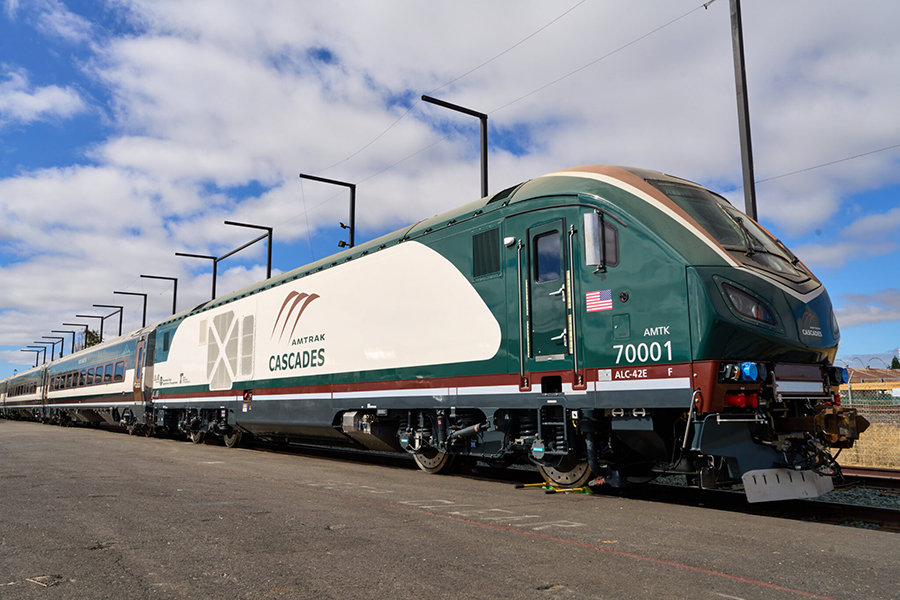
In April, a coalition of train advocates pushed the Washington state legislature to pass a law that mandates big increases in the speed, reliability, and frequency of Amtrak’s Cascades line by 2035. Three principles guided their work: 1) Enlist a strong legislative champion. 2) Build a culture of train ridership with steadily better service. 3) Use great conventional trains as a big step toward building high-speed rail.
The bill passed with strong majorities, i.e., 68-29 in the House and 32-17 Senate. It calls for increasing the number of daily round trips between Seattle and Portland—from 6 to 14—and between Seattle and Vancouver (BC)—from two to five. It also calls for improving the trip times between Seattle and Portland to 2h45m and between Seattle and Vancouver to 3h20m. The time savings is about 45 minutes in both cases. The drive takes a little under 3 hours by car for both routes.
Even more ambitiously, the bill calls for a dramatic improvement in the Cascades’ on-time performance rate—from less than 50%, which is among the worst in the US, to nearly 90%, which would rank it among the best in the nation.
Amtrak’s overall on-time performance rate in 2024 was 75%. Just two lines had an on-time performance rate of 90%—the Capitol Corridor, running from Sacramento to the Bay Area, and the Illini/Saluki, running from Chicago to Carbondale, IL.
Get Involved
Tell Congress: It’s time to reconnect the country with high-speed and regional rail!
The crying need
The Pacific Northwest has demonstrated strong demand for trains. Home to about 10 million people, its population is projected to grow by up to 5 million in the next two decades.
Prior to the pandemic, ridership on the Cascades was consistently in the low 800,000s. It blew past pre-pandemic levels last year, nearly reaching the 1 million mark. That puts it close to the ridership of the Capitol Corridor line, which makes far more daily round trips—i.e, 14 versus 6.
When the upgrades are in effect, the Cascades will be comparable to the Capitol Corridor in terms of frequency and reliability, and its trains will run significantly faster. Presumably, its ridership will continue to spike. (See our series on how the Capitol Corridor became one of the best Amtrak lines in the nation, starting here. It discusses in detail one of the great challenges for US passenger rail, i.e. negotiating with the freight railroads that own the tracks.)
As recently as last year, the state’s vision for the Cascades was much less ambitious. But train advocates stepped in, pushed the legislature to raise the bar—and won.
In April 2024, three advocates co-authored an Urbanist essay, noting that one in four people in the state doesn’t drive and that “if it were fast, frequent, and reliable, Amtrak Cascades would be a viable alternative that seriously competes with driving and flying.”
The authors urged the Washington State Department of Transportation (WSDOT) to think much more ambitiously about the possibilities. For example, they noted that WSDOT’s service plan proposed 90 mph as the line’s maximum speed—even though it had previously committed to 110 mph. They also cast doubt on WSDOT’s assumption that better on-time reliability could be achieved “with small projects and better maintenance,” citing experts who argued that “major projects are essential not only to shorten trip times but also to guarantee reliability.” And they balked at WSDOT’s 20-year time horizon for its planned, minimal improvements.
They concluded with a call for readers to weigh in on WSDOT’s service plan.
How they did it
A year later—April 2025—Washington’s legislature passed the bill that mandated the substantial improvements (noted above) in the Cascades’ speed, frequency, and reliability.
The bill doesn’t specify a fixed level of funding for the upgrades. Instead, it requires WSDOT to incorporate those goals into its planning and budget requests for the Cascades line, and to submit an annual report on the progress made and the challenges encountered. It sets a 10-year time horizon for the upgrades.
In September, three members of the Rail Can’t Wait coalition—which played a key role in securing the win—joined the Alliance to talk about their campaign to improve the Cascades line. Watch it here. In the webinar, they laid out some of the principles behind their success, which advocates can adopt as they work for better trains in their own regions:
- Find a strong legislative champion (or two). In the case of the Cascades, it was Julia Reed, a Democratic member of the House. Reed sponsored the bill and made the case for it in media appearances. Her leadership and visibility proved critical in helping it gain traction. “Most people thought this bill would get a hearing and that would be [the end of it]. But it kept going—all the way to the governor’s desk,” said Arvia Morris, a member of the Climate Rail Alliance and the Rail Can’t Wait coalition, in the webinar. Asked about the key to finding a champion, Morris said that advocates need to meet with the representative in person: “You need to go their town halls, even if they’re not talking about your topic. You go and get to know them and find out what’s interesting to them.” Brandon Bowersox-Johnson of 350 Seattle added that advocates should talk to each representative whose district is served by the route (or potential route). “We were talking to both parties at all times,” he said. “There’s interest on both sides of the aisle. So, talk to everyone who will listen and keep those conversations going.”
- Drive mode shift—and build a culture of train ridership—by aiming for steadily better service. US train and transit systems often cut or eliminate service on the idea that low ridership reflects a lack of demand. The poor and declining service then depresses ridership even more—leading to a vicious cycle. (The Hoosier State line between Chicago and Indianapolis was a classic victim of this false idea.) In truth, demand would spike if train service actually met riders’ needs. (See our Capitol Corridor series for proof.) Recognizing this reality, the Rail Can’t Wait coalition focuses on building a culture of train ridership with steady improvements to speed, frequency, and reliability. “Our [mission] is to really keep advocating for solving these Amtrak Cascades bottlenecks right now, to deliver better train service in the next five years, the next 10 years, on a timeline that helps with the climate crisis, helps with our population growth, and builds that next generation of rail riders,” Bowersox-Johnson said.
- Use great conventional trains as a big step toward high-speed rail. Plans have been brewing for several years for an “ultra” high-speed line in the Pacific Northwest, which could connect Seattle and Portland with a trip of about an hour via dedicated tracks. Washington won a $50 million federal grant last year to do advanced planning on it, and it has the support of the region’s major employers, including Amazon and Microsoft. By comparison, upgrading the Cascades line—for a trip that will take from 2.5 to 3 hours—might seem unexciting. But the Cascades advocates see conventional trains as a key step in the process of building great trains and transit in the region—and building a real alternative to car culture’s dominance—brick by brick. “It’s a false choice to say we’re either going to have intercity rail or high-speed rail,” Reed told the Urbanist. “The truth is that intercity rail is already here and needs to be improved, and high-speed rail is something we have to build in the future.” Bowersox-Johnson said that the projects are “mutually interdependent. . . . We see in other countries that have high-speed rail, they started by improving their intercity rail a lot before building the high-speed routes. And here, we want to build a culture of ridership, of people supporting trains.”
As Washington steadily builds that culture, the next item on the agenda should be to bring the Cascades and HSR projects together into a big-picture plan that allows each mode—transit, buses, conventional trains, and high-speed rail—to build on, support, and create synergies with the others. California is currently the gold standard for this kind of planning.
Watch the full video of the Alliance’s webinar with members of the Rail Can’t Wait Coalition for more.
The Latest from HSRA
Our Latest Blog Posts
Check out the latest news, updates, and high speed rail insights from our blog!