
Take the SurveyWashington is designing a transformative high-speed line The Washington State Department of Transportation (WSDOT) is taking public comment on its study for a high-speed line between Portland, Seattle, and Vancouver, B.C. The study will be released in...
Transit Makes, Keeps Homes Valuable
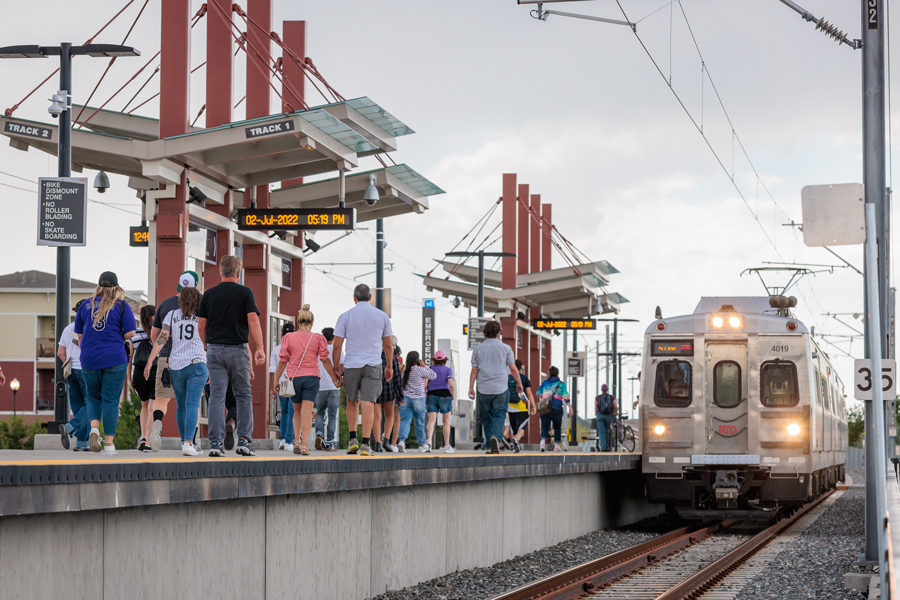
Transit, by its very presence, boosts the value of residential property near stations, and helps the property retain value in a down market. At the same time, billions in real estate value would be imperiled by transit service cuts, as transit authorities near the Transit Fiscal Cliff.
One study from 2013, prepared by the Center for Neighborhood Technology on behalf of the National Association of Realtors and the American Public Transportation Association, intended to determine the effect of transit proximity on property value during the Great Recession.
The study examined five metropolitan areas – Boston, Chicago, Minneapolis-St. Paul, Phoenix and San Francisco – and discovered that the drop in average residential sales prices within the transit shed was smaller than in the region as a whole or the non-transit area.
In fact, in each metropolitan area studied, there was an absolute drop in residential property value from 2006-11 in non-transit areas, and increases ranging from 30% to 129% in the transit-served areas.
For the purposes of this study, “transit served” means near “fixed guideway” transit – either commuter rail, rail rapid transit, light rail or bus rapid transit with a dedicated right of way.
Get Involved
Tell Congress: It’s time to reconnect the country with high-speed and regional rail!
A subsequent report, analyzing the metropolitan areas of Boston; Eugene, Oregon; Hartford, Connecticut; Los Angeles; Minneapolis-St. Paul; Phoenix; and Seattle found that residential properties within a half-mile of public transit options had a 4%-24% higher median sale price than the market as a whole between 2012 and 2016.
A blog post by Inland Real Estate, examining the Chicago-area market, says access to transit is fundamental to real estate value: Properties located near L stations or Metra stops command higher prices, driven by the demand for easy access to the city’s various neighborhoods and business districts.
“Being close to public transportation reduces commute times, offers more transportation options, and generally makes life more convenient. For many residents, especially those who work in the city center or frequently travel for leisure or business, living near a transit station is a top priority. This preference translates into a higher willingness to pay for properties that offer such convenience, thus driving up their market value,” the firm states.
The real estate industry knows the score:
- Fulton Grace Realty endorses transit: “For those living in or commuting to Chicago, the Metra commuter rail system is a lifeline, providing efficient connections between the suburbs and downtown Chicago.”
- The real estate firm Trulia found a significant increase in the number of listings mentioning transit as an asset in Los Angeles.
- The Wall Street Journal reports that the biggest increases in real estate value in South Florida are near the train: “In Fort Lauderdale, home values for residences within the ZIP Code near the station have appreciated by 67% from 2018—when the station opened—to [2022]. That compares with a 33% median price increase for the Broward County area over that period. In West Palm Beach, homes near the station appreciated 37% versus a 30% median increase for the area. The difference was most stark in Miami. Property values near the station were up 83% in price over that period, compared with a 38% median increase for the Miami area.”
- In the Chicago suburbs, Metra stations are magnets for transit-oriented development. Drew Mitchell, partner and senior vice president of development for Holladay Properties, a developer based in South Bend, Indiana, noted that since 2018, Holladay Properties has been building mixed-use projects near suburban train stations to meet growing demand for walkable, connected communities. “Three-quarters of the region’s population lives in the suburbs,” Mitchell said on a webinar organized by the Metropolitan Planning Council. “Having the ability to choose transit improves quality of life and drives economic growth.” He cautioned that losing transit funding would reverse decades of progress: “It would be absolutely tragic if our transit system lost funding – if the same thing that opened up the Chicago suburbs to population growth and business and entertainment is the same thing that took it down,” he said. “It scares me.”
- Forebodingly, In the Philadelphia area, where the Transit Fiscal Cliff did hit before the governor converted capital funds to operating funds to restore service temporarily, the region would lose $19.9 billion in residential property value – $7.7 billion in Philadelphia and $12.2 billion in the suburbs – if permanent transit cuts took effect, according to an analysis of the economic impact of severe cuts in transit service.
This is why it’s a head scratcher that the Illinois Realtors group is spending $500,000 on advertisements criticizing members of the Illinois General Assembly who voted for transit funding this spring, including an increase in the real estate transfer tax.
The campaign website features a photo of a CTA L train and two photos of the mayor of Chicago, apparently to convince suburbanites that transit funding benefits only Chicago.
State Sen. Laura Ellman of Naperville was one of the targets of the Realtors’ campaign, which she says is misguided. “Our transportation networks keep the suburban economy humming, and our housing values will crater if train and bus services are cut or disappear altogether,” Ellman said in a statement to Crain’s Chicago Business. “We need to have serious, thoughtful conversations about the future of transportation in DuPage and Will counties, and throughout our region. It’s disappointing that this organization chose to go on the offensive instead of joining us at the table.”
The Latest from HSRA
Our Latest Blog Posts
Check out the latest news, updates, and high speed rail insights from our blog!