Take the SurveyWashington is designing a transformative high-speed line The Washington State Department of Transportation (WSDOT) is taking public comment on its study for a high-speed line between Portland, Seattle, and Vancouver, B.C. The study will be released in...
Preface by Rick Harnish, Executive Director
We need a federal integrated network plan
Network planning is key to building the business and political case for great trains. That’s why pushing the federal government to create an integrated network plan for the entire country—coordinated with state-level plans—is a core objective of the Alliance.
In the US, state DOTs design individual routes or “city pairs” in isolation. This is a failure of both planning and imagination. It ignores the the power of robust networks to build volume for every segment of line and every node.
The Buffalo – New York Empire Corridor is a great case in point. Without a federal rail plan, the New York State Department of Transportation (NYSDOT) considers only the traffic potential within the state, instead of the total market-shed for the route.
The 2023 Record of Decision, for example, projected that the NYSDOT’s preferred route upgrades in the Corridor would result in train ridership of 2.6 million people annually—by 2035. That’s an increase of about a million riders over the “base alternative.” The trains would average 61 mph, cutting the travel time between New York and Niagara Falls from 9 hours to about 7.5 hours.
It’s something, but it’s hardly transformative.
This limited thinking has consequences. Because NYSDOT doesn’t work from a big-picture plan that taps the power of a regional network, it can’t build a case for the level of speed and frequency that would drive a dramatic mode shift in the corridor. The payoffs just don’t justify the costs.
But what would the minimum network plan include?
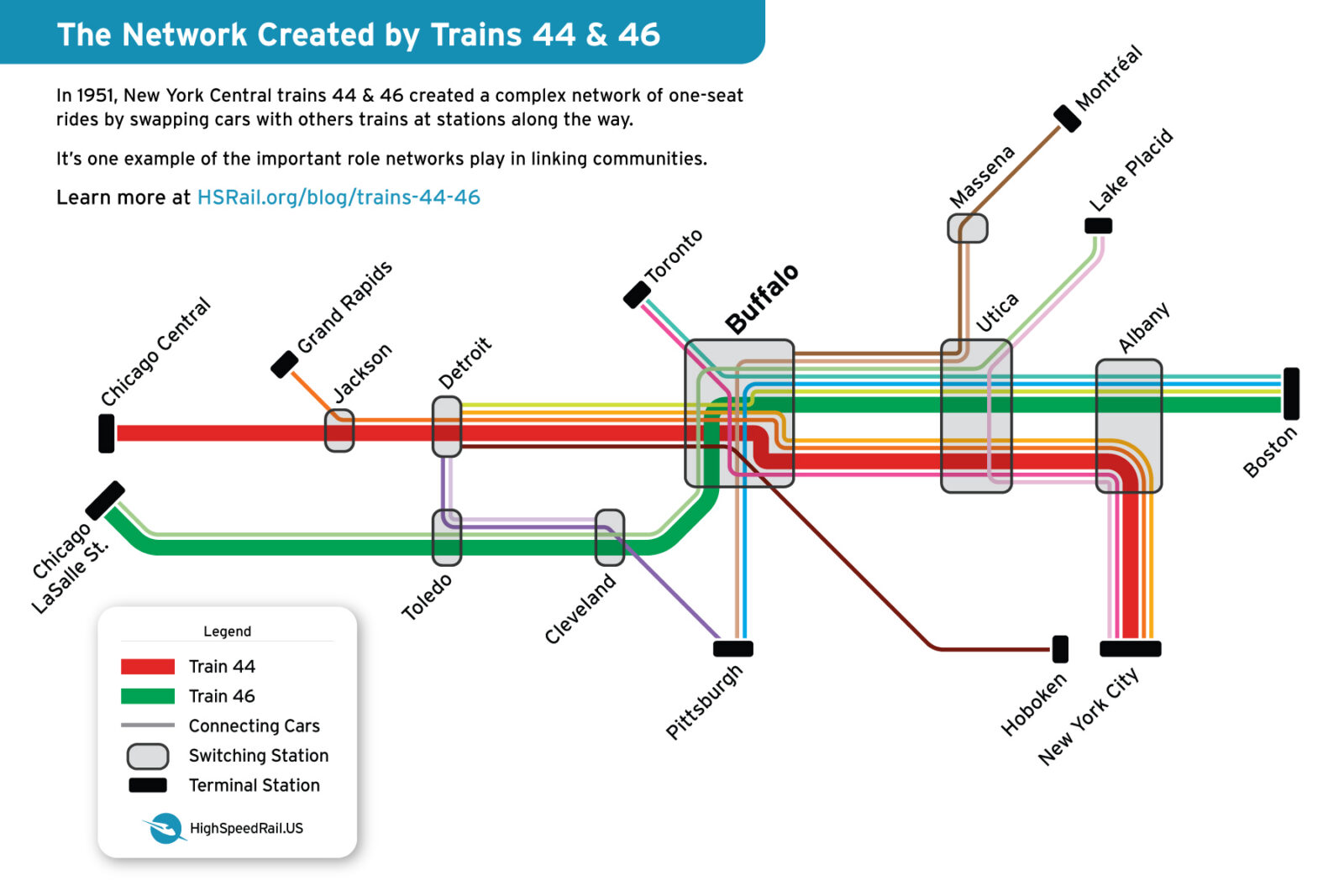
We published a blog post recently suggesting that Buffalo should be an important hub in a multi-state network of great trains. After its publication, I stumbled on a story describing how New York Central’s trains 44 and 46 created a complex network as they swapped coaches and sleepers (hotel cars) with other trains as they traveled eastward from Chicago.
Before flying became routine and the Interstate Highway system was built—when it was OK for trains to be slow—railroads switched cars between trains to create single-seat, direct rides in markets too small to justify an entire train (Grand Rapids – New York, for example).
The trains were slow and infrequent, and all the switching probably woke people up on the “sleeper” trains. We have no interest in bringing that world back.
But imagine a similar network that features state-of-the art trains, easy cross-platform transfers, and well-timed connections. It would connect communities of all sizes across the whole region. Buffalo would be a busy node in a complex network. And that network would be incredibly successful.
The status quo won’t deliver it, unfortunately. But a well-funded, federally-coordinated railway program could make it a reality. And that’s what the Alliance is working for.
With that background in mind, here’s the piece I mentioned about New York Central’s trains 44 and 46:
Was New York Central No. 46 the most “worked” train in North America?
By F.K. Plous
What’s your nomination for the most worked passenger train in the American railroad system?
By “worked” I mean simply the number of times an intercity passenger train stopped so that a local switch-engine crew could either add cars to it or subtract cars from it at an intermediate stop.
My favorite is New York Central train No. 46, the Interstate Express, as set forth in the 1951 system timetable. No train I’ve found in the Offcial Guide of the Railways seems to have been worked harder by the stations where it paused on its itinerary. No. 46 was taken apart and put together again four times on its 961-mile journey from Chicago to Boston.
Moreover, it’s possible that the most worked train in the American passenger-train system actually was a pair of trains that acted as branches of each other. New York Central train No. 46 was not alone in its nightly march across the system. It seems to have collaborated with a second train—No. 44, the New York Special—that paced it over a second, parallel route, between Chicago and Buffalo, where the two trains exchanged cars (including cars they had picked up en route). How many American passenger trains can you think of that did that?
Several other New York Central trains came close to the number of No. 46’s switching maneuvers, but, for reasons to be explained later, no train outside the New York Central’s portfolio approached the ride of the Interstate Express in complexity. It was the king of the worked-on trains.
Taking trains apart and putting them together
Until the late 1960’s, there were all sorts of reasons a passenger train might be worked on between its home terminal and its final destination. A mail car might be added to the head end while the train paused at a station stop. Or a mail car might be cut out en route—either for unloading at an intermediate stop or for forwarding to a branch-line destination via another train. A dining car might be cut out of an eastbound train around 10 p.m. and set aside to be cut into a westbound at 5 a.m. in time for the first breakfast serving. In some cases two trains would meet at a junction and be combined into a single, bigger train.
Another common practice was set-out sleeping cars. Passengers at a downline station would board a parked Pullman at 9 p.m., go to sleep in their berths and never notice when the local switch engine added their car to a through train when it stopped at 1:35 a.m. The same thing happened in reverse when a Pullman car full of sleeping passengers was cut out of a through train at an intermediate stop during the wee hours: The depot switch engine would set the car aside at a platform adjacent to the main line, and a Car Department employee would connect the car’s steam joints to the station’s heating system and its electrical system to station power, leaving the passengers to continue sleeping before awakening in a warm and toasty car with plenty of hot water for washing and shaving before stepping down to the platform between 7 and 8 a.m.
Twin Cities to Chicago: setout heaven
Set-out sleepers were particularly popular on the heavily traveled overnight corridor between the Twin Cities and Chicago. The Burlington, the Chicago & North Western and the Milwaukee road all ran trains that started at Minneapolis and picked up another sleeper 30 minutes later during the stop at St. Paul, with passengers already aboard and many already asleep. And the Milwaukee Road and the Chicago & North Western, both of which ran via Milwaukee, each carried a sleeper that was cut out of the train around 5:30 a.m. at Milwaukee and set on an adjacent depot track so passengers could keep sleeping until disembarking at 8 a.m.
Sometimes two separate trains would be combined at a junction to continue onward as a single train. Sometimes a train split in mid-itinerary so that one set of cars could follow a connecting line to a separate terminal. These maneuvers were not particularly mysterious. The railroads’ timetables usually included a page or more of columns explaining how each train’s makeup changed enroute. But a review of the 70-year-old timetables in the Offcial Guide of the Railways indicates no North American train equaled the Central’s Interstate Express in the complexity of its consist or the number of “cuts and pulls” it underwent during its journey.
Or should we say “journeys?” For the fact is, the Interstate Express connected so many different terminals that it’s hard to envision it as a single train. Technically it was a Chicago-Boston train, but it collected so many cars from so many additional origins and distributed them to so many other destinations that Chicago-Boston doesn’t do it justice. Here, according to the 1951 timetable folder, is how No. 46 navigated its way across the New York Central
Think two trains, not one
The itinerary of the Interstate Express was complex from the start, for several of its cars actually left Chicago in two separate trains from two different stations and followed two different routes to Buffalo, where both trains traded cars in the middle of the night before racing east over the Water Level Route to Albany.
Basically, No. 46’s itinerary was Chicago-Boston via the Central’s Lake Shore & Michigan Southern subsidiary across northern Indiana and northern Ohio and the south shore of Lake Erie. But just as No. 46 left Chicago enroute to the east, a second New York Central train, No. 44, the New York Special, left on a parallel route, setting out and picking up cars at three more stations before both trains exchanged DNA a third time when they came together at Buffalo.
Let’s examine The New York Special first. It left Chicago first—at 9:45 a.m.—from Central Station, the Illinois Central Railroad’s terminal on the city’s lakefront. Although owned by another railroad, Central Station was the preferred terminal for New York Central trains that used the company’s Michigan Central subsidiary to Detroit and its Big Four subsidiary to Indianapolis and Cincinnati. The IC main line connected to those routes in ways that the New York Central’s main line didn’t.
Once under way, No. 44 strides south along the IC’s “Main Line of Mid-America” toward Memphis and New Orleans until, 13.1 miles from Central Station, it swerves left of the IC at 115th Street—Kensington—and tiptoes southeastward across the interlocking to enter the main line of the Michigan Central. MC is the fast route to Detroit, and once No. 44’s consist is clear of the diamonds the hogger will open her up because the schedule is tight—5 hours and 5 minutes for the 283-mile Chicago-Detroit run with stops at Gary, Michigan City, Niles, Dowagiac, Lawton, Kalamazoo, Battle Creek, Marshall, Albion, Jackson and Ann Arbor. No. 44 may be headed for New York, but out here she’s a local. She carries only one sleeping car, a 10-roomette, 6 double-bedroom car that Southern Michigan passengers can use to get an overnight trip to New York. More sleeping cars for the East will join the train at Detroit, where its real overnight mission will begin.
The Grand Rapids sleeper joins the parade
But with a twist. At Jackson, 209 miles from Chicago and 74 miles from Detroit, No. 44 will pause for 15 minutes while the switcher attaches a sleeping car that originated at Grand Rapids.
What? New York Central in Grand Rapids? Isn’t Grand Rapids a Pere Marquette town? True, PM dominated the passenger business in Grand Rapids, but in the railroad frenzy of the 19th century lots of carriers built branch lines into the mainline hubs of their rivals, and Michigan Central tried to spook PM with a 94.5-mile branch connecting Grand Rapids with the Chicago-Detroit main line at Jackson. The branch is mostly for freight, but once a day a passenger local numbered 328-44 leaves Grand Rapids at 12:50 p.m. with several coaches and one of the new 10-roomette, 6-double bedroom sleepers, which is listed in the timetable as a through car to New York. That was probably shrewd marketing on New York Central’s part: Grand Rapids builds furniture, and New York is fully of design shops—along with banks that finance manufacturers—so business travel between the two must have been brisk.
The trip to the connection with No. 44 is astoundingly quick for a branch line—2 hours and 10 minutes to cover 94.5 miles with scheduled stops at Caledonia, Middleville, Hastings, Nashville, Vermontville, Charlotte and Eaton Rapids. Jackson, home of Michigan Central’s car and engine shops, has plenty of switch engines around, so No. 44 stands only 15 minutes while the Grand Rapids Pullman is cut in before the train steams of for Detroit at 3:15 p.m. (Only first-class passengers get to stay in their car during the Jackson transfer, however. Coach passengers must leave 328-44 and board one of No 44’s coaches.)
Parallel partners
The second train, No. 46, the Interstate Express, leaves Chicago five minutes later than No. 44, at 9:50 a.m., from LaSalle Street Station, historic home of New York Central trains headed for New York and Boston. Pausing to load passengers at Englewood Union Station’s curving platform at 63rd Street on the South Side, No. 46 swings southeastward to follow the Central’s historic Lake Shore & Michigan Southern subsidiary through the steel-mill country of South Chicago, East Chicago, Hammond and Gary as it sprints for Toledo, Cleveland and Buffalo. It carries coaches, sleepers, a lounge car, a diner and lots of mail and express at the head end. It will stop at Gary, but because it is on a different route from that used by No. 44, it will use a different station—Gary Union Station, shared with the Baltimore & Ohio Railroad—on Gary’s lakefront.
Porter: crossing in the dunes
Forty-four miles east of Chicago in Indiana’s Lake Michigan sand dunes, the two trains actually will cross each other’s routes within minutes of each other at the busy junction known as Porter. About a mile south of Porter the east-west alignment of the Michigan Central curves to north/northwest, crossing the east-west Lake Shore & Michigan Southern and immediately crossing the state line into Michigan. The tower at Porter will decide which train crosses the diamonds first. Ten miles north of Porter, at New Buffalo, the MC main line will curve gradually to the east and strike out in earnest for Detroit, meaning the two trains are again paralleling each other.
But it’s not a race. They will meet again.
The Vanderbilt family’s two branches do not feud
Progressing across Southern Michigan and pausing to pick up the Grand Rapids sleeper at Jackson, No. 44 will arrive Detroit at 4:50 p.m. and leave at 5:10 p.m. In that interval the depot switcher will pull two cars out of its consist: a tavern lounge-coach and a diner-lounge that handled the lunch business across Southern Michigan. In their place the switcher will add a full 48-seat diner. Dinnertime is approaching, and demand will be strong because the Detroit switcher also is adding three Pullman cars: a 10-roomette 5-double-bedroom car for New York, a 10-roomette-6-double bedroom car for Boston and a very odd duck—a 10-section-3 double-bedroom heavyweight sleeper that will be turned over at Buffalo to the Delaware, Lackawanna & Western Railroad for forwarding to Hoboken, N.J., across the Hudson from Manhattan—in DL&W train No. 2, the Pocono Express. Along with the 10-roomette, 6 double-bedroom sleeper that originated at Chicago, No. 44 will depart with four sleeping cars which, if full, will contain 90 first-class passengers. If all of those passengers decide to eat dinner it will take two seatings to accommodate them, and while many coach passengers will forego an expensive dining-car meal a substantial portion will decide to splurge, generating intense pressure on the crew to get everybody fed before Buffalo.
No 44 pulls out of Detroit at 5:10, descends into the Detroit River tunnel, pauses at Windsor, Ont. at 5:20 and then sprints across the straight, flat track of NYC subsidiary Canada Southern to arrive at Buffalo at 9:50. The dining car is closed and sleeping-car passengers are heading for their berths.
The mysterious Detroit-Toledo-Cleveland connection
But we’re not done with Detroit yet. At 1:30 p.m., before No. 44 even approached Detroit, a New York Central local left Detroit for Toledo and Cleveland carrying coaches and a “sleeper as parlor car”—probably an aging heavyweight 12-section Pullman. Toledo is south of Detroit, but because it’s also slightly to the west, the local gets a westbound-odd number: 305. At Toledo the sleeper-parlor and two coaches are switched into No. 46 when it arrives from Chicago at 3:15 p.m. No. 46 leaves Toledo at 3:25 p.m. and arrives Cleveland at 5:50 p.m., where the sleeper-as-parlor and two coaches are switched out.
The sleeper-as-parlor will go back to Detroit tomorrow. But at least one of the coaches will be remain in No. 46, while the other will be coupled into an unusual connection: an Erie Railroad train numbered 686 that will leave at 6:20 p.m. for Youngstown, where it will arrive at 7:45 p.m. and become No. 86 on New York Central’s subsidiary Pittsburgh & Lake Erie. At 9:20 p.m. it will end its journey at Pittsburgh.
The coordinated journey of Nos. 305, 46, 686 and 86 demonstrates just how useful New York Central’s complex network could be. Nobody ever built a single railroad connecting Detroit with Pittsburgh, but with a little help from its friend the Erie, New York Central could assemble a routing, if not an actual through route, and operate a daily train that got Detroit passengers down to Pittsburgh with reasonable dispatch thanks to skilled switching crews ready to slice and dice No. 46 at Toledo and Cleveland. No. 46 may be a long-distance through train, but it allows a local to hitchhike to its next stop.
The Cleveland stop lasts only 15 minutes. At 6:05 p.m. No. 46 is on its way again, heading for the biggest slicing and dicing event of its entire itinerary: the “Buffalo Shuffle.”
Buffalo was central to the Central
As the timetables of Nos. 44 and 46 make clear, New York Central passenger trains paused for switching at a variety of junctions in their progress across the system. Not just Detroit, Toledo and Cleveland, but even little Jackson, MI, figured in the itinerary of No. 44.
But of all the junctions in the New York Central’s intricate map, none generated as much switching as Buffalo, NY. In its Fall, 2005, issue, Classic Trains ran a story by Bob Chambers called “The Buffalo Shuffle” that explained just how busy Buffalo was as overnight trains from across the giant system converged on the city and exchanged cars: Between 9:15 p.m. and 4:30 a.m. 17 eastbound trains came and went at Buffalo Central Terminal. Those trains picked up 20 sleepers and dropped o? 21 sleepers, along with one lounge car and two dining cars—plus a varying number of coaches. During the same period 15 westbound trains picked up 15 sleeping cars, 3 lounge cars, 1 diner and, depending on the day of the week, several coaches. (Also exchanged but not shown in railroad timetables were head-end cars full of U.S. Mail and Railway Express Co. shipments.)
Nos. 46 and 44 exchange DNA
Among the trains involved in this choreography was No. 44, the Michigan Central train out of Chicago which just spent the first half of the night sprinting across Southern Ontario on the New York Central’s Canada Southern subsidiary. No. 44 arrived in Buffalo a little earlier than Chambers’s starting point—at 8:55 p.m., but as soon as it stopped and detrained its Buffalo passengers, one of the depot switchers went to work on its consist. Out came the 6-bedroom buffetcar and the 10-roomette, 6 double bedroom sleeper, both of which are surrendered to No. 46 for Boston when it arrives at 9:25.
A third Pullman car in No. 44’s consist, a 10-section 3 double-bedroom heavyweight sleeper routed Detroit-New York, will undergo the most unusual treatment in the Buffalo Shuffle: instead of being switched into another New York Central train at Buffalo Central Terminal on the city’s east side, it will be shifted back westward to the downtown terminal of the Delaware, Lackawanna & Western Railroad for forwarding to New York on DL&W train No. 2, the Pocono Express. Although the timetable shows the 10-and-3 as a Detroit-New York sleeper, it actually will terminate at the Lackawanna Terminal in Hoboken, N.J., on the west side of the Hudson, and any passengers for Manhattan will reach their destination by transfer to a trans-Hudson ferry leaving directly from the east end of the terminal building.
That procedure will not encumber many of the sleeper’s passengers, however. Travelers who choose DL&W No. 2 are not so much trying to reach Manhattan as to access DL&W’s destinations such as Corning, Elmira, Binghamton, Wilkes-Barre, Scranton and Newark that the New York Central doesn’t reach.
No. 380—the Canadian contribution
Meanwhile, a third train, No. 380, a joint effort of Canadian Pacific and the Toronto, Hamilton & Buffalo Railway, arrives in Buffalo from Toronto at 8:55 p.m. No. 380 carries a Toronto-New York coach which will be switched into No. 44 and a 10-and-6 Pullman for Boston which will be switched into No. 46. No. 380’s diner-lounge will stay in Buffalo.
The westbound that became an eastbound
Finally, a fourth connection arrives at 9:35 p.m. This is the Pittsburgh-Buffalo Express operated jointly by New York Central and its subsidiary Pittsburgh & Lake Erie. A look at the map shows the Express in this train’s name to be something of a stretch, for its itinerary is not direct.
Buffalo is northeast of Pittsburgh, but the P&LE’s main line actually leaves Pittsburgh heading northwest—away from Buffalo, requiring the train to carry an odd number, as all westbounds do. While on the P&LE the Express will be numbered 33. But when the Express enters the LS&MS main line at Ashtabula, Ohio, and takes a hard right to the northeast it offcially becomes an eastbound New York Central train and is renumbered 284 over the remainder of the distance to Buffalo. When it reaches Buffalo at 9:35 p.m. the switch crew will take it apart: Diner and coach are set over, and two of its three Pullmans are transferred to No. 46: The 10-roomette, 5-double-bedroom car will go to Boston and an 8-section, 1-drawing room, 3-double-bedroom heavyweight sleeper will come out of the train at Utica for forwarding to Massena, N.Y., on the carrier’s Adirondack Division. A third sleeper, a 10-roomette, 5-double-bedroom car for Albany, will move east to New York in train No. 24, the Knickerbocker.
Utica—gateway to the wilderness
No. 46 departs Buffalo at 10:15 p.m. No. 44 follows 10 minutes later. Both face further adjustments to their consists. But No. 46 will be the bigger player. At 1:41 a.m. No. 46 will stop at Utica, a small town in Upstate New York but a major junction on the New York Central, which uses it as a passenger gateway to the 6-million-acre Adirondack Park, a vast combination of state, federal and privately owned wilderness larger than Yellowstone, Grand Canyon and Yosemite national parks combined. In the days before Interstate highways and air-conditioned automobiles, the cool, smoke-free Adirondacks attracted vacationers not just from New York City and the rest of the industrial Northeast but also, thanks to the New York Central and the Pullman Company, from the Midwest as well. While most of the Adirondack business moved in the summer, skiers kept the trains busy in the wintertime too.
So when No. 46 stops at Utica in the middle of the night the depot switcher immediately goes to work on its consist, pulling out three heavyweight Pullmans: a 10-section/buffet car that joined the consist at Buffalo, an 8-section, 1-drawing room 3-compartment car that originated at Pittsburgh and will terminate at Massena (Mondays, Wednesdays and Fridays only), and an 8-section, 2-drawing room, 2-compartment heavyweight running from Chicago to Lake Placid (Tuesdays and Fridays). Two of the cars will be placed in Adirondack Division train No. 17, which will backtrack on the main line as far as Rome, where it will switch onto the single-track branch to Watertown. But the 10-section/buffet car out of Buffalo will be switched into a second Adirondack Division train, No. 5, which will go all the way to Montreal.
These cars will not travel alone, however. Before they leave Utica No. 17’s consist will be built out with similar cars arriving on westbound trains. No. 35, the Iroquois, left Boston at 7 p.m. and is scheduled to arrive at Utica at 3:09 a.m. When that happens, the depot switcher will remove a 10-roomette, 5-double bedroom sleeper and place it in No. 17’s consist, probably so softly that only on-board insomniacs will notice. That car will go up the St. Lawrence Division to Rome, Watertown and Richland. No. 17 also will get some coaches from Boston. And Adirondack Division train No. 4 will hand over a 10-section-buffetsleeper from Montreal that will be switched into No. 35’s consist for Buffalo.
These transactions are merely incidental to No. 46’s work, but they are introduced here to show why Utica played such a huge role in the New York Central’s passenger-train network. No wonder this little town got such a big depot.
No more switching—onward to Boston
No. 46’s intense switching activity is over. All cars in the consist are now routed to Boston. The rest of the train will pause for five minutes at Albany for a crew change and mechanical inspection, but there is no further switching. No, 46 will leave Albany, the busy junction of the lines east to Boston and south to Manhattan, at 3:25 a.m. for scheduled stops on the Boston & Albany Railroad at Pittsfield, Springfield, Worcester and Framingham. The diner stays with the train and probably will open during the Springfield stop at 6:30 a.m., so Boston passengers will be able to enjoy breakfast before No. 46 pulls into South station at 9:05 a.m. No. 44 will pause for a crew change at Albany between 4:05 and 4:15 a.m., make a brief stop at Poughkeepsie at 5:22 a.m. and end its run at Grand Central at 7:15 a.m.
There’s no No. 45
The intense switching performed on No. 46 naturally leads the astonished fan to wonder: “What happens when the Interstate Express runs westbound? Does it make all the same stops and exchange all the same cars at the same stations?
Actually, nothing of the sort happens, because there is no westbound analogue to No. 46. The timetable does contain a westbound train called the Interstate Express, but it’s numbered 251, not 45, and it’s not the mirror image of No. 46 with all the same cars headed back to Pittsburgh, Buffalo, Toledo, Detroit and Chicago. It’s a simple Buffalo-Cleveland day train that carries a New York-Cleveland 10-roomette-6-double bedroom sleeper, a Buffalo-Pittsburgh diner-lounge and coaches. All the rest of No. 46’s equipment will return to its respective terminals in other trains.
Other railroads could not duplicate No. 46’s complexity
Browsing through the Guide, it’s impossible to find another train subject to as much switching as New York Central No. 46. The reason is simple: No other railroad had a route structure as rich and complex as the New York Central’s. West and south of Chicago the number of large cities drops radically, the distances between them lengthen and large, busy junctions are fewer, leaving no need for the intricate web of diverging and converging main lines like the Central’s.
Even the Central’s sole rival, the Pennsylvania, was not a serious challenger. Although the Pennsy was a bigger railroad with more miles of main line than the New York Central, it never had an alternate Chicago-New York main line through Canada and lacked the capacity to mix and mingle travel between Chicago and the East the way the Central did. And it had nothing like the vast Adirondacks on its lines. Summer travelers seeking relief from the heat could do so via the Pennsy, but only indirectly over connections via other carriers into New England.
Pittsburgh was busy (but not as busy as Buffalo)
The Pennsy did have its own version of the Buffalo Shuffle, however. That would be at Pittsburgh, which, like Buffalo, sits halfway between Chicago and New York and served as the main junction for lines from the East to both of Penney’s western termini—Chicago and St. Louis (along with Detroit, a lesser destination that Pensy did not reach until 1922). In the middle of the night Pennsy overnighters from New York, Philadelphia and Washington would converge on Pittsburgh and exchange sleeping cars with trains headed for Chicago, St. Louis, Indianapolis, Dayton, Columbus and Detroit. The late William F. Howes, Jr., a Chessie System vice president and a major railfan, once told this writer that when he was a graduate student at Carnegie-Mellon University in Pittsburgh during the 1960s he used to hang out at Pennsylvania Station during the wee hours to watch the intense switching required to sort the cars from incoming to outgoing trains.
“I once figured out that between midnight and 4 a.m. there were more than 400 people asleep aboard Pennsy trains in the Pittsburgh station,” he said. “It may have been the busiest hotel in town.”
Did I once see No. 46?
There’s a chance that I actually witnessed the New York Central’s Interstate Express when I was 11 years old. This would have been in 1951, when I was visiting my grandparents in Gary, Ind. My grandfather, Mike Chasson, was a native of Omaha and a former rip-track clerk on the South Omaha Terminal Railroad who migrated to Chicago in 1924. At some point after that he and my grandmother moved to the booming new steel town of Gary and established a small convenience store at the corner of 8th and Madison streets. Whenever I visited my grandparents that store became my railroad academy. The Wabash Railroad’s Chicago-Toledo main line ran only a block south of the store and was busy day and night with huge 4-8-2s hauling long freight trains, and when the whistle sounded and the bells started ringing there was just enough time for a boy to race to the crossing and wave at the engine crew.
But for me the biggest thrills came when the store ran low on stock and Gramps would take me along in his red 1938 Buick on a quick run across Gary for emergency supplies of bread, produce or cold cuts. That meant leaving Wabash territory and venturing out among the half-dozen other railroads that crisscrossed Gary. On one of those errands, I distinctly remember heading west in the car past Gary Union Station around mid-morning. We were on the street just at the base of the south side of the elevation carrying the B&O and New York Central tracks, —a street that’s gone now because its footprint is occupied by the block-wide elevation of the Indiana Toll Road.
Looming above on the elevation an eastbound New York Central passenger train was just starting to accelerate out of the station—toward us. The spectacle held me fascinated. I wasn’t yet old enough to identify the different locomotive types, but this one had to be either a Mohawk or a Niagara, because I remember it had elephant ears to deflect the smoke upward at speed. But there was no speed yet. The train was just getting started, and the eruptions from the stack seemed to form a skyscraper of smoke as the drivers chewed into the rail.
A catalog of car types
As impressive as the locomotive was, however, the train it was pulling hypnotized me even more. It seemed to be carrying every type of railroad passenger car operated in North America save an observation car on the hind end. I was old enough to distinguish sleepers from coaches, and thanks to the editions of Trains and Railroad displayed in the magazine rack in my grandparents’ store, I was learning the difference between the pre-war heavyweights and the new streamlined passenger cars. Dining and lounge cars, of course, were immediately identifiable by their unique window arrangement, with big, evenly spaced windows in the dining area and much smaller ones at the galley end. The train leaving Gary for the East that morning seemed to be carrying nearly every species of passenger car ever built, plus baggage cars, mail cars and the green, wooden-sided boxcars bearing the red diamond of the Railway Express Agency.
That train could have been No. 46. No. 46 left Gary at 10:23 a.m., and I remember the encounter as occurring mid-morning. But whether that train was No. 46 or not, it was a working train, and as it clattered past us with its short, wooden express cars rocking on the rail joints, I realized that this was the kind of train I liked best. The new streamliners were glamorous, and I wanted to ride them all, but in moments of reflection—and even 11-year-olds have them—I admired the all-business/no-nonsense look of that big train as it went about what very obviously was business.
Did No. 46 make more money than No. 26, the Twentieth Century Limited? I didn’t know, and I still don’t, but it looked as if it did. It looked busy. Too busy to wait for a uniform consist of lightweight cars. It bustled with business and with whatever variety of railcar was needed to carry it.

The Latest from HSRA
Our Latest Blog Posts
Check out the latest news, updates, and high speed rail insights from our blog!