Corridors to be removed and funding reduced Recently, we’ve been running stories about big infrastructure projects that are making real progress. Northeast Corridor projects—including the Portal North Bridge, Frederick Douglass Tunnel, and the Susquehanna bridge—are...
Funds for North Carolina S-Line Released
How Virginia and North Carolina are Building a Publicly Owned Railroad
The Federal Railroad Administration has released $550 million for the S-Line, a passenger-rail project in North Carolina and Virginia. The money is part of a $1.09 billion grant awarded in 2023 to restore the 18-mile segment running between Raleigh and Wake Forest. The grant was largely stalled through 2025. The release of roughly half the total builds momentum for a key passenger-rail line that will link the Southeast to the Northeast with faster, more frequent, and more reliable trains.
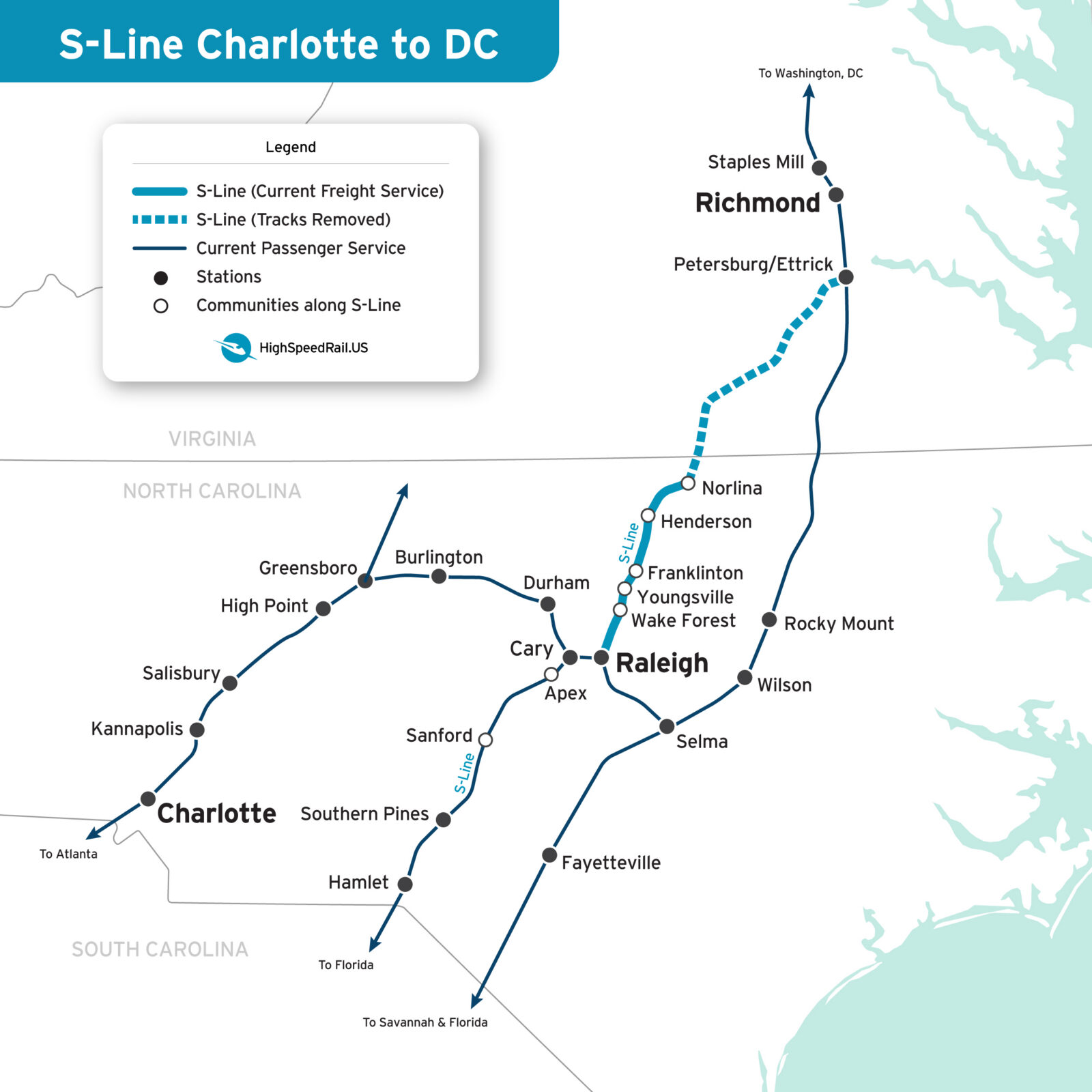
The S-Line is a CSX freight corridor running from Richmond to Tampa, Florida. The Raleigh-to-Richmond segment has carried almost no traffic for decades; in fact, a substantial portion of the tracks (between Norlina, NC, and Petersburg, VA) was pulled up decades ago.
In 2022, Virginia closed a deal with CSX to purchase the 75 miles within its borders (Petersburg to the North Carolina line). It was part of a broader, $525 million deal to purchase right-of-way in several corridors. In June, the FRA released $65 million for North Carolina to buy the S-Line within its borders (Raleigh to Ridgeway).
As a result, the entire 162-mile Raleigh to Richmond corridor—known as R2R—is now publicly owned.
All of this is happening because North Carolina and Virginia run two of the strongest state passenger-rail programs in the country. Both have spent years planning, buying right-of-way, and lining up federal money. The result is a corridor that is being assembled methodically, piece by piece, through cross-state collaboration and planning.
It’s a model that other states would do well to study and learn from.
The value of public ownership
Public ownership shifts control of scheduling and frequency to the train operator. That’s critical because conflicts with freight traffic are the most persistent source of delays for most US passenger trains. Public ownership lays the foundation for getting the most out of other upgrades to the line.
The route between Raleigh and Richmond will be about 30 miles shorter and more direct. And the trains will run at up to 110 mph, versus the top speed of 79 mph on the existing route. The upgraded infrastructure, higher speeds, and more direct route will cut more than an hour from the trip, which is currently about 3 hours 20 minutes. Driving time is 2.5 to 3 hours, depending on traffic.
NCDOT notes that the rebuilt line will be among the Southeast’s “most technologically advanced railroads.” Work on the Raleigh-Wake Forest segment includes a second platform at Raleigh Union Station, new track infrastructure, and several grade separations where roads cross the tracks at grade.
Wake Forest is also building a new mobility hub with a separate, $13.2 million RAISE grant awarded in 2025, administered by NCDOT. The town plans to colocate it with the passenger-rail platform, close enough to downtown that arriving passengers can walk to the city center.
Down the line
Beyond the 18-mile Raleigh–Wake Forest segment, the R2R project is not yet funded and there is no schedule for building it.
Officials expect train service to Wake Forest to launch in the early 2030s. From there to Norlina, the track is intact and carries a handful of slow freight trains. It needs new signals, grade separations, and rebuilt track to handle 110 mph passenger service.
From Norlina to Petersburg, Virginia, there is no railroad at all. CSX abandoned the line in 1986 and pulled the tracks the following year, though many of the bridges survived. Everything else must be rebuilt. The final stretch of track—roughly 10 miles from Centralia into Richmond—is intact but will need to be upgraded.
Those projects await funding from the FRA and their respective states. In March, the FRA released $58 million (from a 2022 CRISI grant) to fund preliminary engineering, surveying, and design work throughout the corridor.
Fast, frequent trains—from Portland to Atlanta
The region that R2R runs through is among the fastest growing in the nation.
For example, North Carolina has added nearly half a million residents from other states since 2020. It roughly doubled its population—from 5.5 million to 11.2 million—from 1975 to 2025. State demographers expect it to pass Georgia and Ohioto become the seventh-largest state in the early 2030s.
That growth is concentrated along the R2R’s southern endpoint. The Raleigh–Cary metro and the wider Triangle have nearly half of North Carolina’s 50 fastest-growing cities and towns. Raleigh passed 500,000 residents in 2025.
So the R2R corridor matters on its own terms. But it’s also a key piece of a broader network.
Think of the eastern seaboard as a single rail network stretching roughly 1,000 miles, from Portland, Maine, to Atlanta. Together, the metro areas in this corridor account for roughly one-fifth of the US population—about 65 million people. The R2R’s 162 miles will bring the corridor substantially closer to a seamless network of fast, frequent trains.
The Northeast Corridor (Boston to D.C.) is in the middle of the most serious round of upgrades in its history, with aging bridges and tunnels being replaced and capacity being added after decades of deferred work.
Meanwhile, Virginia is planning and building major improvements throughout the corridor between Richmond and Washington—the essential middle link that connects the Southeast to the Northeast.
And the Tier I environmental review is finished for a high-speed line from Charlotte to Atlanta, though no construction funding has been identified. The preferred, 274-mile route would connect the new Charlotte Gateway Station directly to the Hartsfield-Jackson Atlanta International Airport.
A model to replicate
R2R is happening because North Carolina and Virginia have identified key railroad projects and gone after the federal money to build them.
North Carolina’s $1.09 billion grant was the product of years of planning, studies, and relationship-building with the communities along the route. Virginia’s $525 million deal with CSX came together the same way—as one piece of a multi-corridor strategy.
Virginia, in particular, has a long-range plan for what its passenger-rail network should become—and a willingness to spend significant state money to buy the assets.
The plan is Transforming Rail in Virginia, a $3.7 billion initiative the General Assembly launched in 2020 by creating the Virginia Passenger Rail Authority. It’s built around buying 386 miles of right-of-way and 223 miles of track from CSX, plus a $2.3 billion Long Bridge Project, targeted for completion in 2030.
R2R is a key part of Transforming Rail in Virginia, which is why Virginia moved first to buy the S-Line right-of-way. That move gave North Carolina—watching its neighbor to the north commit to the line—good reason to follow.
As noted, funding for most of the R2R hasn’t been secured yet. But the hardest part—the part where a multi-state corridor becomes publicly owned and is then engineered and funded for the first segment—is done.
That’s a success worth studying and a model worth replicating.
Subscribe to Our Weekly Newsletter
Your #1 source for the latest news in high-speed and regional rail – and how you can get involved
The Latest from HSRA
Our Latest Blog Posts
Check out the latest news, updates, and high speed rail insights from our blog!