
“Frequency is freedom" —Jarrett Walker, Human Transit Frequency, combined with consistent headways, drives ridership. Greater frequencies reduce total travel times, serve different travel markets throughout the day, and improve system reliability. They make...
Issue in Brief
Fusing multiple types of trains (and buses) into a flourishing network
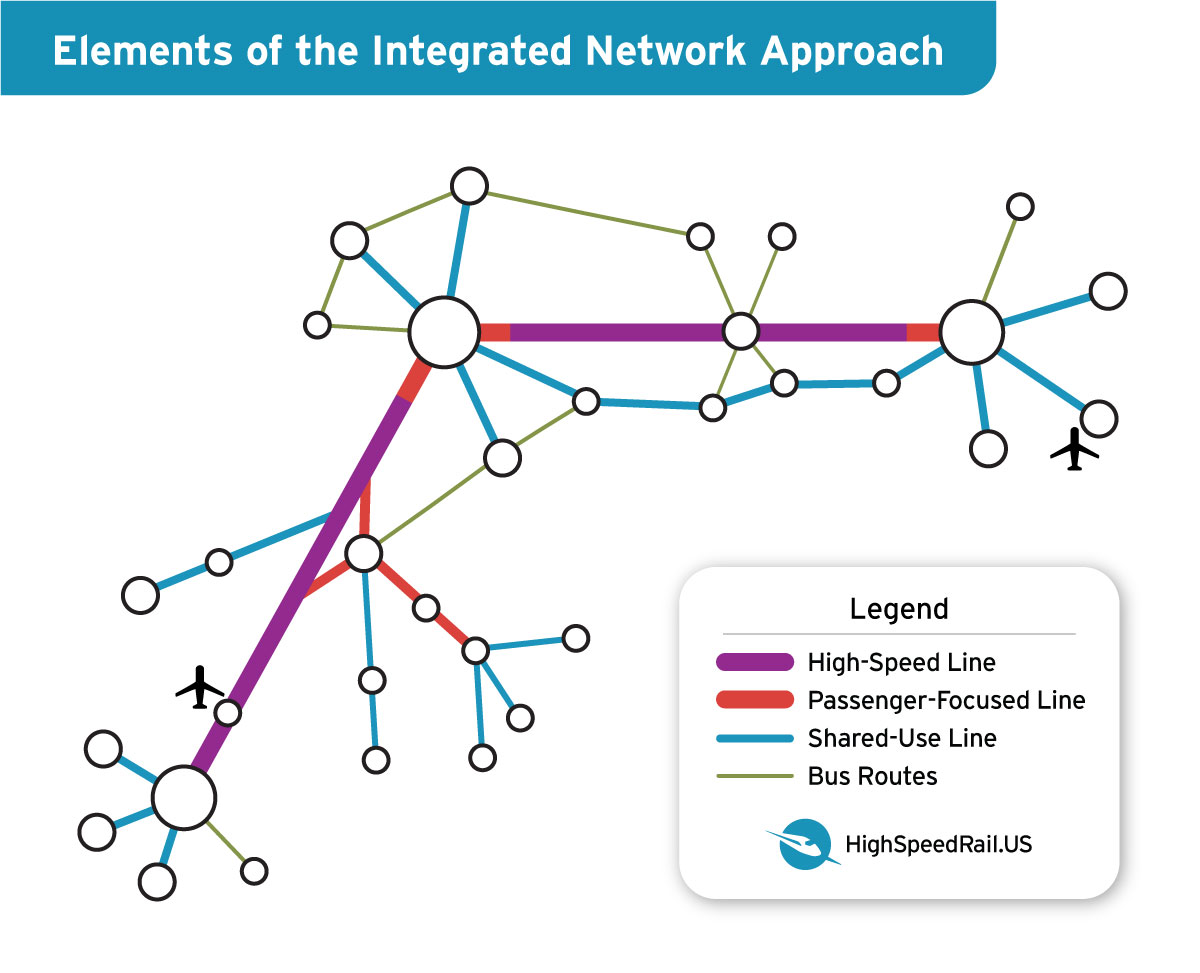
The Integrated Network Approach combines the transformative power of dedicated high-speed lines with the geographic coverage of shared-use lines.
It has a role for all kinds of trains, serving communities of all sizes.
Crucially, these different trains are all integrated in terms of their schedules and payment methods. And that integration has three crucial impacts:
- For riders: It’s easy and convenient to transfer between high-speed and conventional trains (plus intercity buses), and vice versa.
- For communities: Since the network has a role for trains of all kinds, it serves communities of all sizes. Not every town or city can have high-speed rail; but even small towns can be within easy distance of a conventional train line or intercity bus station.
- For politics: The network’s broad geographic reach gives it a broad, durable political base. When more people benefit from easy access to trains, they push legislators to invest more money in the network.
Core Principles

Trains are Multi-Purpose Mobility Machines
Many people, traveling for many reasons, between many city pairs can use the same train.

Railroads are Versatile
Different components can be put together in different ways to meet local needs.

A Big Picture Network Plan is Essential
There is no way to see the full potential of a corridor when studied in isolation.
Key elements
Big-picture plan, long-term vision,
The core principle of the Integrated Network Approach is that there’s a place for all kinds of trains—and that a network’s power depends on their coordination and integration. Which requires not only a plan but a long-term vision for how the network can steadily grow and serve more people, more effectively. Currently, California is the only state with an integrated network plan.
Modern trains
Newer trains are a world apart from older rolling stock. They’re much safer, greener, more comfortable, and more cost-effective. And they take curves and accelerate faster on conventional tracks, which saves riders both time and stress.
Three types of track
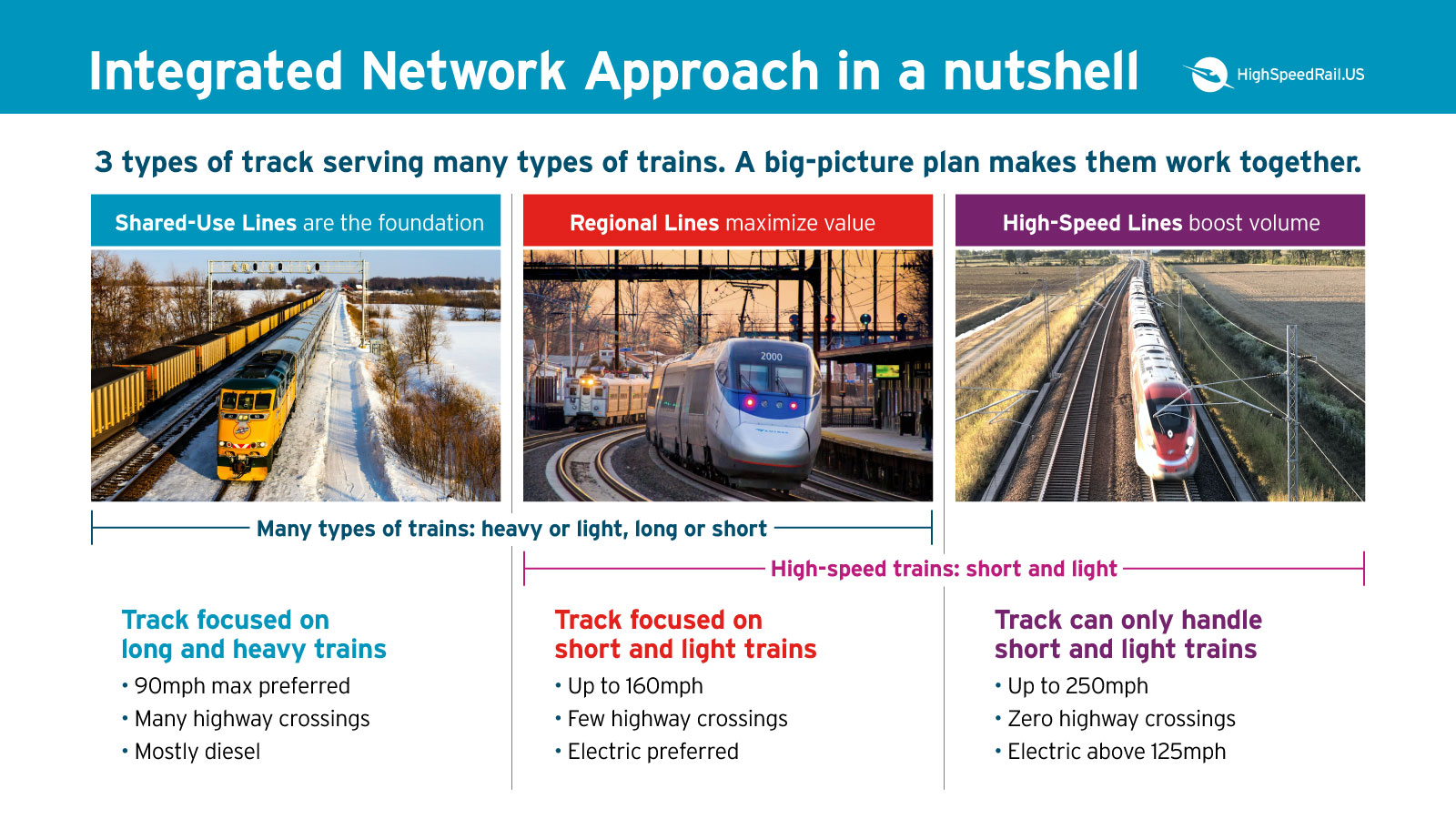
Railways are very versatile. Different types of trains and track can be combined in different ways, depending on existing assets and local needs. To simplify, there are three types of track:
Shared-use lines are the foundation
80-mph (mostly) – 110 mph (rarely)
Flexible tracks for heavy loads
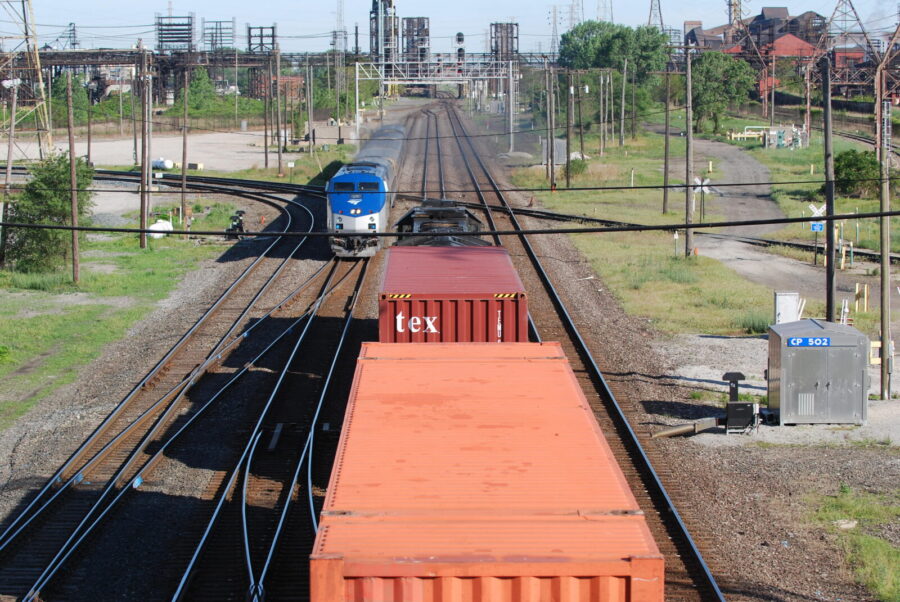
Railroad lines shared by heavy freight trains and light passenger trains are a great way to reach a large number of cities, both big and small.
Notable examples include the Capitol Corridor in California, the Lincoln Corridor in Illinois, and Brightline in Florida.
Passenger-focused lines maximize existing assets
Up to 160 mph
Less flexible track
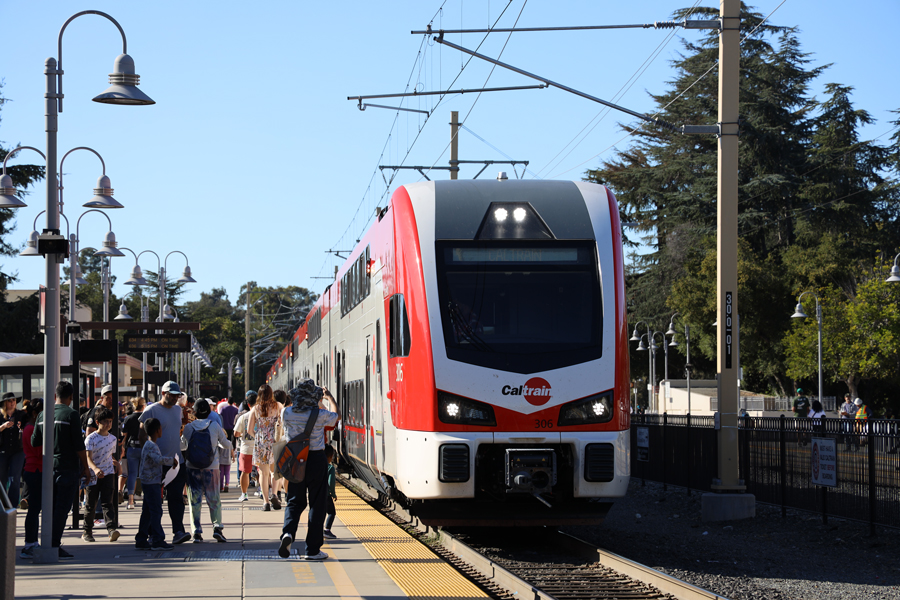
Rebuilding existing lines to focus on fast passenger trains is a great use of resources.
Amtrak’s Northeast Corridor and Caltrain in the Silicon Valley are prime examples
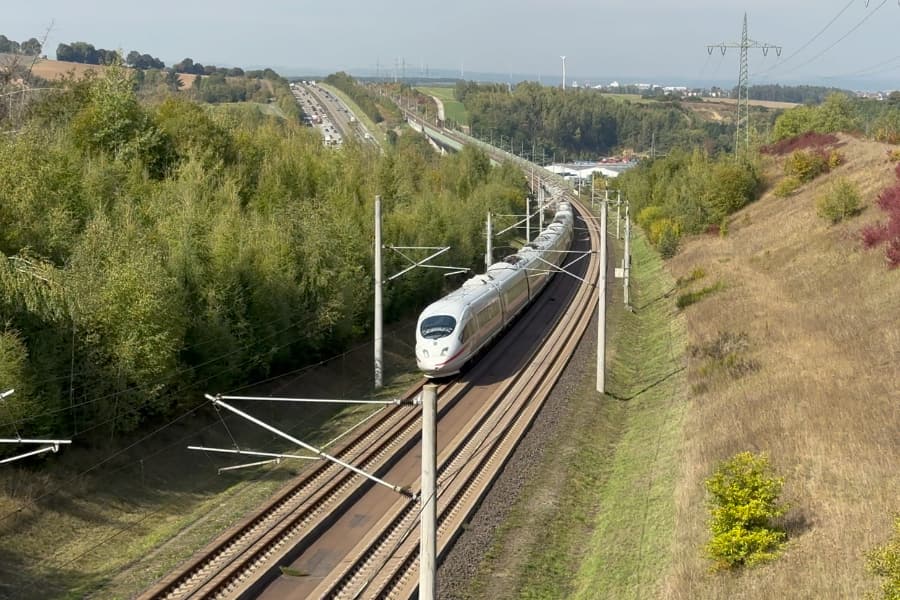
High-speed lines slash travel times in half
125 mph – 250 mph
Rigid track with precision alignment
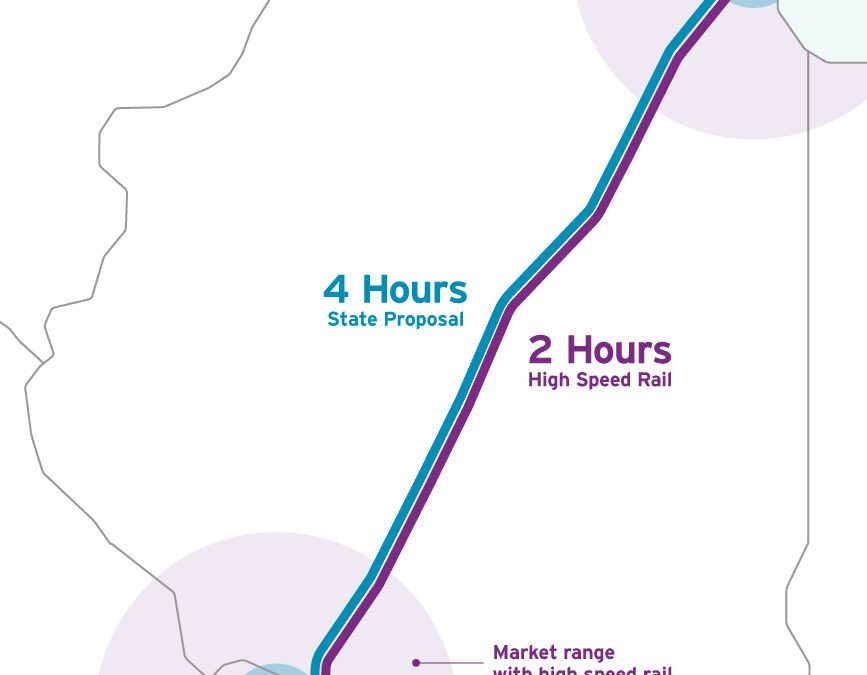
To compete with driving, trains must be fast and frequent. That means long sections of high-speed track with no highway crossings and no delays from freight trains.
One high-speed line can improve travel across an entire region—not just between major endpoints—with intermediate stops and connecting services.
Why the big-picture view is critical to success
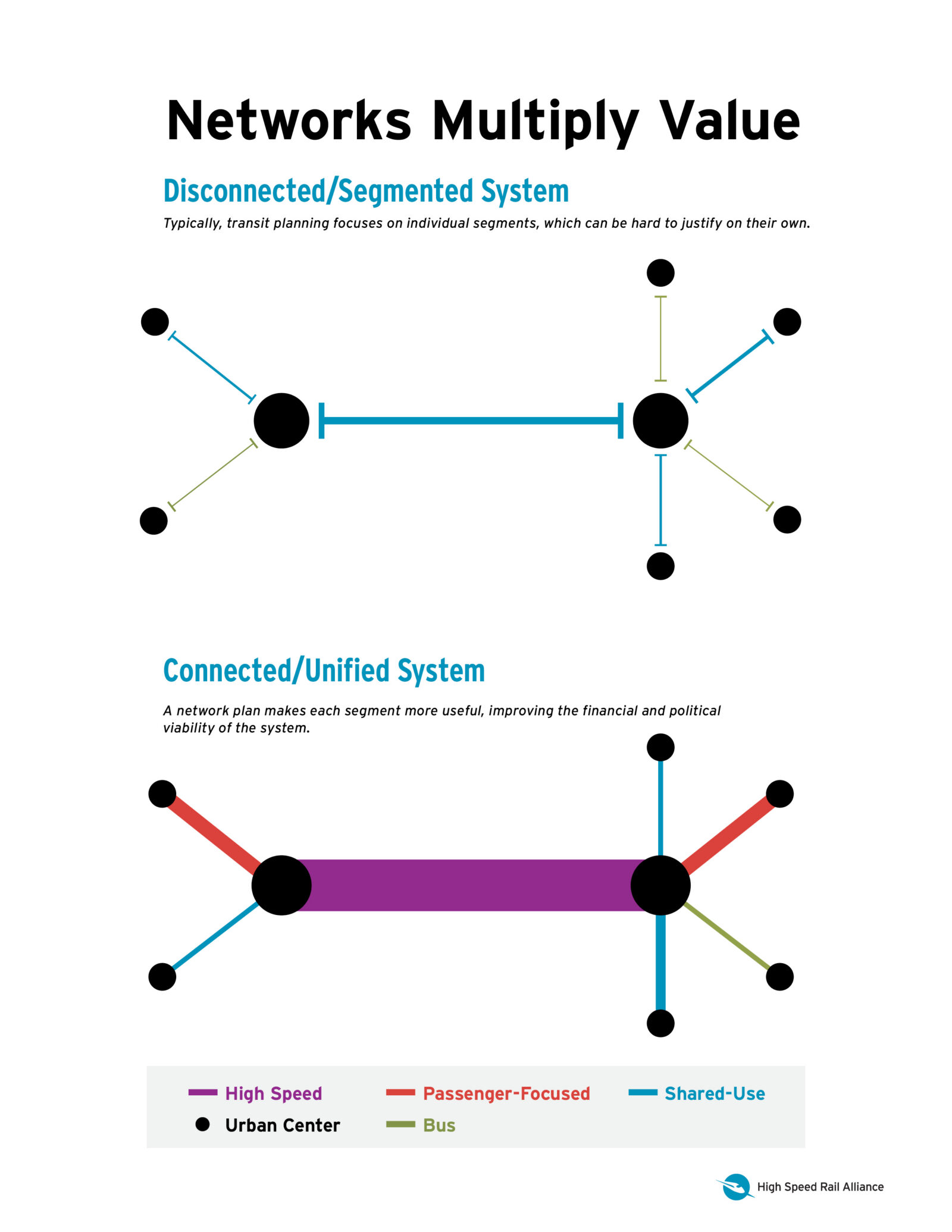
Transit planners usually study routes in isolation from each other.
There’s no big-picture plan for how the parts could and should work together. So each segment is judged by its value as a stand-alone project.
When there’s a big-picture plan, each new segment or upgrade is judged by its value as one part of a much bigger, broader, integrated network.
Those are two fundamentally different ways of assessing value. And the impacts are immense.
A holistic approach helps justify more frequent service on each railroad line. More frequent service on each line boosts ridership throughout the whole network. And more people on trains also means more people on local transit systems and intercity buses.
It’s a virtuous cycle: An integrated, well-coordinated system feeds more riders into the individual segments; and when riders use the individual segments more, the broader system thrives.
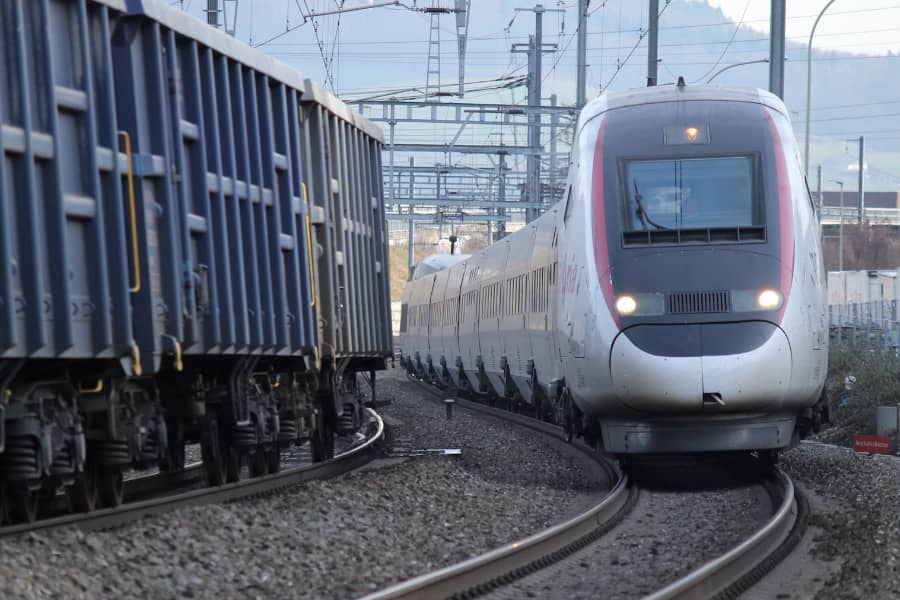
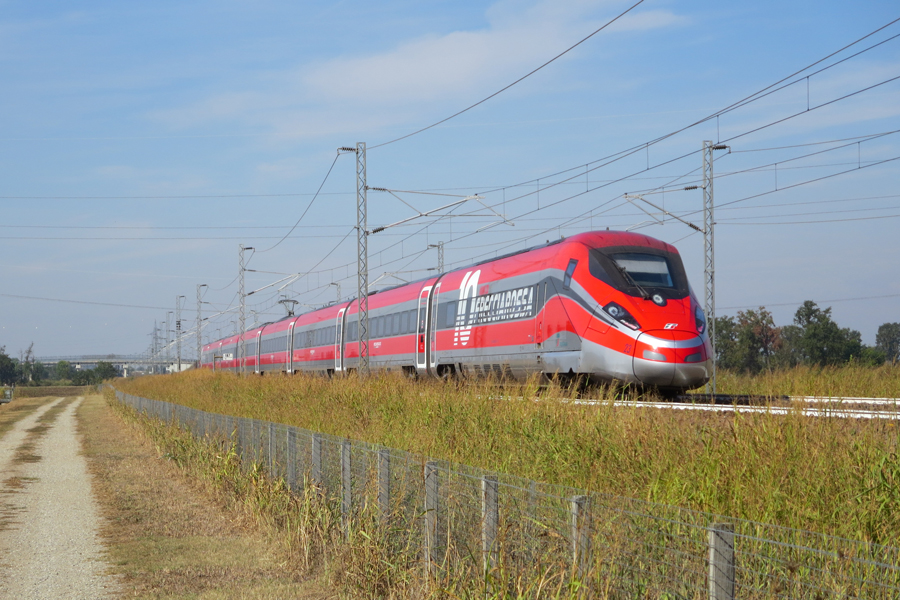
High-speed trains often use conventional, “shared-use” tracks for part of their trip.
How does the rest of the world build high-speed rail?
Most countries add new segments of high-speed line to their existing network while simultaneously upgrading the network’s shared-use lines—used by passenger, commuter, and freight trains.
Each new or upgraded line is a building block. It adds to the strength and vitality of the broader network. When the elements are well-coordinated and fully integrated, the whole network grows steadily larger and more useful.
In some cases, high-speed trains run in “unified service”—using both high-speed and shared-use tracks in a single trip. In other cases, passengers can buy a single ticket and switch easily between high-speed trains and conventional passenger trains to reach their destination.
Ideally, the schedules and payment systems are coordinated with local transit systems and intercity bus lines.
Example
France: One segment at a time.
Strategic segments of high-speed line have far-reaching impacts.
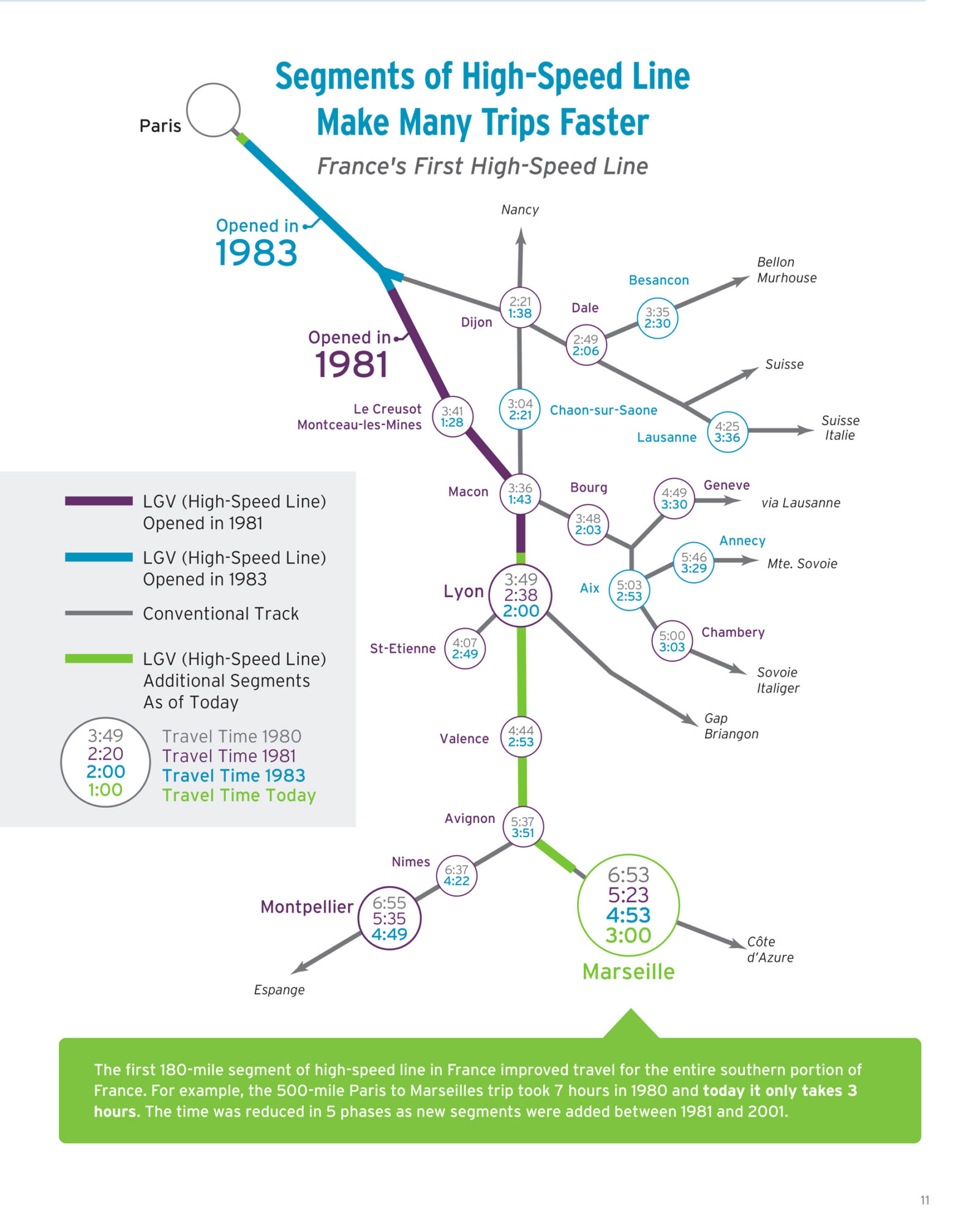
Europe’s first dedicated high-speed line—the LGV Sud Est (or Southeast High-Speed Line)—shows the importance of just getting started, even if the entire line isn’t high-seed rail at the outset.
It’s frequently called the Paris – Lyon line, but when it opened in 1981, the LGV Sud EST’s high-speed segment was only two-thirds of the distance between those cities (or about 180 of 280 miles).
Even so, the line improved travel for the entire southeast region of France. Eighteen cities and towns got direct high-speed rail service. Dozens more saw better service through connecting trains and buses.
The U.S. will need to take a slightly different approach, but the French model offers valuable lessons.
Potential demonstration segment
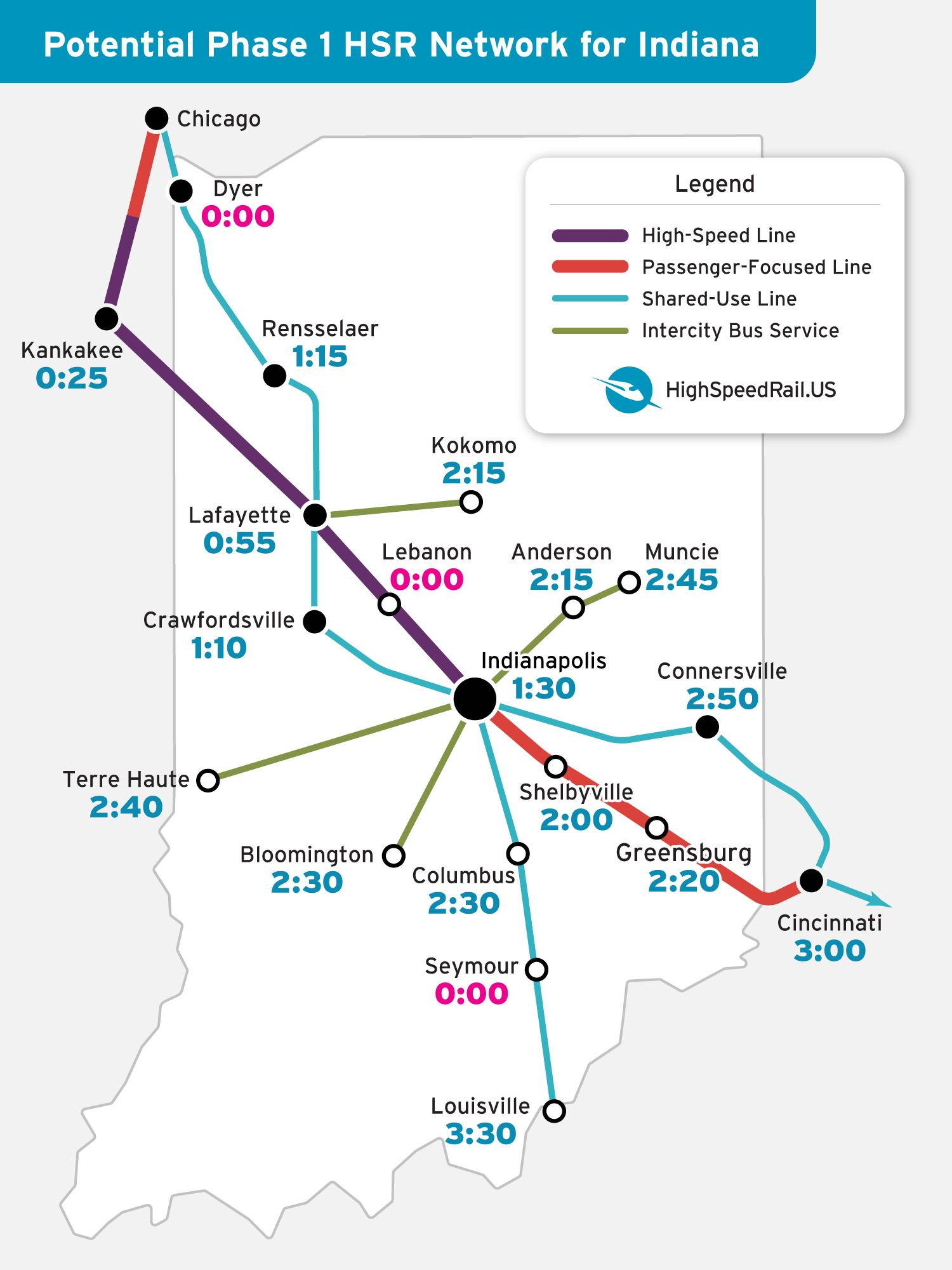
How the Integrated Network Approach could work in Indiana
Chicago – Indianapolis long enough to show the impact and short enough to get done quickly
Chicago and Indianapolis are about 200 miles apart. That’s far enough to make driving a real hassle but too close for flying to be a practical alternative.
So it’s an ideal route for demonstrating the power of high-speed trains. A 220-mph high-speed line from Chicago to Indianapolis—with a stop in Lafayette, near Purdue University—could serve about 4 million passengers a year.
Planning and building this route with the Integrated Network Approach would benefit scores of cities and towns across Northern and Central Indiana.
The network outlined in the map would serve 210 city pairs.
Learn more
Get Involved
How do we make it happen?
By joining together, amplifying our voices, and building our power as a movement.
Projects are in initial stages all across the country. You can get engaged to ensure those projects are the best they can be.
Become a member to help accelerate the progress.
Not ready to join? Sign up for our weekly newsletter to stay in touch.
Related Articles