There are no shortcuts to building high-speed rail. We need the confidence and political will to do it right. The hardest part of building high-speed rail is acquiring a right-of-way that’s straight, serves population centers, and keeps environmental impacts to a...
Recap: 2026 HSRA Annual Conference
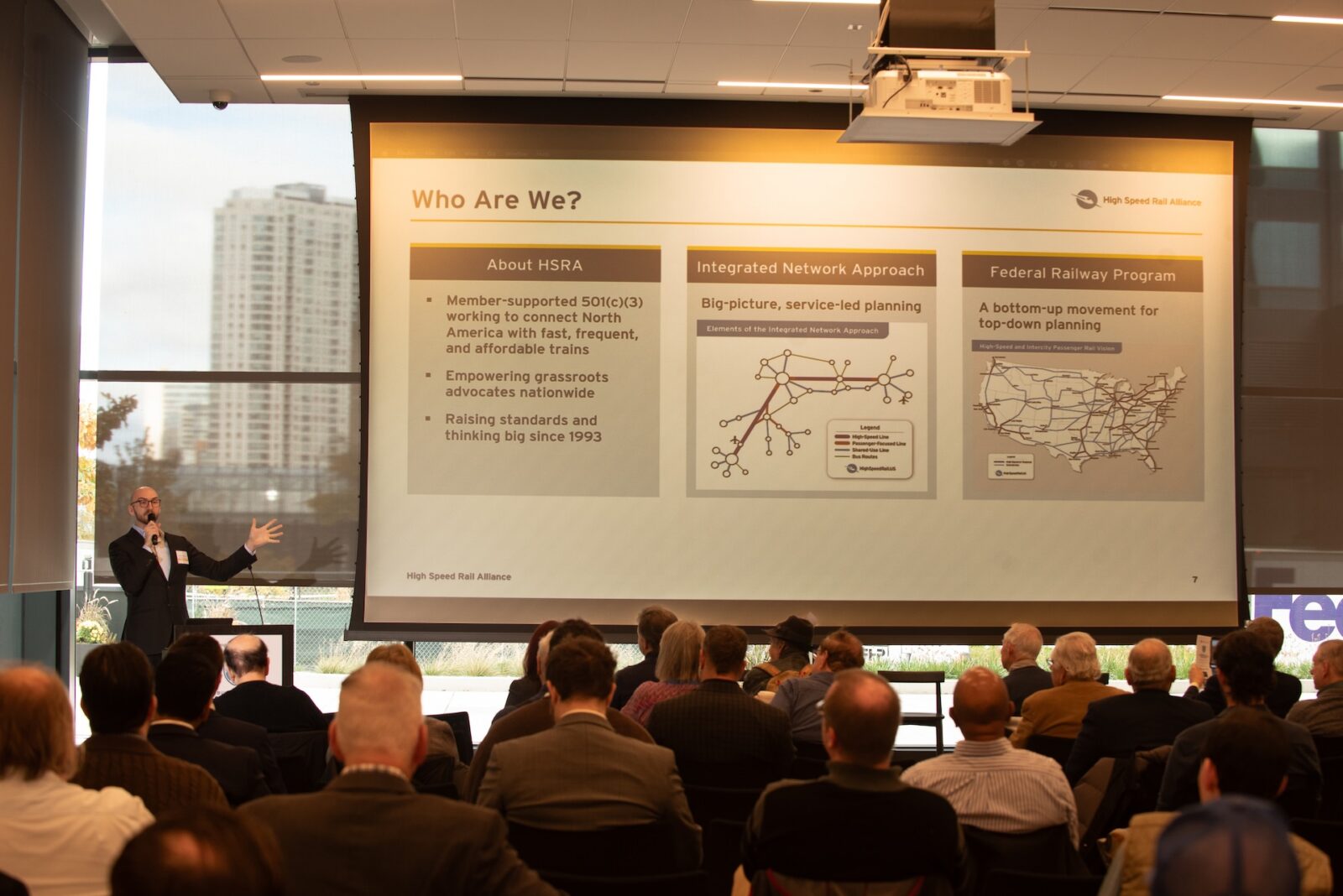
“Building the Passenger Rail Coalition” Takes All Kinds
Our annual conference “Building the Passenger Rail Coalition” took place in Chicago on Friday, November 13, 2026. The event brought together High Speed Rail Alliance members and allies from Illinois, Indiana, Iowa, Michigan, Minnesota, and Wisconsin. Even further-flung states such as Arizona and New York were represented.
Legislative champions, partner advocates, and sustainability experts took the stage to share about what it takes to get this work done.
Successful transportation advocacy takes organized planning, collaboration, and the unique talents of all kinds of people. It means being ready for moments of great opportunity, even when the wins seem far away. Thankfully for advocates in 2026, the conditions for these opportunities continue to become more favorable.
We thank everyone who attended and made this event possible.
Here’s a recap to help you keep this momentum going:
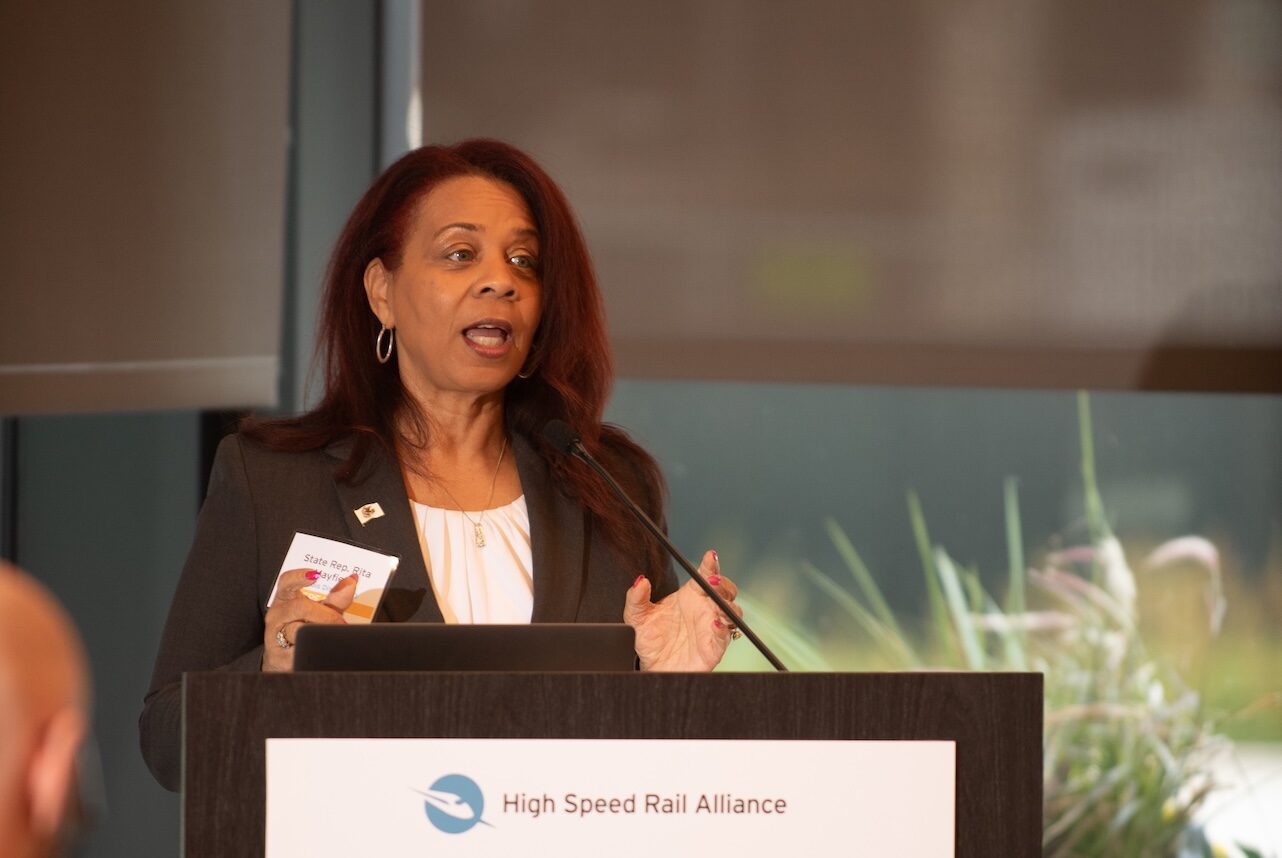
State Representative Rita Mayfied on “Standing Up for Passenger Rail in Illinois”
The Passenger Rail Planning Act Lives On
State Representative Rita Mayfield (IL-60) has been one of HSRA’s most vocal allies in Springfield. Her keynote address “Standing Up for Passenger Rail in Illinois” outlined her ongoing work to advance great trains in the heart of the nation’s rail network.
In January 2026, Representatives Mayfield and Kam Buckner (IL-26) introduced the Passenger Rail Planning Act, which set forth aspirational intercity rail frequencies from Chicago to surrounding cities. This legislation began critical conversations about how Illinois can implement hourly train service, who should plan for it, and what resources still need to be identified.
Mayfield also cosponsored a resolution in the Illinois House supporting the American High-Speed Rail Act in May 2026, which was subsequently adopted. She was also a chief cosponsor for HB 4442, now law, which extended the lifespan of the Illinois High-Speed Railway Commission until 2030.
We have been honored to work closely with Representative Mayfield and other legislators on these efforts, and we thank her for letting us feature her ambition and dedication at our annual gathering.
For other decision-makers who want to get involved: You’d be in great company.
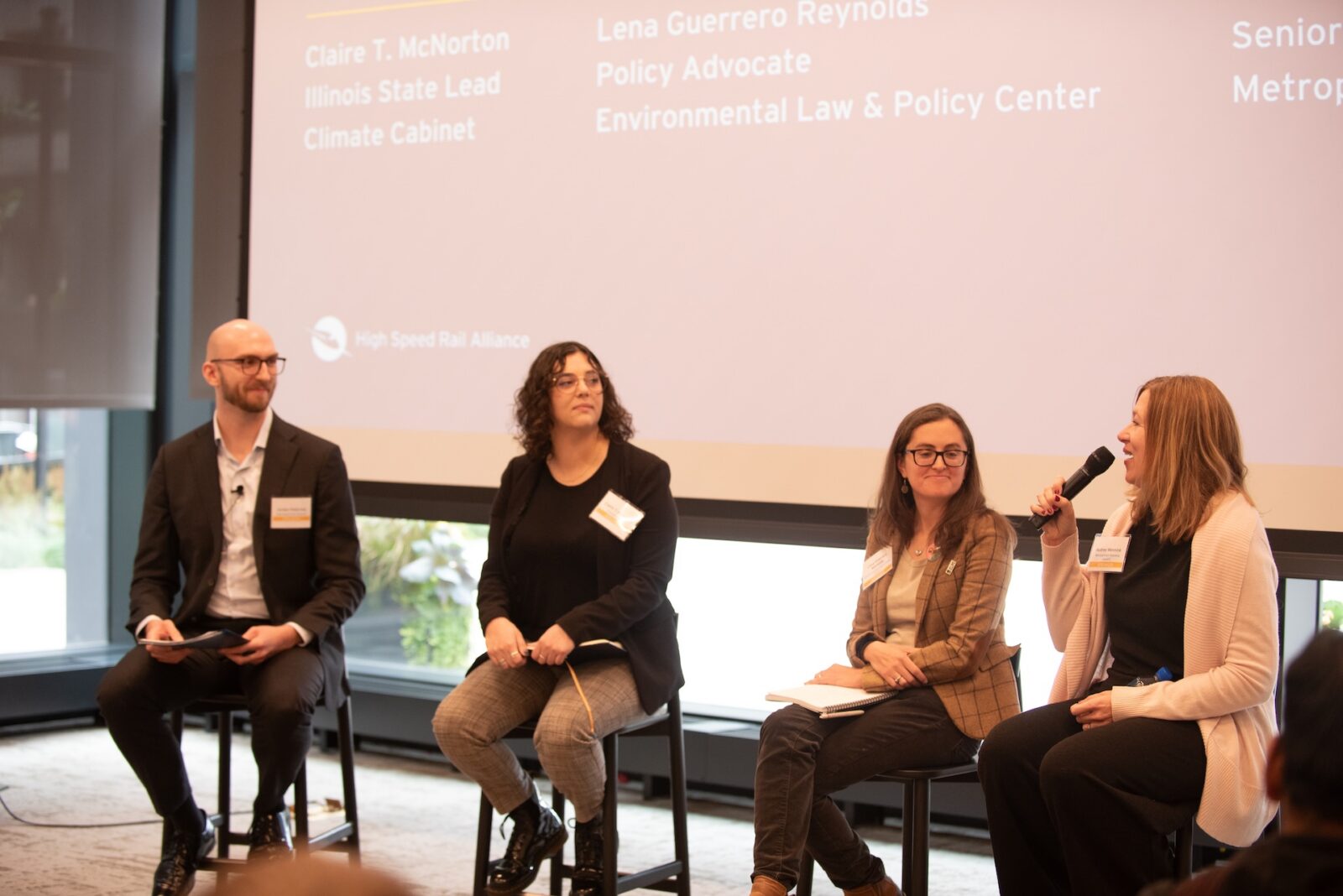
Claire T. McNorton (Climate Cabinet), Lena Guerrero Reynolds (Environmental Law & Policy Center), and Audrey Wennink (Metropolitan Planning Council) on a panel moderated by HSRA Outreach Manager Jordan Pokorney
The NITA Story: Long-Term Collaboration Pays Off
The Northern Illinois Transit Authority (NITA) officially launched in September 2026. Our 2025 conference “Averting the Fiscal Cliff” came at a time when the future of Chicago-area transit was still uncertain.
NITA replaces the Regional Transportation Authority overseeing the Chicago Transit Authority, Pace, and Metra. The new umbrella agency comes with a new governance structure, an increased annual budget of $1.5 billion, and the goal to implement “one network, one timetable, and one ticket” across all transit in the Chicago area.
The story of how NITA came to be provides takeaways for advocates about the need to work together across multiple stakeholders.
Three professional advocates whose organizations were key players in the NITA effort spoke on a panel at the event: Claire T. McNorton (Climate Cabinet), Lena Guerrero Reynolds (Environmental Law & Policy Center), and Audrey Wennink (Metropolitan Planning Council).
The discussion between McNorton, Reynolds, and Wennink touched on the effectiveness of sustaining a multi-year campaign. Advocacy for what eventually became NITA began as early as 2022 when post-COVID ridership and dwindling federal rescue money threatened to cause drastic service cuts to Chicago-area transit.
Success finally came in the early morning of Halloween 2025 when the NITA Act was passed by the Illinois General Assembly. The road to get there was by no means easy, but by working together, these advocates and countless others turned a looming fiscal cliff into a golden opportunity to advance modern, integrated transit at the regional level.
As all three panelists emphasized, you can’t do this work alone. Everyone, regardless of occupation or experience, can and should be a part of transportation advocacy.
Indeed, even full-time advocates can’t do this without you.
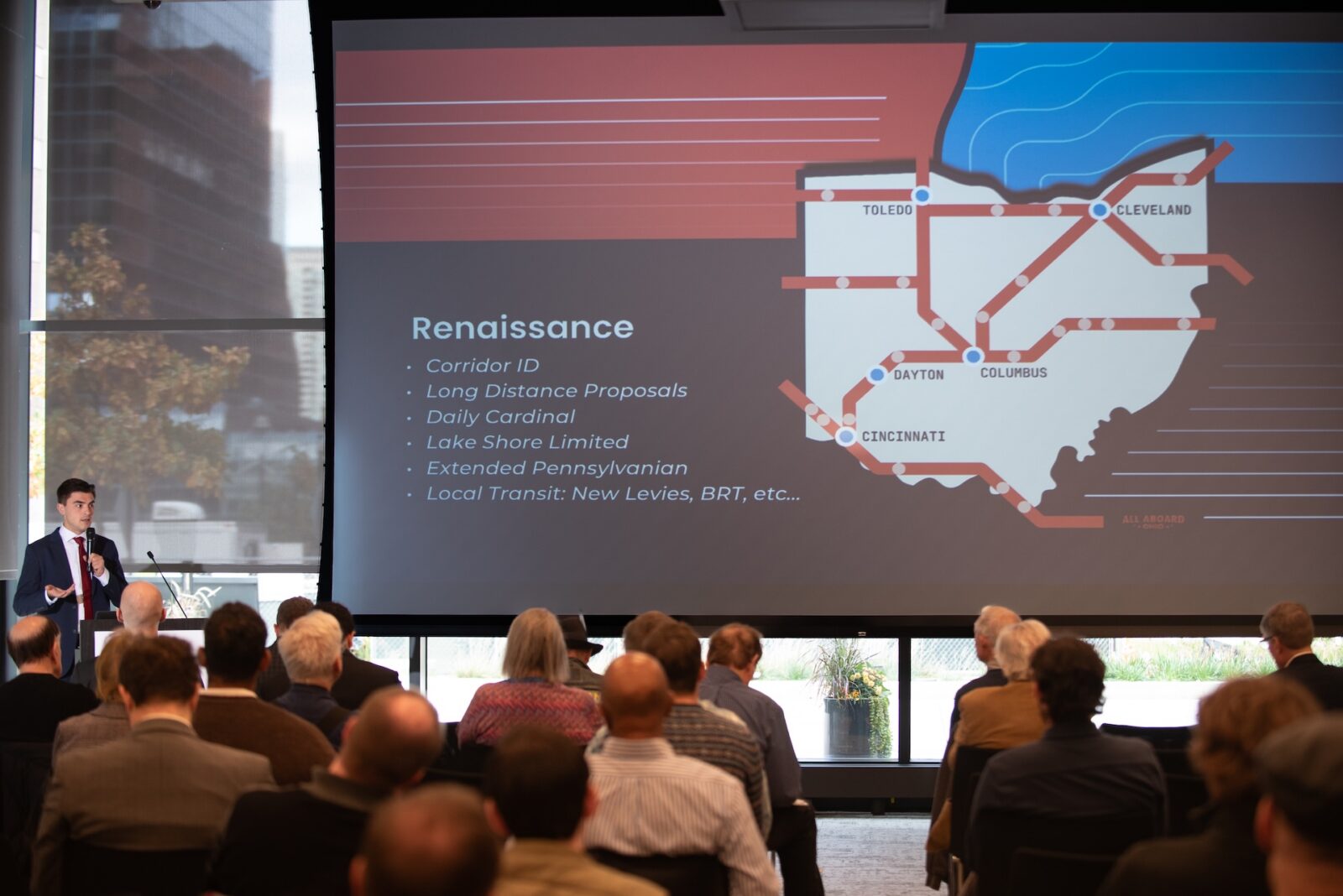
All Aboard Ohio Chair Mitch Radakovich charts the organization’s past, present, and future progress.
Ohio’s Toolkit for a Scalable Statewide Rail Movement
All Aboard Ohio (AAO) has existed since 1973. Its evolution in recent years has been nothing short of astounding.
The organization has grown to over 8,000 members across eight chapters throughout the state. Mitch Radakovich, its board chair and a past HSRA webinar guest, kicked off the afternoon session to talk about this transformation.
Like the NITA effort, AAO’s mission is strengthened by an urgent yet straightforward problem: Almost all of Ohio’s three Amtrak routes stop in the dead of night, and several obvious connections within the state do not exist beyond their proposed forms in the Corridor ID Program.
Radakovich is also known as “Caffeine Mitch,” and for good reason: Aside from being a lover of coffee, he has an infectious gusto for what he does that you can’t help but be inspired by.
Since assuming his role as board chair in 2023, Radakovich and other entrepreneurial AAO leaders have grown the half-century-old nonprofit into something structured, modern, and stackable. AAO is member- and volunteer-powered, and their chapter structure allows the group to dig deep within Ohio’s various regions. Their savvy social media presence is well-known in the rail advocacy sphere, and this communication strategy ensures that the next generation is plugged in and equipped for action.
We look forward to seeing AAO continue to grow and hope others can model their success.
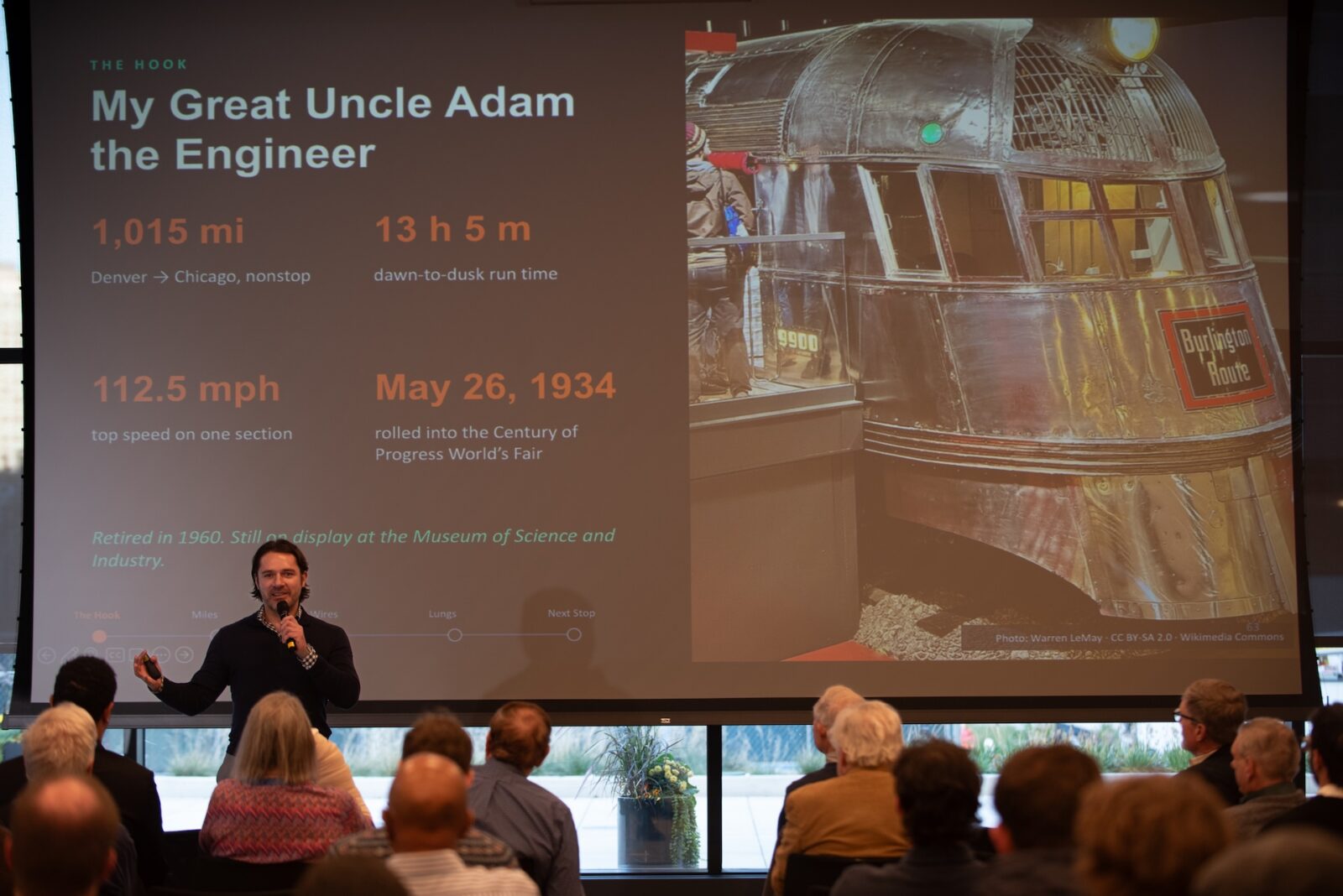
HSRA Board Treasurer Matthew X. Roling: “Every generation gets to pick its future.”
Put Up the Damn Wires
HSRA has been fortunate to have new leadership on our board this year. Scott Paladino, a board member since 2023, stepped in as president. Sean Corrie, a new addition to our board from the Québec Government Office in Chicago, made a few remarks at the event alongside Québec’s chief representative to the Midwest Jean-François Hould.
Our newest treasurer Matthew X. Roling has been another welcome addition.
He’s a clinical assistant professor at the Kellogg School of Management at Northwestern University and the founding executive director of the Abrams Climate Academy, a year-long fellowship program. (You may have seen his posts about sustainability and the world’s fastest trains on our blog.)
Given his background, Roling has a talent for approaching climate action in terms that resonate with the business community.
His presentation “Sustainable Trains: What Actually Moves the Needle” emphasized the need to get people onto mass transit to effectively combat climate change. As the Alliance has long advocated, the ultimate electrification solution has existed since 1879: electric trains.
Roling hit us with the math behind meaningful decarbonization. For example, if Americans drove the same miles per person as the French, we would reduce our carbon footprint by 400–500 million tonnes of CO₂e annually—more than all of France emits in an entire year. This would of course require the United States to build mass transit like the French, including a national high-speed rail network.
Back to the wires: Overhead catenary electrification improves service, reduces pollution, and safeguards human health. The most efficient vehicles do not carry their own power source. Consequently, electric trains are lighter than their diesel-electric counterparts, accelerating more quickly and allowing for greater service frequencies on a single line.
Looking back at American history, Roling also reminded us that the Milwaukee Road had long-distance, electrified freight mainlines running through the Rockies and Cascades until June 1974. The decision to take down these wires cost the railroad dearly.
The Milwaukee Road announced their de-electrification efforts in February 1973. That October, the Arab oil embargo hit, causing gas prices to skyrocket. In 1974, copper from the railroad’s scrapped infrastructure sold for half its value the year before. By 1977 the Milwaukee Road was bankrupt.
Considering the ongoing crises of climate, energy, and affordability, the upfront costs of overhead catenary are worth the investment. Like indoor plumbing (and good pizza), we’ve already figured out electrification.
The value of this permanent infrastructure lasts for centuries. Let’s quit the stopgaps and put up the damn wires.
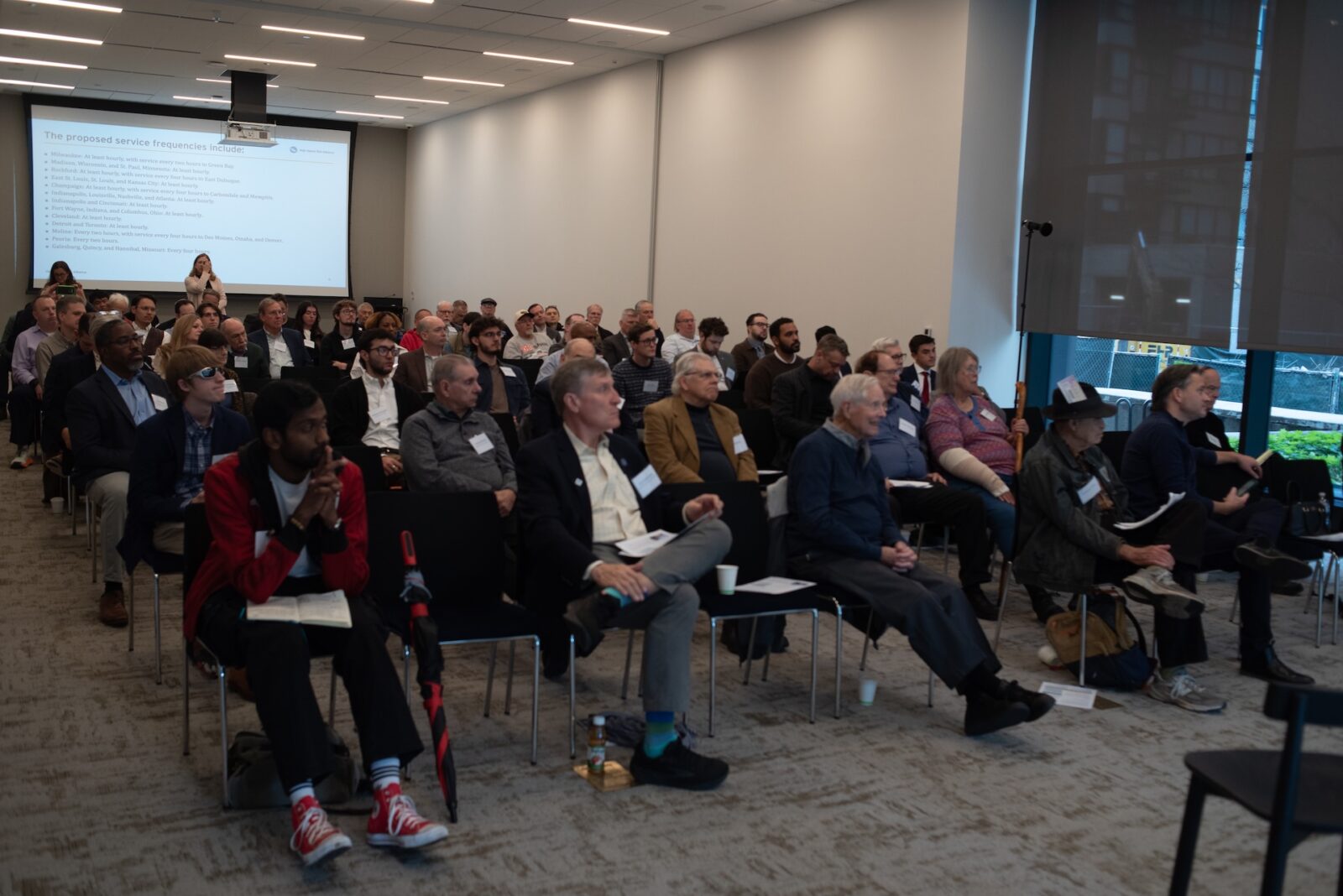
Attendees at “Building the Passenger Rail Coalition”
Putting It Together
Americans are rediscovering passenger rail. Voters approved 85% of transit ballot measures across all U.S. elections in 2026, funding critical projects in South Carolina, Colorado, the Bay Area, and beyond. It would be hard to identify a more opportune time to help change the way America moves.
We express our gratitude to our speakers, our sponsors the Québec Government Office in Chicago and the Chaddick Institute for Metropolitan Development at DePaul University, our board and staff, our volunteers, and last but not least, all High Speed Rail Alliance members.
Incredible change is happening because of our passenger rail coalition. We invite you to keep the pressure on with us in the exciting years ahead.
Get Involved
Tell the next Congress: It’s time to reconnect America with great trains!
The Latest from HSRA
Our Latest Blog Posts
Check out the latest news, updates, and high speed rail insights from our blog!